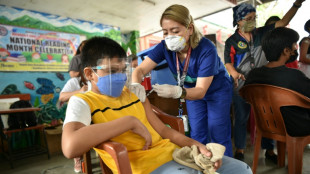
'Make America Healthy Again' report updated to remove nonexistent studies / Photo: © AFP

 Zverev thrashes Shang to set up Djokovic quarter-final at China Open

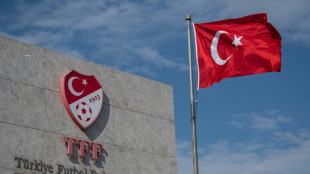 Turkey football ref chief jailed pending trial for graft

 North Korea says test of intermediate-range strategic missile included use of AI

 Rampant Sayers leads Hong Kong to third men's rugby gold in a row

 Ethiopia's Tigray rebels abandon regional capital as govt advances

 Bulgaria's Tsar Samuel returns 'home' after 1,000 years
 'Glad it's over': Kim powers to Games gold and military exemption

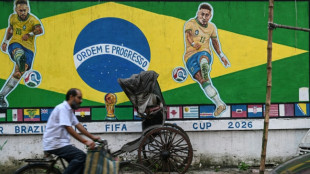 After 11 World Cups, football finally comes home for one Indian fan

 Marc Marquez wins sprint at Japan MotoGP, Martin grabs pole
 Alcaraz fends off Arnaldi to reach Japan Open quarters
 Antonelli tops times in final practice at Bahrain GP

 Gauff digs deep to beat Osorio in China Open second round

 Fresh protests to hit Spain after housing measures defeated

 'He's here with me': Japan cycle queen dedicates gold to late brother
 Japan Olympic chief says 'lot more' athletes at Games than expected
 Asian carmakers besting US rivals at home, China poised to strike

 Widgets & Web Offers All-Inclusive Investor Relations Websites for Public Companies, IPOs and SPACs

 Adams named new US captain to 2030 World Cup
 China a better influence in Latin America than US: poll

 Judge pauses construction of border project in Texas national park
 Belgium's De Bruyne fires double to sink Turkey, France held by Italy

 US jobs data boosts stocks as oil prices dip

 US Supreme Court to hear high-stakes climate case

 Trump expected to name intel chief Clayton as AI czar: reports
 Argentina unveils passports-for-investment scheme

The White House downplayed questions about its flagship report on children's health, but edited the document Thursday after authors listed in the paper confirmed it cited studies that do not exist.
The highly anticipated "Make America Healthy Again" (MAHA) report was released on May 22 by Health Secretary Robert F. Kennedy Jr. and the presidential commission tasked with assessing drivers of childhood chronic disease.
But authors and publishers of at least four studies listed in the original document told AFP they or their organizations were credited with papers they did not write -- or that never existed.
White House Press Secretary Karoline Leavitt described the mishaps as "formatting issues" during a press briefing Thursday.
"It does not negate the substance of the report," said Leavitt, who expressed confidence in Kennedy and his team, and insisted that their work was "backed on good science."
- 'Totally fabricated' -
The errors were first reported Thursday by NOTUS, a US digital news website affiliated with the nonprofit Allbritton Journalism Institute.
Noah Kreski, a Columbia University researcher listed as an author of a paper on adolescent anxiety and depression during the Covid-19 pandemic, told AFP the paper is "not one of our studies" and "doesn't appear to be a study that exists at all."
The initial citation included a link that purported to send users to an article in the peer-reviewed medical journal JAMA Pediatrics, but it was broken.
Jim Michalski, a spokesman for JAMA Network, said it "was not published in JAMA Pediatrics or in any JAMA Network journal."
Columbia University epidemiologist Katherine Keyes, who was also listed as an author of the supposed JAMA study, told AFP she does research on the topic but does not know where the statistics credited to her came from, and that she "did not write that paper."
Guohua Li, another Columbia University professor apparently named in the citation, said the reference is "totally fabricated" and that he does not even know Kreski.
AFP also spoke with Harold Farber, pediatrics professor at Baylor College of Medicine, who said the paper attributed to him "does not exist" nor had he ever collaborated with the co-authors credited in the original MAHA report.
Similarly, Brian McNeill, spokesperson for Virginia Commonwealth University, confirmed that professor Robert Findling did not author a paper the report says he wrote about advertising of psychotropic medications for youth.
A fourth paper on ADHD medication was also not published in the journal Pediatrics in 2008 as claimed, according to the journal's publisher, the American Academy of Pediatrics.
- 'Rife with misinformation' -
The Department of Health and Human Services (HHS) declined to comment, referring AFP's questions to the White House.
At her briefing, Leavitt declined to answer how the report was produced and whether artificial intelligence tools may have been used to craft it, directing those questions back to HHS.
All of the citations investigated by AFP were replaced with links to real sources in the updated version, though in one case, purported research was supplanted by an article from The New York Times.
The Democratic National Committee on Thursday blasted the report as "rife with misinformation," accusing Kennedy's agency of "justifying its policy priorities with studies and sources that do not exist."
Kennedy was approved as health secretary earlier this year despite widespread alarm from the medical community over his history of promoting vaccine misinformation and denying scientific facts.
Since taking office, he has ordered the National Institutes of Health to probe the causes of autism -- a condition he has long falsely tied to the measles, mumps, and rubella (MMR) vaccine.
The report's chronic disease references appear to nod to that same disproven theory, discredited by numerous studies since the idea first aired in a late 1990s paper based on falsified data.
It also criticizes the "over-medicalization" of children, citing surging prescriptions of psychiatric drugs and antibiotics, and blaming "corporate capture" for skewing scientific research.
M.Furrer--BTB