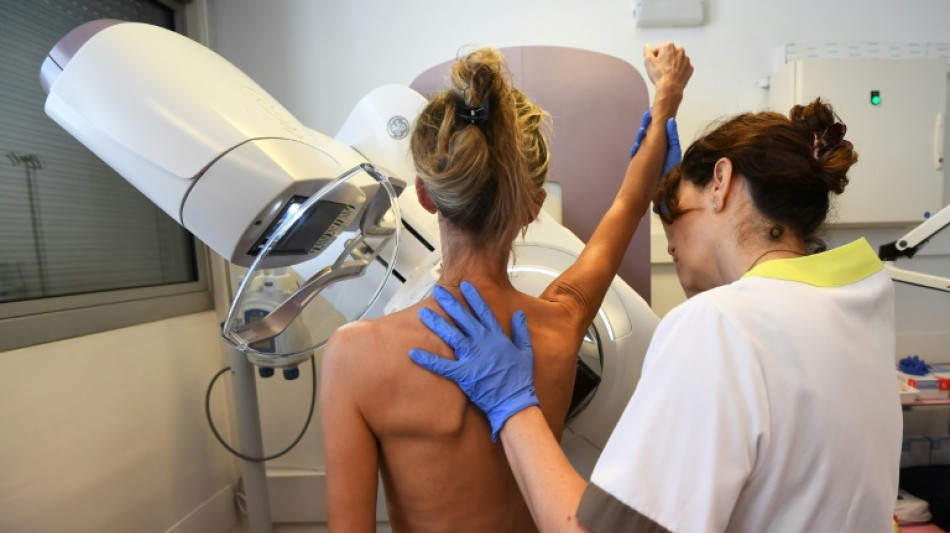
New hope for patients with less common breast cancer / Photo: © AFP/File

 Zverev thrashes Shang to set up Djokovic quarter-final at China Open

 Turkey football ref chief jailed pending trial for graft

 North Korea says test of intermediate-range strategic missile included use of AI

 Rampant Sayers leads Hong Kong to third men's rugby gold in a row

 Ethiopia's Tigray rebels abandon regional capital as govt advances

 Bulgaria's Tsar Samuel returns 'home' after 1,000 years

 'Glad it's over': Kim powers to Games gold and military exemption

 After 11 World Cups, football finally comes home for one Indian fan

 Marc Marquez wins sprint at Japan MotoGP, Martin grabs pole

 Alcaraz fends off Arnaldi to reach Japan Open quarters

 Antonelli tops times in final practice at Bahrain GP

 Gauff digs deep to beat Osorio in China Open second round

 Fresh protests to hit Spain after housing measures defeated

 'He's here with me': Japan cycle queen dedicates gold to late brother

 Japan Olympic chief says 'lot more' athletes at Games than expected

 Asian carmakers besting US rivals at home, China poised to strike

 Widgets & Web Offers All-Inclusive Investor Relations Websites for Public Companies, IPOs and SPACs

 Adams named new US captain to 2030 World Cup

 China a better influence in Latin America than US: poll

 Judge pauses construction of border project in Texas national park

 Belgium's De Bruyne fires double to sink Turkey, France held by Italy

 US jobs data boosts stocks as oil prices dip

 US Supreme Court to hear high-stakes climate case

 Trump expected to name intel chief Clayton as AI czar: reports

 Argentina unveils passports-for-investment scheme

A new treatment nearly halves the risk of disease progression or death from a less common form of breast cancer that hasn't seen major drug advances in over a decade, researchers reported Monday.
Results from the study, presented at the annual meeting of the American Society for Clinical Oncology, are expected to be submitted to regulators and could soon establish a new first-line therapy for people with HER2-positive metastatic breast cancer -- the advanced stage of a form that comprises 15–20 percent of all breast cancer cases.
HER2-positive cancers are fueled by an overactive HER2 gene, which makes too much of a protein called human epidermal growth factor receptor 2 that helps cancer cells grow and spread.
Patients with HER2-positive breast cancer that has spread to other parts of the body live around five years.
"Seeing such a striking improvement was really impressive to us -- we were taking a standard and almost doubling how long patients could have their cancer controlled for," oncologist Sara Tolaney, chief of the breast oncology division at Dana-Farber Cancer Institute, told AFP.
The current standard of care, known as THP, combines chemotherapy with two antibodies that block growth signals from the HER2 protein. The new approach uses a drug called trastuzumab deruxtecan (T-DXd), an antibody attached to a chemotherapy drug.
- 'Smart bomb' -
This "smart bomb" strategy allows the drug to target cancer cells directly. "You can bind to the cancer cell and dump all that chemo right into the cancer cells," explained Tolaney.
"Some people call them smart bombs because they're delivering chemo in a targeted fashion -- which is how I think we're able to really increase efficacy so much."
Common side effects included nausea, diarrhea and a low white blood cell count, with a less common effect involving lung scarring.
T-DXd is already approved as a "second-line" option -- used when first-line treatments stop working. But in the new trial, it was given earlier, paired with another antibody, pertuzumab.
In a global trial led by Tolaney, just under 400 patients were randomly assigned to receive T-DXd in combination with pertuzumab, thought to enhance its effects.
A similar number received the standard THP regimen. A third group, who received T-DXd without pertuzumab, was also enrolled -- but those results haven't yet been reported.
- 44 percent risk reduction -
At a follow-up of 2.5 years, the T-DXd and pertuzumab combination reduced the risk of disease progression or death by 44 percent compared to standard care.
Fifteen percent of patients in the T-DXd group saw their cancer disappear entirely, compared to 8.5 percent in the THP group.
Because this was an interim analysis, the median progression-free survival -- meaning the point at which half the patients had seen their cancer return or worsen -- was 40.7 months with the new treatment, compared to 26.9 months with the standard, and could rise further as more data come in.
Tolaney said the results would be submitted to regulators around the world, including the US Food and Drug Administration, and that future work would focus on optimizing how long patients remain on the treatment, particularly those showing complete remission.
"This represents a new first-line standard treatment option for HER2-positive metastatic breast cancer," said Dr. Rebecca Dent, a breast cancer specialist at the National Cancer Center Singapore who was not involved in the study
G.Schulte--BTB