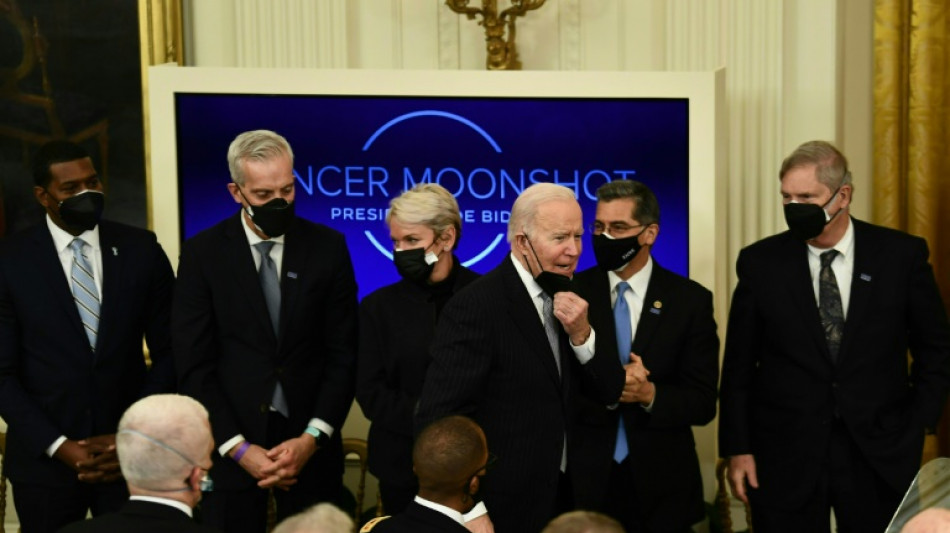
Biden relaunches cancer 'moonshot' to halve death rate / Photo: ©

 Prague’s Concert for the Future Kicks Off on Wenceslas Square

 Prince William and Princess of Wales to Announce Earthshot Prize Winners in Mumbai

 Indonesia Forest Fires: Health Crisis, Diplomatic Strains and the Search for Solutions

 BYD Dolphin G Leasing Deal: Plug-in Hybrid Supermini Available from £174 a Month

 JUEL Group Expands from Real Estate to Hospitality with Hyatt Centric Malta Opening

 French Economy Shrinks 0.1% as Consumer Confidence Slumps

 Wall Street Ends Turbulent Week Higher Despite Inflation and AI Jitters

 Kansas City Fed Chief Says Inflation Is Still Running Too Hot

President Joe Biden announced a relaunch of the government's cancer "moonshot" effort in a White House ceremony Wednesday, setting a goal of cutting the US death rate from the disease by half.
The ambitious effort was first launched in 2016 with $1.8 billion in federal funds spread out over seven years. Only $400 million of that remains available to cover this year and 2023.
Biden, whose son Beau died of brain cancer in 2015 at age 46, spearheaded the original project as vice president under Barack Obama. Speaking to a packed room in the White House, he said he wanted to breath new life into "an American moment."
"This is a presidential priority," he said: to "end cancer as we know it."
The goal, Biden said, is to cut today's age-adjusted death rate from cancer by 50 percent over the next 25 years.
He proposed achieving this through leadership in marshalling resources for a more united effort between patients, hospitals, biopharmaceutical companies and researchers.
A White House Cancer Moonshot coordinator has been named and a cross-governmental cabinet will oversee goals, including expanding and reorganizing cancer screening networks.
Emphasis is also being put on addressing racial inequity in access to cancer care.
Biden said a particularly urgent step is to redress the backlog of nine million cancer screenings from canceled appointments during the Covid-19 pandemic.
"Screening is how you catch it early before it's too late," he said, adding that he knew a check-up could be "scary."
- 'Grief' and 'purpose' -
The initiative's name deliberately echoes the 1969 triumph of NASA landing the first humans on the Moon.
However, so far there is no new funding announced.
Biden urged Congress to help and a senior official told reporters he was "very confident that there will be robust funding."
"I've got to say, in these times of disagreements, there's certainly one thing on which we all agree, across party, across everything -- which is the effect of cancer on their lives," the official said, speaking on condition of anonymity.
"I know nothing that unites us more and that is more bipartisan."
In speeches, Biden and his wife Jill spoke of the pain and shock they endured as they searched for solutions to their son's fatal illness.
"For Joe and me, it has stolen our joy. It left us broken in our grief," the first lady said. "But through that pain we found purpose, strengthening our fortitude for this fight to end cancer as we know it."
Vice President Kamala Harris also spoke movingly about her mother, a breast cancer researcher who died of colon cancer in 2009.
"My mother's discovery helped save women's lives," she said. Then "after a lifetime working to end cancer, cancer ended my mother's life."
However there is hope for a cure, the vice president said.
"Today we are closer than we have ever been. Since the turn of the century we have made significant breakthroughs," she said. "When we reach the Moon, we plant our flag on it."
Already since 2000, the death rate from cancer among Americans has fallen by around 25 percent as a result of better treatments, diagnosis capabilities, therapeutics, vaccines and a halving in adult long-term cigarette smoking.
S.Keller--BTB



