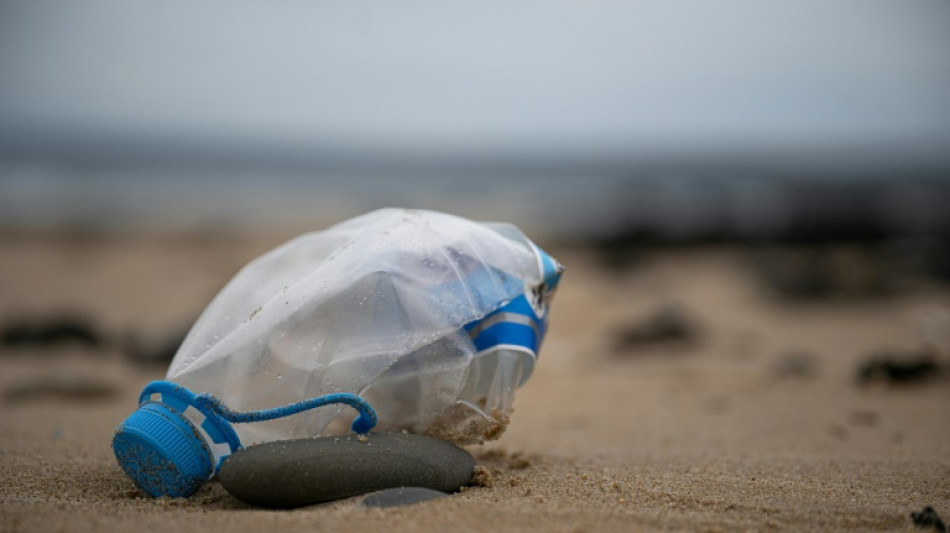
Decision time as plastic pollution treaty talks begin / Photo: © AFP/File

 World No.1 Sinner pulls out of Shanghai Masters to delay return
 Red Bull's Verstappen grabs pole position for Bahrain GP

 India beat Pakistan in blockbuster as golfer Kim wins 'crazy' gold
 India beat arch-rivals Pakistan to win Asian Games cricket gold
 Ethiopia's Tigray rebels abandon regional capital as govt advances: journalist

 Tom Kim powers to Games gold and exemption from military service

 Split loyalties for Indian football fans at Brazil friendly

 India-Pakistan blockbuster brings cricket fever to Japan baseball field
 Wong waiting on Rafa after winning Asian Games tennis gold
 With Russia next door and rising costs, Latvia goes to the polls

 Penalty hero rues empty seats as Games hosts Japan win football gold

 North Korea fires ballistic missile after Seoul's apology demand

 US regulator finds Boeing 737 MAX software bug 'not a safety concern'

 Ohtani 'managing' injuries as Dodgers launch MLB post-season

 Botched US execution leaves murderer unconscious on ventilator: lawyers
 Cornell rape case exposes sexual violence at US colleges
 France held by Italy in Zidane's homecoming after Olise stunner

 Ethiopian pro-government militia claims Tigray airport as regional tensions spike
 Ohtani shaking off injuries as Dodgers launch MLB post-season
 Sea levels to rise in California as coastal wave surges up west coast
 New rallies urged in France as protests disrupt over 730 schools
 Djokovic survives China Open scare, Sabalenka starts strong
 King Charles to evoke colonial 'darkest days' on Caribbean tour

 Tesla shares jump after global car sales top estimates
 DR Congo Ebola outbreak killed more than 4,000: official figures
Countries were to start the clock Tuesday on 10 days of talks aimed at hammering out a landmark global treaty on combating the scourge of plastic pollution.
Three years of negotiations hit the wall in South Korea in December when a group of oil-producing states blocked a consensus.
Since the failure in Busan, countries have been working behind the scenes and are giving it another go in Geneva, in talks at the United Nations.
Key figures steering the negotiations said they were not expecting an easy ride this time round, but insisted a deal remained within reach.
"There's been extensive diplomacy from Busan till now," UN Environment Programme executive director Inger Andersen told AFP.
UNEP is hosting the talks, and Andersen said conversations across, between and among different regions and interest groups had generated momentum.
"Most countries, actually, that I have spoken with have said: 'We're coming to Geneva to strike the deal’.
"Will it be easy? No. Will it be straightforward? No. Is there a pathway for a deal? Absolutely."
- Human bodies riddled -
Plastic pollution is so ubiquitous that microplastics have been found on the highest mountain peaks, in the deepest ocean trench and scattered throughout almost every part of the human body.
In 2022, countries agreed they would find a way to address the crisis by the end of 2024.
However, the supposedly final round of negotiations on a legally-binding instrument on plastic pollution, including in the seas, flopped in Busan.
One group of countries sought an ambitious deal to limit production and phase out harmful chemicals.
But a clutch of mostly oil-producing nations rejected production limits and wanted to focus more narrowly on treating waste.
Ecuadoran diplomat Luis Vayas Valdivieso, chairing the talks process, said an effective, fair and ambitious agreement was now within reach.
"Our paths and positions might differ; our destination is the same," he said Monday.
"We are all here because we believe in a shared cause: a world free of plastic pollution."
- 'Plastic-free future' -
More than 600 non-governmental organisations are attending the Geneva talks.
Valdivieso said lessons had been learned from Busan, and NGOs and civil society would now have access to the discussions tackling the thorniest points, such as banning certain chemicals and capping production.
"To solve the plastic pollution crisis, we have to stop making so much plastic," Greenpeace delegation chief Graham Forbes told AFP.
The group and its allies want a treaty "that cuts plastic production, eliminates toxic chemicals, and provides the financing that's going to be required to transition to a fossil fuel, plastic-free future", he said.
"The fossil fuel industry is here in force," he noted, adding: "We cannot let a few countries determine humanity's future when it comes to plastic pollution."
- Dumped, burned and trashed -
Well over 400 million tonnes of plastic are produced globally each year, half of which is for single-use items.
While 15 percent of plastic waste is collected for recycling, only nine percent is actually recycled.
Nearly half, 46 percent, ends up in landfills, while 17 percent is incinerated and 22 percent is mismanaged and becomes litter.
A report in The Lancet medical journal warned Monday that plastic pollution was a "grave, growing and under-recognised danger" to health, costing the world at least $1.5 trillion a year in health-related economic losses.
The new review of existing evidence, conducted by leading health researchers and doctors, compared plastic to air pollution and lead, saying its impact on health could be mitigated by laws and policies.
To hammer home the message, a replica outside the UN of Auguste Rodin's famous sculpture "The Thinker" will be slowly submerged in mounting plastic rubbish during the talks.
The artwork, entitled "The Thinker's Burden", is being constructed by the Canadian artist and activist Benjamin Von Wong.
"If you want to protect health, then we need to think about the toxic chemicals that are entering our environment," he told AFP.
But Matthew Kastner, spokesman for the American Chemistry Council, said the plastics industry and the products it makes were "vital to public health", notably through medical devices, surgical masks, child safety seats, helmets and pipes delivering clean water.
S.Keller--BTB


