Summer 2025 already a cavalcade of climate extremes / Photo: © AFP/File

 World No.1 Sinner pulls out of Shanghai Masters to delay return
 Red Bull's Verstappen grabs pole position for Bahrain GP

 India beat Pakistan in blockbuster as golfer Kim wins 'crazy' gold

 India beat arch-rivals Pakistan to win Asian Games cricket gold

 Ethiopia's Tigray rebels abandon regional capital as govt advances: journalist

 Tom Kim powers to Games gold and exemption from military service

 Split loyalties for Indian football fans at Brazil friendly

 India-Pakistan blockbuster brings cricket fever to Japan baseball field

 Wong waiting on Rafa after winning Asian Games tennis gold

 With Russia next door and rising costs, Latvia goes to the polls

 Penalty hero rues empty seats as Games hosts Japan win football gold

 North Korea fires ballistic missile after Seoul's apology demand

 US regulator finds Boeing 737 MAX software bug 'not a safety concern'

 Ohtani 'managing' injuries as Dodgers launch MLB post-season

 Botched US execution leaves murderer unconscious on ventilator: lawyers

 Cornell rape case exposes sexual violence at US colleges
 France held by Italy in Zidane's homecoming after Olise stunner

 Ethiopian pro-government militia claims Tigray airport as regional tensions spike

 Ohtani shaking off injuries as Dodgers launch MLB post-season
 Sea levels to rise in California as coastal wave surges up west coast

 New rallies urged in France as protests disrupt over 730 schools

 Djokovic survives China Open scare, Sabalenka starts strong

 King Charles to evoke colonial 'darkest days' on Caribbean tour

 Tesla shares jump after global car sales top estimates

 DR Congo Ebola outbreak killed more than 4,000: official figures

Record heat, massive fires, deadly floods... August has barely begun, but the summer of 2025 is already marked by a cascade of destructive and deadly weather in the northern hemisphere.
"Extreme temperatures and precipitation have become more intense and more frequent on a global scale," says Sonia Seneviratne, a professor at ETH Zurich and member of the UN-mandated climate science advisory panel, the IPCC.
"We are in the midst of climate change," Fred Hattermann, a scientist at the Potsdam Institute for Climate Impact Research (PIK), told AFP.
"The risk of extreme events has increased significantly," he said, noting that 2024 was the first year in which the planet's average surface temperature was 1.6 degrees Celsius above the preindustrial benchmark.
That deceptively small jump makes a huge difference.
Higher temperatures increase evaporation, so that more water is stored in the atmosphere. This, in turn, increases the risk of heavy rainfall and flooding.
"with every increment of temperature rise the risk of more and stronger extremes increases," Hattermann added.
- 50C in the Gulf, Turkey -
Already in May, temperatures exceeded 50C in the United Arab Emirates. On August 1, the thermometer hit 51.8C, just under the all-time record of 52C.
The entire Gulf region is suffocating: the Saudi capital Riyadh recorded temperatures of 44°C, while Kuwait frequently hit 50C.
As did Iraq, where air conditioning has become vulnerable to chronic power cuts, and water reserves are at their lowest level in years.
Turkey saw the 50C threshold exceeded for the first time: the town of Silopi on the border with Iraq and Syria reached 50.5C on July 26.
The country has experienced thousands of fires this summer amidst a severe drought.
In Asia, meanwhile, Japan broke its all-time temperature record on Tuesday with 41.8C in the city of Isesaki, northwest of Tokyo. The country's iconic cherry trees, emblematic of the archipelago, are blooming earlier than ever due to the heat.
- Torrential rains in Hong Kong -
On Tuesday, Hong Kong saw the highest rainfall total for August in more than 140 years of record-keeping: 35.5 centimetres (14 inches) in a single day.
On mainland China, a week earlier, severe weather killed at least 44 people and left nine missing in rural districts north of Beijing.
- Pakistan floods, Finland heat -
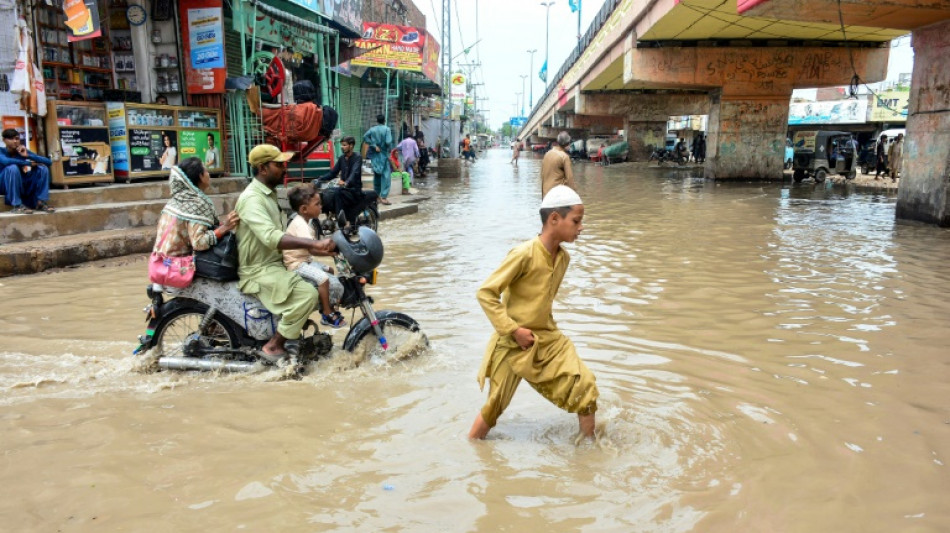
266 people, nearly half of them children, have already lost their lives in Pakistan due to torrential rains sweeping across the country.
The 2025 monsoon, which started early, was described as "unusual" by authorities. Punjab, Pakistan's most populous province, recorded 73 percent more rainfall in July than in 2024.
People come to Scandinavia to seek cooler climes, but since July Norway, Sweden and Finland have experienced sustained temperatures more typical of the Mediterranean.
August 3 marked the end of a 22-day period with temperatures above 30°C in Finland: a record.
In Rovaniemi, a Finnish city north of the Arctic Circle, temperatures reached 30C, higher than in southern Europe at the same time.
- Mega-fires in Canada -
Canada is experiencing one of the worst forest fire seasons on record, amplified by drought and above-normal temperatures.
Other parts of the world are also burning, from Scotland to Arizona and Greece.
According to the European Union's Copernicus weather and climate observatory, total smoke and greenhouse gas emissions since the beginning of summer in the northern hemisphere are among the highest ever recorded.
I.Meyer--BTB