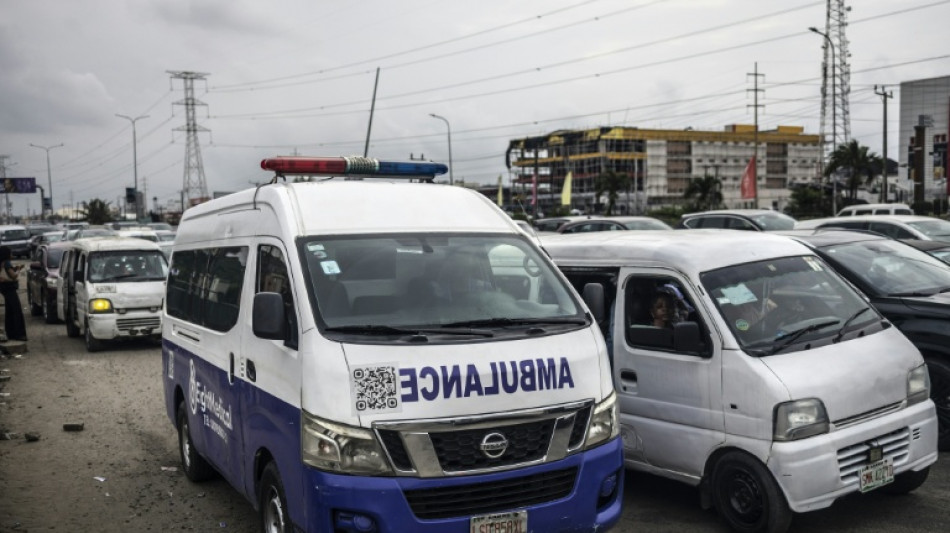
In mega-city Lagos, 20 million count on just 100 ambulances / Photo: © AFP

 'Glad it's over': Kim powers to Games gold and military exemption

 After 11 World Cups, football finally comes home for one Indian fan
 Marc Marquez wins sprint at Japan MotoGP, Martin grabs pole

 Alcaraz fends off Arnaldi to reach Japan Open quarters

 Antonelli tops times in final practice at Bahrain GP

 Gauff digs deep to beat Osorio in China Open second round

 Fresh protests to hit Spain after housing measures defeated

 'He's here with me': Japan cycle queen dedicates gold to late brother

 Japan Olympic chief says 'lot more' athletes at Games than expected

 Asian carmakers besting US rivals at home, China poised to strike

 Widgets & Web Offers All-Inclusive Investor Relations Websites for Public Companies, IPOs and SPACs

 Adams named new US captain to 2030 World Cup

 China a better influence in Latin America than US: poll

 Judge pauses construction of border project in Texas national park

 Belgium's De Bruyne fires double to sink Turkey, France held by Italy
 US jobs data boosts stocks as oil prices dip

 US Supreme Court to hear high-stakes climate case
 Trump expected to name intel chief Clayton as AI czar: reports

 Argentina unveils passports-for-investment scheme

 Brazil election debate chaos sparks censorship row

 England's Carse charged by cricket body over nightclub incident

 Amazon vows $1 bn for data center towns, decries 'myths'

 Oil prices drop on G7 fuel release, US jobs data boosts stocks

 G7 agrees deal to ease global energy supply concerns

 Spain's government dealt blow as lawmakers reject housing bills

Standing outside a public hospital in Lagos, Nigeria's biggest city, Michelin Hunsa is still "traumatised" from the two-hour wait it took to get an ambulance for her mother, found unconscious by her neighbours.
Such waits can be deadly and are not unusual in the mega-city, where notorious traffic jams snarl commutes and only about 100 ambulances serve a population of more than 20 million.
"It's a serious problem, we waited far too long," Hunsa, 25, told AFP. Her mother, suffering a cerebral haemorrhage, ultimately survived the ordeal.
Political and business big-wigs regularly bust through traffic in the largest city in west Africa with armed convoys and flashing lights -- despite not being in any actual emergency.
Ambulances blast sirens, take shortcuts and speed as fast as they can -- but sometimes to no avail.
Part of the problem stems from mistrust among other drivers, who are used to a state of quasi-war on the roads from frustrated commuters trying to get ahead.
"I'm sure most of the time they don't transport real emergency cases, that's why I don't move," said Anthony Folayinka, a 38-year-old ride share driver.
Queen Soetan, a 33-year-old ambulance driver, told AFP such sentiments were common.
"Most people will not just want to leave the road, so it does affect our intervention time," she said.
The government currently provides 35 ambulances, Olusegun Ogboye, permanent secretary to the Lagos state ministry of health, told AFP.
That number pads the 80 to 90 operated by companies but still leaves the city with a ratio of roughly one ambulance per 200,000 people -- far below recommended medical guidelines.
- Private companies, floating clinics -
Since its founding in 2021, Eight Medical has run 34 ambulances, day and night.
The name comes from medical experts' recommended response time for ambulances of eight minutes or less.
"In Lagos, we are still far from it, but that's the goal I want to reach with my team," said business founder Ibukun Tunde-Oni, a 36-year-old doctor.
He was motivated to start the service after the deaths of two uncles -- one of whom died from a heart attack and the other who died in an ambulance while having an asthma attack.
Tunde-Oni has had his own lacklustre experiences with ambulances as well, once having to wait for three hours to receive care after breaking his arm in a road accident.
No data is available on how many people have died waiting for an ambulance, or while ensnared in one of the city's infamous "go slows", as traffic jams are known.
But "100 ambulances for Lagos is not enough", Tunde-Oni told AFP.
And the city is only growing.
According to the University of Toronto's Global Cities Institute, Lagos is on track to become the most populated city in the world by 2100, with 88 million residents.
But public services have not kept up with the breakneck growth in Nigeria, already Africa's most populous country with more than 220 million people.
Successive governments have been accused of squandering the nation's vast oil wealth: even if there were more ambulances, they'd still have to contend with Lagos's many pockmarked and unpaved roads.
Those who make it to the hospital are treated in poor conditions and by underpaid staff.
Lack of coordination with hospitals means that ambulances don't always know which locations have open beds, Tunde-Oni added.
Authorities have also tried to get creative: with the city sitting on a massive lagoon, in 2022 they put in place a floating clinic and boat ambulance to serve the 15 to 20 communities on the water's edge, said Ibrahim Famuyiwa, a waterways official.
But lacking funds to expand the initiative, the priority remains increasing Lagos's traditional ambulances, mostly through public-private partnerships.
K.Brown--BTB