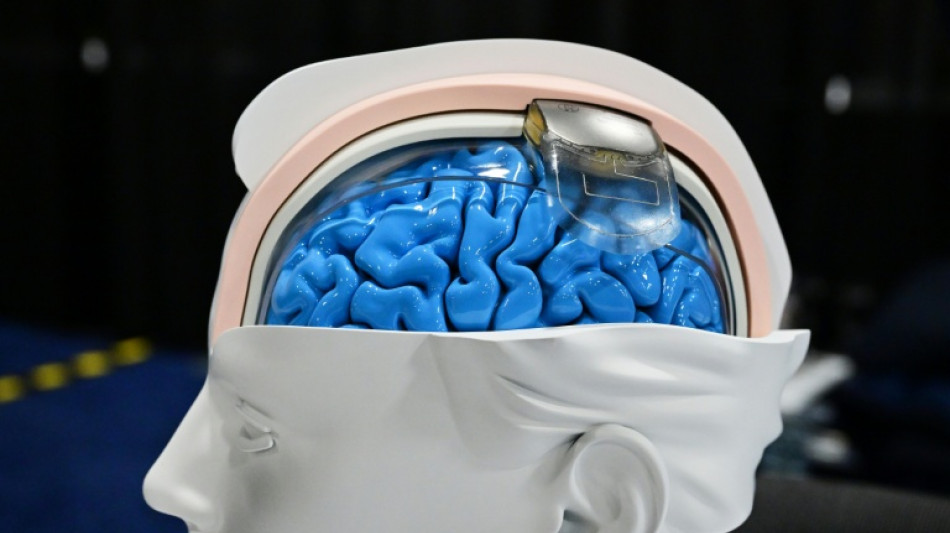
'We're already living in science fiction': The neurotech revolution / Photo: © AFP/File

 Split loyalties for Indian football fans at Brazil friendly

 India-Pakistan blockbuster brings cricket fever to Japan baseball field

 Wong waiting on Rafa after winning Asian Games tennis gold

 With Russia next door and rising costs, Latvia goes to the polls

 Penalty hero rues empty seats as Games hosts Japan win football gold

 North Korea fires ballistic missile after Seoul's apology demand

 US regulator finds Boeing 737 MAX software bug 'not a safety concern'

 Ohtani 'managing' injuries as Dodgers launch MLB post-season

 Botched US execution leaves murderer unconscious on ventilator: lawyers

 Cornell rape case exposes sexual violence at US colleges

 France held by Italy in Zidane's homecoming after Olise stunner

 Ethiopian pro-government militia claims Tigray airport as regional tensions spike

 Ohtani shaking off injuries as Dodgers launch MLB post-season

 Sea levels to rise in California as coastal wave surges up west coast

 New rallies urged in France as protests disrupt over 730 schools
 Djokovic survives China Open scare, Sabalenka starts strong

 King Charles to evoke colonial 'darkest days' on Caribbean tour

 Tesla shares jump after global car sales top estimates

 DR Congo Ebola outbreak killed more than 4,000: official figures

 Djokovic survives China Open scare against wildcard world no. 104

 Lula, Bolsonaro trade blows in final scramble for votes in Brazil

 New clashes erupt as protests disrupt over 560 French schools

 NY governor vows to close loophole after alleged Cornell gang rape

 Ethiopia Tigray rebels pushed back as regional tensions spike

 Stocks rise, yields fall as US job numbers disappoint

From translating thoughts into words to allowing paralysed people to walk, the field of neurotechnology has been quietly surging ahead, raising hopes of medical breakthroughs -- and profound ethical concerns.
Some observers even think that neurotech could end up being as revolutionary as the far more hyped rise of artificial intelligence (AI).
"People do not realise how much we're already living in science fiction," King's College London researcher Anne Vanhoestenberghe told AFP.
The scientist leads a laboratory developing electronic devices which are implanted into a person's nervous system -- not just the brain, but also the spinal cord that transmits signals to the rest of the body.
It has been a big couple of years for neurotech research. In June, Californian scientists revealed that a brain implant they developed could translate the thoughts of a man with the neurodegenerative disease ALS into words almost instantly, in just one-fortieth of a second.
Swiss researchers meanwhile have enabled several paralysed people to regain significant control of their body -- including walking again -- by implanting electrodes into their spinal cords.
These experiments, and other trailblazers in the field, are still far from restoring full capability to patients who have lost the ability to talk or walk.
It also remains to be seen how such technology, some of which requires invasive brain surgery, could be made available to people in need across the world.
But still, "the general public is unaware of what is already out there and changing lives," Vanhoestenberghe said.
And these devices are becoming more effective at a remarkable rate, she emphasised.
"Previously it took thousands of hours of training before someone could compose several words using their thoughts," she said. "Now it only takes a couple."
- Musk wants human-AI 'symbiosis' -
Neurotechnology has been propelled by a combination of scientific advances -- including growing understanding of the human brain -- and technological progress which has shrunk devices down so small they can slot into our skulls.
Algorithms using artificial intelligence have significantly sped things along, helping to interpret and transform the data coming from brains.
Numerous start-ups that have emerged since the late 2000s have raised tens of billions of dollars for research that has only recently started translating into concrete achievements.
The most publicised company is billionaire Elon Musk's Neuralink, which says that it has now implanted 12 people with its chip.
While Musk has made characteristically lofty claims, experts have remained cautious about his firm's accomplishments.
"Neuralink is currently just smoke and mirrors, with a lot of hype," Herve Chneiweiss, a neurologist and expert in ethics at France's research organisation INSERM, told AFP.
However, "the day they manage to produce commercial products -- and it won't be long -- it will be too late to worry about it," he cautioned.
Many experts are concerned about the ethical implications of neurotechnology -- particularly because some companies are looking well beyond healthcare applications, instead hoping to use computers to improve our cognitive abilities.
Musk, for one, has repeatedly said he ultimately wants Neuralink to allow humans to achieve "symbiosis" with AI.
- 'Innermost thoughts under threat' -
Against this background, the United Nations' agency for science and culture UNESCO recently approved recommendations for how nations can regulate neurotechnology.
These recommendations -- which are not legally binding -- are due to come into effect on Wednesday.
The authors, who include Chneiweiss, adopted a broad definition of neurotech. It includes devices already widely available such as smartwatches and headsets that do not directly interact with the brain, but instead measure indicators providing an idea of the user's mental state.
"Today, the main risk is invasion of privacy: our innermost thoughts are under threat," Chneiweiss said.
He warned, for example, that neurotech data could "fall into the hands of your boss", who could then decide that you are not spending enough time thinking about work.
Some have already started trying to address such concerns.
Late last year, the US state of California, a global hub of neurotech research, passed a law protecting the brain data of consumers.
J.Fankhauser--BTB