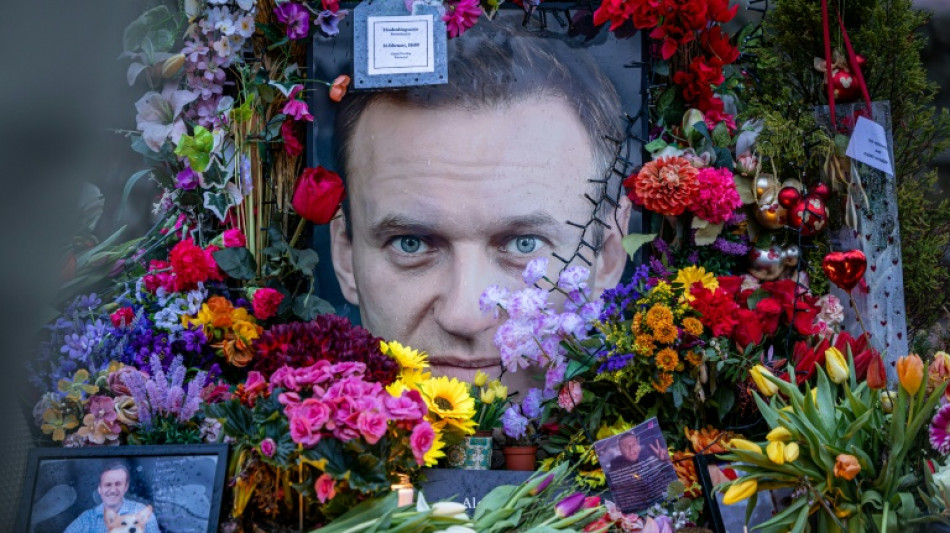
Russian poisonings aim to kill -- and send a message / Photo: © ANP/AFP

 'He's here with me': Japan cycle queen dedicates gold to late brother

 Japan Olympic chief says 'lot more' athletes at Games than expected

 Asian carmakers besting US rivals at home, China poised to strike

 Widgets & Web Offers All-Inclusive Investor Relations Websites for Public Companies, IPOs and SPACs

 Adams named new US captain to 2030 World Cup

 China a better influence in Latin America than US: poll

 Judge pauses construction of border project in Texas national park

 Belgium's De Bruyne fires double to sink Turkey, France held by Italy

 US jobs data boosts stocks as oil prices dip

 US Supreme Court to hear high-stakes climate case

 Trump expected to name intel chief Clayton as AI czar: reports

 Argentina unveils passports-for-investment scheme

 Brazil election debate chaos sparks censorship row
 England's Carse charged by cricket body over nightclub incident

 Amazon vows $1 bn for data center towns, decries 'myths'

 Oil prices drop on G7 fuel release, US jobs data boosts stocks

 G7 agrees deal to ease global energy supply concerns

 Spain's government dealt blow as lawmakers reject housing bills

 Food, medicine shortages deepen in Russian-occupied Oleshky

 Man City whistleblower Rui Pinto facing 'dire consequences' - lawyers

 Russia 'tearing Kyiv apart', mayor says, as strikes paralyse traffic

 Taiwan boxer Lin wins Games gold as Japan edge North Korea on penalties

 Japan tame North Korea to win Games gold after shootout drama

 US posts weak job growth data in September

 Ethiopia's conflict: the regional dimension

Polonium, Novichok and now dart frog poison: the finding that Russian opposition leader Alexei Navalny was killed with a rare toxin has revived the spectre of Moscow's use of poisons against opponents -- a hallmark of its secret services, according to experts.
The neurotoxin epibatidine, found in Ecuadoran frogs, was identified in laboratory analyses of samples from Navalny's body, the British, Swedish, French, German and Dutch governments said in a joint statement released on Saturday at the Munich Security Conference.
"Only the Russian state had the means, motive and opportunity to deploy this lethal toxin," said Britain's Foreign Office, with the joint statement pointing to Russia as the prime suspect.
The Kremlin on Monday rejected what it called the "biased and baseless" accusation it assassinated Navalny, a staunch critic of President Vladimir Putin who died on February 16, 2024, while serving a 19-year sentence in a Russian Arctic prison colony.
But the allegations echo other cases of opponents being poisoned in connection -- proven or suspected -- with Russian agents.
In 2006, the Russian defector Alexander Litvinenko was killed by polonium poison in London. Ukrainian politician Viktor Yushchenko, campaigning against a Russian-backed candidate for the presidency, was disfigured by dioxin in 2004. And the nerve agent Novichok was used in the attempted poisoning of former double agent Sergei Skripal in the UK in 2018.
"We should remain cautious, but this hypothesis is all the more plausible given that Navalny had already been the target of an assassination attempt (in 2020) on a plane involving underwear soaked with an organophosphate nerve agent, Novichok, which is manufactured only in Russia," said Olivier Lepick, a fellow at the Foundation for Strategic Research specialising in chemical weapons.
- Toxin 'never been used' -
"To my knowledge, epibatidine has never been used for assassinations," Lepick added.
Until now, the substance was mainly known for its effect on animals that try to attack Ecuadoran poison dart frogs.
"It's a powerful neurotoxin that first hyperstimulates the nervous system in an extremely violent way and then shuts it down. So you'll convulse and then become paralysed, especially in terms of breathing," said Jerome Langrand, director of the Paris poison control centre.
But to the scientist, using this substance to poison Navalny is "quite unsettling".
"One wonders, why choose this particular poison? If it was to conceal a poisoning, it's not the best substance. Or is it meant to spread an atmosphere of fear, to reinforce an image of power and danger with the message: 'We can poison anywhere and with anything'?" he said.
- Russian 'calling card' -
For many experts, the use of poison bears a Russian signature.
"It's something specific to the Soviet services. In the 1920s, Lenin created a poison laboratory called 'Kamera' ('chamber' in Russian), Lab X. This laboratory grew significantly under Stalin, and then under his successors Khrushchev and Brezhnev... It was this laboratory that produced Novichok," said Andrei Kozovoi, professor of Russian history at the University of Lille.
"The Russians don't have a monopoly on it, but there is a dimension of systematisation, with considerable resources put in place a very long time ago -- the creation of the poison laboratory, which developed without any restrictions," he added.
Even if a poisoning can fail -- some targets survived, such as Yushchenko and Skripal -- it also serves to send a message, and acted as "a calling card" left by the Russian services, according to Kozovoi.
"Poison is associated in the collective imagination and in psychology with a terrible, agonising death. The use of chemical substances or poisons carries an explicit intention to terrorise the target and, in cases such as Litvinenko, Skripal or Navalny, to warn anyone who might be tempted to betray Mother Russia or become an opponent," said Lepick.
"A neurotoxin, a radioactive substance, or a toxic substance is much more frightening than an explosive or being shot to death."
C.Kovalenko--BTB