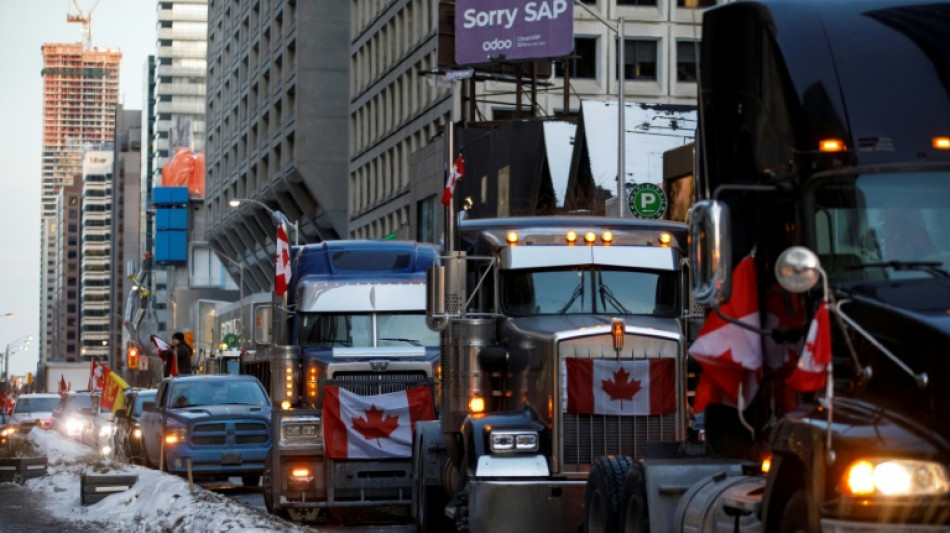
Impasse at Canada truckers' protest as mayor seeks mediator / Photo: ©

 Prague’s Concert for the Future Kicks Off on Wenceslas Square

 Prince William and Princess of Wales to Announce Earthshot Prize Winners in Mumbai

 Indonesia Forest Fires: Health Crisis, Diplomatic Strains and the Search for Solutions

 BYD Dolphin G Leasing Deal: Plug-in Hybrid Supermini Available from £174 a Month

 JUEL Group Expands from Real Estate to Hospitality with Hyatt Centric Malta Opening

 French Economy Shrinks 0.1% as Consumer Confidence Slumps

 Wall Street Ends Turbulent Week Higher Despite Inflation and AI Jitters

 Kansas City Fed Chief Says Inflation Is Still Running Too Hot

Canadian authorities struggled Monday to tackle a truckers' protest against Covid restrictions which has paralyzed the national capital for days and threatens to snowball into a full-blown political crisis for Prime Minister Justin Trudeau.
Ottawa Mayor Jim Watson urged the federal government to appoint a mediator to work with protesters and find a way to defuse the 10-day-long demonstration which has infuriated local residents with incessant honking and diesel fumes.
On Sunday, Watson declared a state of emergency in the capital, calling the protests an "occupation" and declaring them "out of control."
The "Freedom Convoy" demonstrations began January 9 in western Canada as protests by truckers angry with vaccine requirements when crossing the US-Canadian border, but have morphed into broader protests against Covid-19 health restrictions and Trudeau's government.
Protest organizer Tamara Lich said Monday that activists were willing to engage with the government to find a way out of the crisis, but insisted that pandemic restrictions be eased.
"What we're trying to do right now is reaching out to all of the federal parties so that we can arrange a sit down," Lich said during a meeting streamed on YouTube. "So that we can start these talks and see how we can move forward, have their mandates and the restrictions lifted, restore Canadians rights and freedoms and go home."
Facing criticism for allowing the center of the capital to be blocked and many businesses to have to close, Ottawa police Sunday announced new measures to tame the protests by banning people from bringing fuel and other supplies to the rallies.
"Anyone attempting to bring material supports (gas, etc) to the demonstrators could be subject to arrest," the police said on Twitter.
Officers have since arrested several people, seized multiple vehicles and issued hundreds of traffic tickets.
- 'Reacted too strongly' -
Trudeau, who has been in quarantine after testing positive for Covid-19 a week ago, did not comment on the weekend protests.
On Thursday he ruled out the possibility of deploying the army to disperse the protesters "for now," saying that one must be "very, very cautious before deploying the military in situations against Canadians."
"Trudeau has nothing to gain by going to speak to the demonstrators," Genevieve Tellier, a political scientist at the University of Ottawa, told AFP.
But another political analyst, Frederic Boily of the University of Alberta, said the protests could escalate into a full-blown political crisis.
"Justin Trudeau reacted badly initially," Boily said. "He reacted too strongly and too abruptly at the start of the protests when he tried to paint them as a far-right protest."
Boily added that Trudeau "added fuel to the fire" by turning vaccination into a political issue, especially during last summer's election campaign.
But the opposition also finds itself in a bind politically.
The Conservatives, who will soon be voting to elect their new leader, are themselves divided on the issue of the protests.
"They are afraid that part of their supporters will be tempted by the extreme right, but it is a risky bet for them", said political analyst Daniel Beland.
While only about 10 percent of Canadian adults remain unvaccinated, as many as 32 percent of the population support the anti-mandate protests, according to a recent survey.
O.Bulka--BTB



