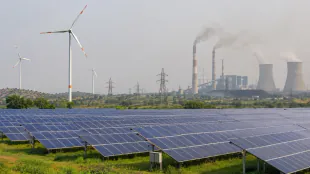
As Trump returns, China seizes chance for climate mantle / Photo: © AFP/File

 China's Factory Activity Contracts as Export Orders Weaken

 US Retail Sales and Fed Minutes Set Up a Critical Test for Consumers

 Oil Heads for Second Weekly Loss as Supply Surplus Emerges
 Four Mainland Universities Join Scheme for Hong Kong DSE Admissions from 2027

 Canada Signals Openness to Chinese Automakers if US Trade Talks Fail

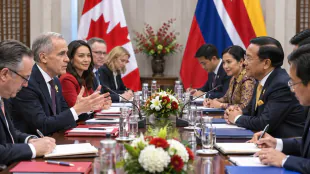 Canada Expands Asian Trade Push as US Negotiations Resume

 US Jobless Claims Rise to 200,000 but Layoffs Remain Historically Low

 Euro-Area Growth Slows to 0.4% While Employment Stalls

 US Wholesale Inflation Eases Monthly but Hits a Four-Year Annual High

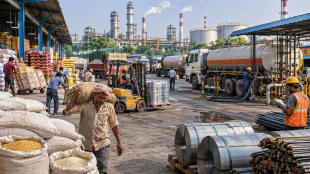 India's Wholesale Inflation Jumps to 12.29% as Fuel Costs Surge

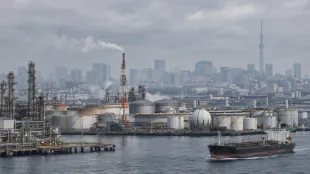 Japan's Economy Edges Into Contraction as Costly Oil Weighs on Demand

 Helen Haines Discharged from Hospital Following Attack That Cost Her Both Legs

 River Medway Reveals Financial Struggles Before 'Drag Race' Windfall

 OBI Pharma Signs Collaboration and License Agreement with Novartis
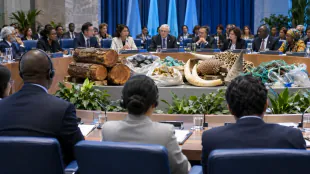
With Donald Trump expected to take the United States again out of climate diplomacy, China, the world's largest emitter but green energy powerhouse, is seizing on the chance to project itself as the global leader.
At COP29 climate talks in Azerbaijan, China has sought to show a cooperative side and for the first time gave details on its international climate finance, while still firmly resisting pressure to be reclassified as a donor.
The go-nice approach -- a contrast to Beijing's frequent shrillness about international disputes -- keeps the tone from a year ago at COP28 in Dubai.
There, China and the then US envoy John Kerry worked together for a breakthrough call on the world to transition away from fossil fuels responsible for climate change.
Few expect the warm feelings between China and the United States -- which together account for 41 percent of global greenhouse gas emissions -- to persist after Trump returns to the White House on January 20.
Trump is an outspoken and three-fold sceptic -- on working with China, on providing foreign assistance and on climate change in general.
Trump's election "opens up an opportunity for China to step up into even more of a climate leadership role," said Belinda Schaepe, a China analyst at the Centre for Research on Energy and Clean Air in London.
"It makes it easy for China to portray itself as the more responsible global power of the two," she said.
But she said China would bolster its case if it offered forward-looking promises on aid and ambitious targets for cutting emissions through 2035, not just in the longer term.
- Addressing critics on finance -
In the Baku talks, wealthy countries are being urged to go beyond an expiring goal of providing $100 billion a year to poor countries worst hit by climate change.
China has resolutely resisted pressure by Western nations as well as some threatened island states to be considered a donor, which would subject it to greater accounting scrutiny.
Vice Premier Ding Xuexiang, visiting Baku, revealed that China had contributed $24.5 billion in international climate finance since 2016.
Jennifer Morgan, Germany's negotiator, said the announcement "shows that China can do a lot and is already doing a lot".
"But we can only take account of what has been reported transparently," she said.
One option would be for China to promise future aid but on a voluntary basis, while remaining listed as a developing country.
The classification dates back to 1992, before China's breakneck economic development. The Asian power has now surpassed Europe as the second-largest historical emitter after the United States.
"Not only China, but also Gulf nations and other countries should give in line with their capabilities," said Susana Muhamad, Colombia's environment minister.
But she also said that if Trump pulled the United States out of the Paris accord, "I think there are countries that will take the climate lead and China is very committed, at least in terms of the multilateral process."
US climate negotiators' leverage evaporated with Trump's election on November 5.
President Joe Biden, on a visit Sunday to the Brazilian Amazon, said his administration has made good on his promise to deliver more than $11 billion in bilateral climate finance this year, a major increase during his term.
- Turbulence ahead -
China's priority on climate is rooted in self-interest as authorities address dire environmental woes.
China has also quickly emerged as the global leader on clean energy, dominating the electric car and solar industries -- leading both the United States and European Union to impose tariffs.
Li Shuo, director of the China climate hub at the Asia Society Policy Institute, said he saw China negotiating constantly in Baku with the Europeans -- much like they did previously with Kerry -- in anticipation of difficulties once Trump takes office.
"The politics will get worse before they get better. The US-China relationship will deteriorate and the China-EU relationship will see turbulence," he said.
But Li said that a US exit under Trump could have an unexpected upside in climate negotiations, if not on climate overall.
"Ironically, the Trump election might make dealmaking easier because the US carries the most extreme position," he said.
L.Janezki--BTB