
Common water disinfectant creates potentially toxic byproduct: study / Photo: © GETTY IMAGES NORTH AMERICA/AFP/File

 Nothing to seal here: NZ police help stranded pup home

 White House releases list of products US, China could tax less

 'Pseudo-journalism': Partisan 'news' sites target US midterms

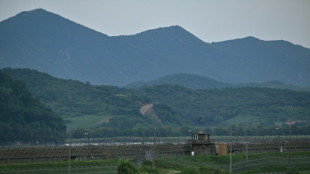 'Currently impossible': North Korea defections in freefall

 Erasmus sizes up 'improved' Wallabies ahead of 2027 World Cup

 Scandal-weary Brazilians to vote as Lula faces Bolsonaro son

 SpaceX aims to put Starship in orbit for the first time

 Pope to speak on united Europe from French border town

 Scheffler makes sportsmanship stand over tee screamer

 Anthropic CEO Amodei to dine with Trump at White House

 Dupont scores twice to send Toulouse to Top 14 summit

 Greece stun Klopp's Germany as Ireland show sorrow for Gaza

 Ramos fires holders Portugal to Nations League win in Norway

 Greece hand Klopp first defeat as Germany manager

 Pope promises French sex abuse victims to prevent further harm

 UK village on edge over threats to air base in terror alert

 Two giant pandas, emblems of China soft diplomacy, arrive in US

 Aleksandar Vucic: from Milosevic minister to long-serving Serbian statesman

 Trump expects new Iran talks despite rejecting deal offer

 Xavi gets first win as Netherlands boss, Denmark beat Wales

 Madrid housing protest camp enters second night as PM vows action

 Tigray TV station hit by drone, rebels advance in north Ethiopia

 Banton hundred paves way for England ODI series win over Sri Lanka

 Milestone man Kohli powers India to big ODI win over West Indies

 Swiss reject plan to toughen neutrality

A group of chemical compounds used to disinfect water for one-third of the US population and millions of others globally produces a potentially toxic byproduct, according to new research published Thursday, sparking calls for an "immediate" investigation into possible health impacts.
Inorganic chloramines have been used for decades to remove pathogens from public water supplies.
Though chlorine remains the most widely used disinfectant in the US and globally, chloramines have increasingly replaced it in many systems to reduce certain byproducts linked to bladder and colon cancer, low birth weight, and miscarriage.
Today, more than 113 million Americans rely on chloraminated drinking water, with the compound also in use across Canada, Asia, and Europe.
"However, chloramines themselves decompose into products that are poorly characterized," said Julian Fairey, lead author of the study published in the journal Science, during a press briefing.
One such product, identified more than 40 years ago but left chemically unresolved, was simply dubbed the "unidentified product."
Fairey and his team have finally cracked the mystery.
Using a combination of traditional chemistry methods and modern tools like high-resolution mass spectrometry and nuclear magnetic resonance spectroscopy, they identified the compound as "chloronitramide anion."
The compound was detected in all 40 chloraminated drinking water samples tested, with concentrations reaching up to 100 micrograms per liter -- exceeding typical regulatory limits for disinfection byproducts, which range between 60 and 80 micrograms per liter.
Although toxicological studies have yet to be conducted, the researchers sounded a warning.
"The chemical structure looks concerning, as does the concentrations at which this compound is forming, so we certainly think health effects studies are warranted," Fairey said.
Their study calls for the compound to be "an immediate candidate" for quantification in public waters and for closer health and toxicity studies.
Water utilities could consider reverting to chlorine, Fairey suggested, though this would require secondary disinfectants to neutralize the known toxic byproducts chlorine produces.
With further study and regulatory action likely years away, the researchers recommended home filtration systems using activated carbon blocks for people who are concerned.
M.Ouellet--BTB



