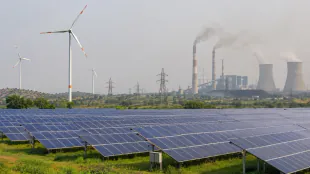
China reports warmest autumn since records began / Photo: © AFP/File

 US Mortgage Rate Falls for Fourth Week but Remains Above 7%

 Italy Raises 2026 Growth View but Warns Energy Will Keep Inflation High

 UK Economy Grows 0.7% in Third Quarter as Services Lead Expansion

 India's Retail Inflation Reaches 6.09% as Food Prices Accelerate

 China's October Activity Data Reveal a Weak Start to the Fourth Quarter
 Thomas Tuchel Refuses to Name England Number One Goalkeeper After James Trafford's Display

 Qatar's Amir and Venezuelan Acting President Discuss Energy Cooperation

 Russell Brand’s Wife Reads Prison Letter Denying Guilt; Fellow Inmate Questions Faith

 Alouettes and Elks Set for 113th Grey Cup Showdown

China reported its warmest autumn this year since records began decades ago, its National Climate Centre announced on Wednesday.
China is the leading emitter of the greenhouse gases scientists say are driving global climate change and making extreme weather events more frequent.
Beijing has pledged to bring planet-warming carbon dioxide emissions to a peak by 2030 and to net zero by 2060.
"During this year's autumn season (Sept 1 to Nov 30), the national average temperature was 11.8 degrees Celsius, 1.5 degrees higher than the average year, the highest ever since 1961," the centre announced on its social media account.
The country had already logged its hottest August on record this year, after a summer of extreme weather conditions, from torrential rainfall to searing heat waves.
Global warming can make such weather more frequent not just through high temperatures but also the knock-on effect of extra heat in the atmosphere and seas.
Warmer air can hold more water vapour, and warmer oceans mean greater evaporation, resulting in more intense downpours and storms.
In China this autumn, most regions experienced temperatures 1 to 2 degrees Celsius above average, while parts of central, east, southwest and northwest China experienced average temperatures that were 2 to 4 degrees Celsius higher during the period compared to previous years, the National Climate Centre said Wednesday.
Sixteen provinces and regions, including Liaoning, Tianjin, and Chongqing, recorded their highest average autumn temperatures since 1961.
And daily maximum temperatures at 375 national weather stations exceeded or equalled local historical autumn extremes.
The average number of high-temperature days nationwide in September also hit a record high for the same period in history, while Sichuan, Chongqing, and the middle reaches of the Yangtze River suffered from heat and drought in early autumn, the centre said.
Residents of the southern city of Guangzhou experienced a record-breaking long summer this year, with state media reporting there were 240 days where the average temperature was above 22C (71.6 degrees Fahrenheit), breaking the record of 234 days set in 1994.
This year is "virtually certain" to be the hottest in recorded history with warming above 1.5C, EU climate monitor Copernicus said in November.
Copernicus said 2024 would likely be more than 1.55 degrees Celsius (2.8 degrees Fahrenheit) above the 1850-1900 average -- the period before the industrial-scale burning of fossil fuels.
This does not amount to a breach of the Paris deal, which strives to limit global warming to below 2C and preferably 1.5C, because that is measured over decades and not individual years.
A.Gasser--BTB