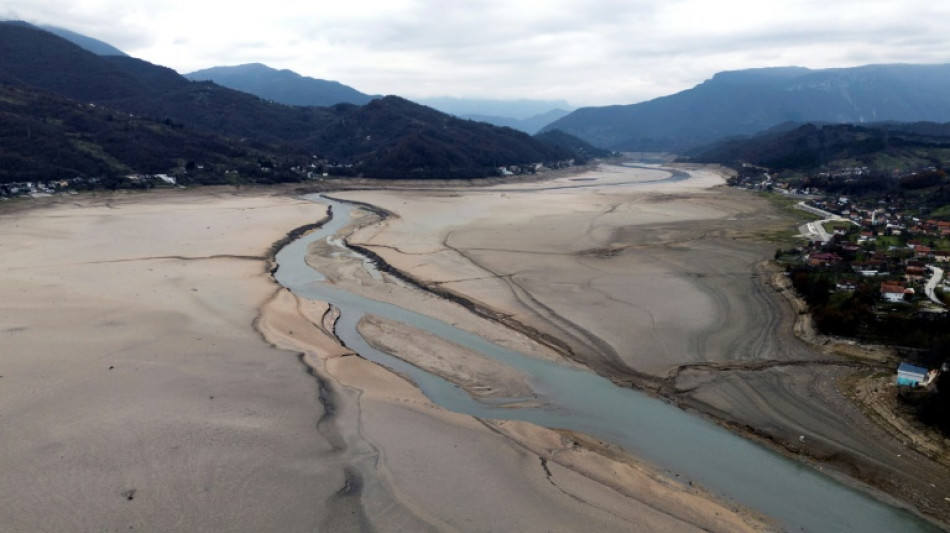
'Scary' drought empties one of Bosnia's largest lakes / Photo: © AFP

 Oil prices spike after Trump rejects Iran truce offer

 Taylor Swift sets new record at MTV VMAs
 Seoul seeks apology after Ukraine reveals transfer of North Korean POWs

 Messi on target again but Miami downed by Columbus

 In Washington's political cauldron, a fight over foie gras
 Flavio Bolsonaro: political heir in his father's shadow

 Ravens grab last-second win in Rio as Commanders stop Seahawks

 USA rallies to capture 11th consecutive Presidents Cup

 Phillies clinch, Astros wrap up division on final day of MLB season

 Commanders hand champion Seahawks their first loss

 Dupont scores twice to send Toulouse top of Top 14

 Ireland beat Israel but no handshakes due to war in Gaza

 Tense standoff over flashpoint N.Ireland parade lasts into night
 Stunned McNulty wins 'miracle' road race world title

 Re-released 'Avengers: Endgame' snaps-up N. America box office lead

 American McNulty wins shock road race world title

 Serbia's President Aleksandar Vucic announces resignation

 Tuchel urges Bellingham to play with 'rage'

 Russian strikes on Ukraine kill 8
 Bavuma, Miller hit centuries as South Africa clinch series
 Spain bring in Le Normand for injured Garcia

 UK Labour party meets buoyed by Burnham but seeking concrete plans

 Nor'easter lashes US east with punishing rain and wind

 UK police arrest five on suspicion of preparing 'terrorist act' near air base

 Washington denounces Iran's truce proposal as 'cynical'

Staring across what was once one of Bosnia's largest expanses of water, all that Saliha Kuljanin can see is boats left high and dry after months of drought emptied Lake Jablanicko.
"The climate has certainly changed, but this is scary!" Kuljanin, 68, told AFP near the lake's receding shores in southern Bosnia.
For years, the village of Ostrozac, where Kuljanin lives, had profited from the tourists attracted by Jablanicko's emerald waters.
But the rain has dried up this year and its water levels have plummeted.
Every year as the summer ends, water is gradually released from the 30-kilometre (18-mile) long lake so that the autumn rains can be absorbed.
"Its levels vary a little -- it goes down and up. But now, I don't know what's going on," said Kuljanin, pointing to the beached boats far from the remaining sliver of water left in the area.
Bosnia may be one of Europe's poorest countries but it has long been rich in one resource: water.
The World Bank estimates Bosnia's resources of renewable fresh water at nearly 10 cubic metres (350 cubic feet) per person per year.
Some of Europe's most pristine rivers run through the country's rugged terrain, making it a paradise for rafters, kayakers and other outdoor enthusiasts.
But the lack of rainfall this year has changed the equation. "The drought has been truly catastrophic," Kuljanin said.
Further upstream, the lake has completely dried out.
The lack of water has also complicated operations for a nearby power plant that relies on the lake's dam for energy.
- Landslides -
"The year 2024 was exceptionally bad for the functioning of the power plants," said Fahrudin Tanovic, an executive at public power company Elektroprivreda BiH.
"As last winter there was no snow, the inflow of water into the lake in spring was perhaps at the lowest level since its existence."
Thermal power plants still produce much of Bosnia's power, accounting for between 55 and 70 percent of the country's electricity at any time, according to the statistics office.
Hydroelectric plants produce most of the remaining power, with just four percent coming from solar or wind.
The drought has made nearby areas more susceptible to landslides, as the soil dries out and loosens.
In the nearby Jablanica area, at least 27 people were killed by sudden heavy rains in October that flooded towns and triggered landslides.
Scientists warn that climate change is making extreme weather events more frequent.
K.Thomson--BTB