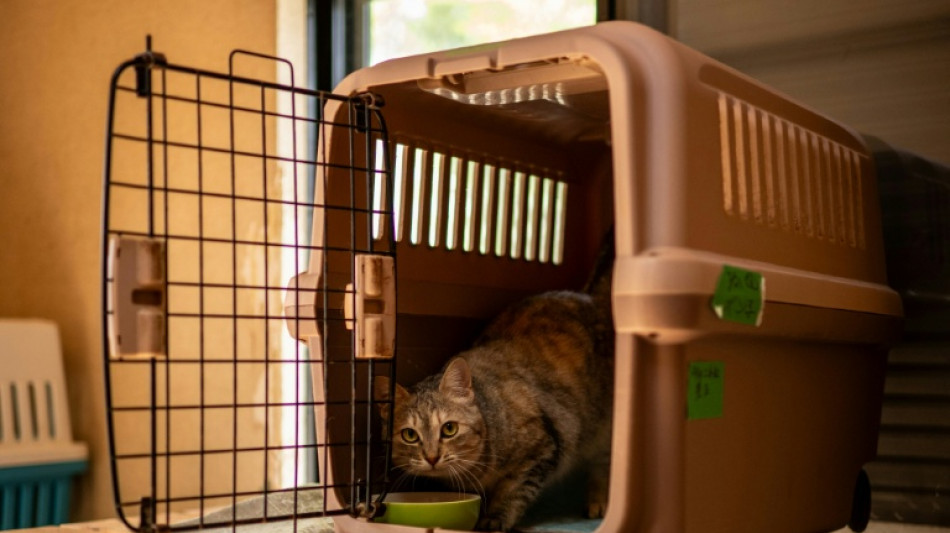
Japan startup seeks approval of cat kidney disease treatment / Photo: © AFP/File

 Venezuela releases more political prisoners after opposition talks

 England's best 'for a long time' despite Spain defeat, says Kane

 Powerful storm pummels northeast US with rain, high winds

 Filmmaker Mike Leigh wins top prize at Spain festival with 'last film'

 Spain beat England in Nations League to extend unbeaten run

 Ireland squad vote to play Israel tie despite Gaza unease

 Gutsy Vollering wins cycling road race world title

 Vollering wins cycling road race world title

 Man City's meteoric rise clouded by dark shadow

 Mbappe out for two weeks or more with knee injury say Real

 Lyon collapse away to Stade and suffer first Top 14 loss

 Russia accuses Europe of seeking to thwart Ukraine talks

 Man City chairman defiant over reported Premier League charges

 Germany ready to 'walk through fire' for Klopp, says Tah

 At least 16 killed in Russian and Ukrainian strikes

 Powerful storm pummels US Northeast

 Bangkok declares disaster after homes flooded, roads submerged by heavy rain

 Norris calls for errant Colapinto to be banned for causing Baku crash

 Russell finds himself again and prepares to heap pressure on Antonelli

 South Korea hold nerve to win Asian Games basketball gold

 Russell holds off Verstappen to claim imperious victory in Baku

 Russell holds off Verstappen to win Azerbaijan Grand Prix

 India's Kohli says 2027 ODI World Cup will be his last

 Huge crowds cheer Pope Leo along Champs-Elysees ahead of Paris mass

 Putellas wants to bring 'winning culture and mentality' to London City

A Japanese startup has filed for approval of a new drug to treat chronic kidney disease in cats, the founder said on Monday, offering hope for a common affliction that currently has no definitive cure.
The Tokyo-based Institute for AIM Medicine filed the treatment with the agriculture ministry on Friday, researcher Toru Miyazaki said, after a trial showed the drug significantly extended the life of afflicted cats.
"Most cats suffer from chronic kidney disease, and many die from end-stage renal failure or uraemia," Miyazaki, a former professor of the University of Tokyo, told AFP.
"We undertook drug development with the aim of overcoming this situation and alleviating the financial and physical burden on both cats and their owners," he said.
Miyazaki's research came under spotlight five years ago when he had to halt the development of the drug due to a shortage of research funding during the Covid-19 pandemic.
Following media reports, he received a flood of donations from cat lovers and owners totalling nearly 300 million yen ($2 million) between 2021 and 2022.
Chronic kidney disease is common among older cats, affecting up to 40 percent of felines aged more than 10, and 80 percent of those over 15, according to Cornell Feline Health Center in the US.
It is "a progressive disease with no definitive cure", the center said.
Miyazaki's study, published in the Veterinary Journal in February, tracked 11 cats that received the treatment and 15 non-treated cats for a year.
The cumulative survival rate for the treated cats was between 80 and 83 percent, while it was 20 percent for the non-treated cats.
B.Shevchenko--BTB