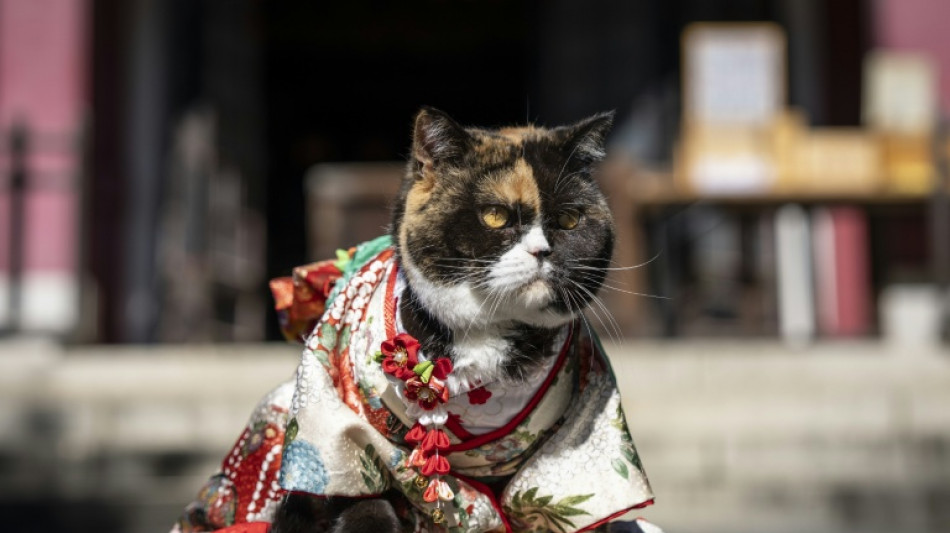
Kimono-clad pets blessed at Japan festival lacking enough kids / Photo: © AFP

 Freshways milk-price cut deepens pressure on UK dairy farms

 Labour and National remain virtually tied as New Zealand vote count advances

 The Good Daughter adapts Karin Slaughter thriller with Rose Byrne and Meghann Fahy

 Heavy-lift drone evacuates wounded Ukrainian soldier from frontline kill zone

 Morrison says West Brom recovered after pressure from successive derby losses

 Britain considers 2027 state visit for Ukraine’s Zelensky

 Udinese Falls to Last Place in Serie A After Loss to Venezia

 BSG Chemie Leipzig Defeated by Regionalliga Leaders Rot-Weiß Erfurt

 Trump and Vance Pursue Secret Diplomacy with Iran Amid Military Pressure

 Inside SFFILM’s Operations: Jordan Menashe on Managing Doc Stories Logistics
Chanting and swishing a wooden wand, a Japanese priest blessed a cat, a shiba inu and several Yorkshire terriers at a shrine in Tokyo on Saturday, in a rite usually reserved for children.
The annual "Shichi-Go-San" festival literally means "Seven-Five-Three" and traditionally allows families to celebrate the growth of their children at those ages.
But with Japan's population in decline, more and more worshippers are bringing beloved animals to the event instead.
"I came here to pray for my pet's healthy growth and well-being," Shoko Kodama, a 46-year-old doctor, told AFP at Ichigaya Kamegaoka Hachimangu, a Shinto shrine in the capital.
The 46-year-old doctor said she had spent two months hand-crafting a bespoke, bright-red kimono for her cat, a five-year-old British shorthair called Amber.
"This little one is like my child," she said. "Just having her around makes all the unpleasant things in life melt away."
Outside the shrine, other pet owners dressed their fluffy companions in colourful kimonos and posed them for photos to mark the special occasion.
They then brought them into the inner sanctuary, where the priest, Kenji Kaji, performed a purification rite with a wand decorated with white paper streamers.
He told AFP the role of pets in people's lives had shifted as "the family structure has changed" in Japan, which is grappling with an ageing population and a low birth rate.
"I think the number of instances where people who don't have children, or have finished raising them, and welcome a dog or cat as a member of the family has been increasing," Kaji said.
Kaji's shrine has been accepting around 400 families for each festival since the early 2000s, due to demand from pet owners.
Miyu Shiro, the 23-year-old owner of two Yorkshire terriers, said marking the event with her dogs "feels perfectly natural".
"They're part of our family," she said, as she snapped photos of her pups, neatly combed and wearing flower-shaped hair clips.
Data in June showed that Japan's fertility rate fell again last year to a record low, underscoring the demographic crisis gnawing at the world's fourth-largest economy.
With a median age of 49.9 years, Japan also has the second-oldest population in the world, after the tiny city-state of Monaco, according to the World Bank.
Koichi Ohara, 57, who attended the festival with his wife and friends, said his three Chihuahuas gave him "unconditional love".
"They're more affectionate than human children. They listen to what we say too," he laughed, adding that he had three kids.
"Just like us humans, I hope they can live long and in peace."
C.Kovalenko--BTB