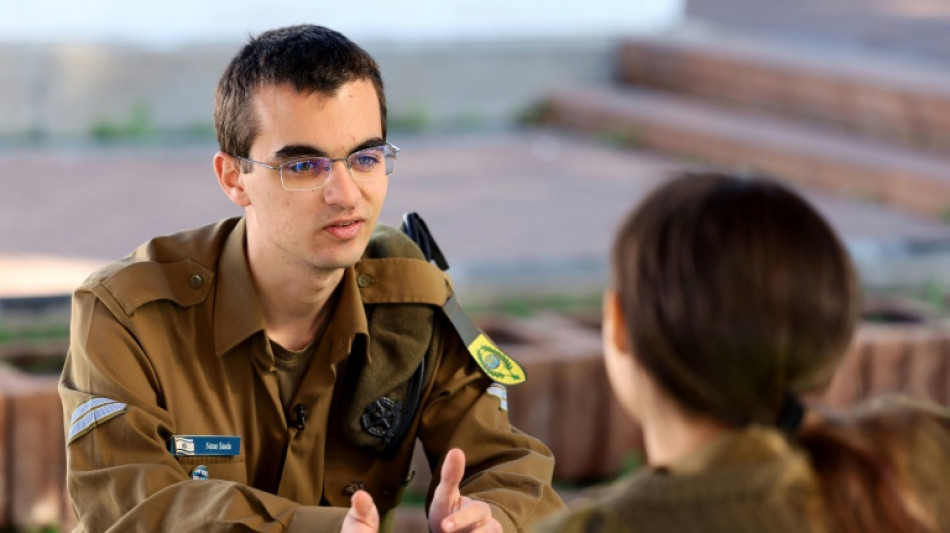
Israel military integrates soldiers with autism / Photo: © AFP

 Pegula shakes off nerves in US Open first-round win
 FIFA president Infantino 'must go', says ex-UEFA boss Platini
 England v Pakistan second Test: Three talking points
 Rashford's return 'fantastic' for Man Utd, says Carrick

 At least 8 die, more missing, as ferry capsizes off Northern Cyprus
 Pegula shakes off nerves, Ruse in US Open first-round win

 Fernandes treble inspires Man Utd rout, Chelsea beat Brighton in thriller

 Android photo recovery depends on recently deleted folders

 Realme P4s, iQOO Z11 and Nothing Phone 4b compared

 Google Maps adopts Lake America label for US users

 WIRED tests label makers for home organisation

 CERN creates quark-gluon plasma with smaller atomic nuclei

 Brighton swimmers adjust routines around sewage alerts

 Beeston pub closes after office fire injures man

 Former Nottingham hospital chief linked to NHS training firm

 Forest linked with Liverpool goalkeeper Mamardashvili

 Forest defender Tyler Bindon joins Charlton on loan

 Robinson strikes again as England wrap up Pakistan series win
 Red-hot Chelsea not the finished article says Alonso
 Dortmund's Konstantelias to miss 'several months' with knee injury
 Chelsea beat Brighton in seven-goal thriller, Leeds hold Brentford

 At least seven die in ferry capsize off Northern Cyprus; 23 missing
 In-form Marc Marquez wins Aragon MotoGP Grand Prix
 At least six die in ferry capsize off Northern Cyprus
 Niamey back to normal after soldier mutiny
Israeli soldier Nathan Saada is busy at his computer on an army base in Tel Aviv, where he is part of a specialised programme designed for military personnel with autism.
Around 200 people with high-functioning autism have joined the ranks since the scheme -- Titkadmu (Move Forwards) -- was launched in July 2021.
"I wanted to enlist because, in Israel, military service is important. It's something that each young person must do, and I also wanted to have this experience," said Saada, wearing a Titkadmu badge proudly on his khaki uniform.
The 20-year-old has an administrative role and, sitting at his desk, is putting the finishing touches to a chart.
"I have responsibilities; they count on me," said Saada, from the northern city of Haifa.
Military service is obligatory for most over-18s in Israel, with men serving for 32 months and women for two years.
There are automatic exemptions for around a third of citizens: ultra-Orthodox Jews who make up around 13 percent of the population, and Arab-Israelis who account for about 20 percent.
For those who are enlisted, military service is a rite of passage.
The army plays a central role in society in Israel, which has fought wars with all of its neighbours since the state's creation in 1948.
People with autism are exempt from military service, although since 2008 they have been welcomed for short courses.
For years, few signed up, said Brigadier-General Amir Vadmani, from the military's human resources department.
That changed with the establishment of Titkadmu, the brainchild of an officer with autism.
Aside from combat units, said Vadmani, "you'll find them in all the departments. In the air force, the navy, the ground forces, in the intelligence unit, everywhere".
"Soldiers with autism have huge potential" and are a real asset to the military, he added. "These young people want to prove that they can succeed, that they are like everyone else."
- 'Helps me a lot' -
Vadmani said it is particularly important to integrate people with autism in the military because the numbers of those diagnosed are rising.
According to the Israeli Society for Children and Adults with Autism (ALUT), diagnoses are increasing by an average of 13 percent annually.
This is partly due to a broadening of criteria, according to ALUT spokeswoman Lital Porat.
One in every 78 children will be diagnosed with autism in Israel, the group says. This compares with one in 100 children globally, according to a World Health Organization estimate.
People with autism can benefit from joining the military because it provides "a framework which prepares them to lead a life as independent as possible", said Porat.
As part of the Titkadmu programme, the military has adapted its training methods and put in place a support network.
Once a week, Saada is visited on his base by a fellow soldier, Liri Shahar, who has been tasked with following up with what the army terms its "special" groups.
"We tell each other how the week went, if anything particular happened," said Shahar, 19, who serves as an intermediary between Saada and his commander. "We talk about everything."
Diagnosed at age four, Saada said he sometimes struggles with social interactions and communication.
"It helps me a lot to have a person who I can turn to, who can advise me and help me," he said.
Although the Titkadmu programme is in its infancy, Vadmani said it has long-term goals for the recruits.
"The idea is to help them integrate into the labour market, by capitalising on the skills they have acquired during their service," he said.
Saada already has clear ambitions for his life outside the base when he is discharged next year.
"I'd love to become a filmmaker," he said, smiling. "I've already written several screenplays."
J.Fankhauser--BTB