US trade shifts on Covid and China tensions, but no 'decoupling' yet / Photo: © AFP/File

 Medvedev advances without drama at US Open

 Calhanoglu fires Inter to nervy Cagliari win, Como stun Napoli

 Monaco beat Marseille to go top, Rosenior's Paris FC thump Nice
 Pegula shakes off nerves in US Open first-round win

 FIFA president Infantino 'must go', says ex-UEFA boss Platini

 England v Pakistan second Test: Three talking points

 Rashford's return 'fantastic' for Man Utd, says Carrick

 At least 8 die, more missing, as ferry capsizes off Northern Cyprus

 Pegula shakes off nerves, Ruse in US Open first-round win

 Fernandes treble inspires Man Utd rout, Chelsea beat Brighton in thriller

 September smartphone calendar spans Apple, Poco, Vivo and Xiaomi

 Android photo recovery depends on recently deleted folders

 South West Water ranks worst in environmental comparison

 Screen-free fitness bands gain ground as users seek fewer alerts

 Practical boundaries can reduce group-chat overload

 Brighton swimmers adjust routines around sewage alerts

 Beeston pub closes after office fire injures man

 British woman dies after stabbing at German station

 Russell Hobbs dual air fryer discounted to £99

 Eight dead and 23 missing after ferry sinks off Cyprus

 Robinson strikes again as England wrap up Pakistan series win

 Red-hot Chelsea not the finished article says Alonso

 Dortmund's Konstantelias to miss 'several months' with knee injury

 Chelsea beat Brighton in seven-goal thriller, Leeds hold Brentford

 At least seven die in ferry capsize off Northern Cyprus; 23 missing

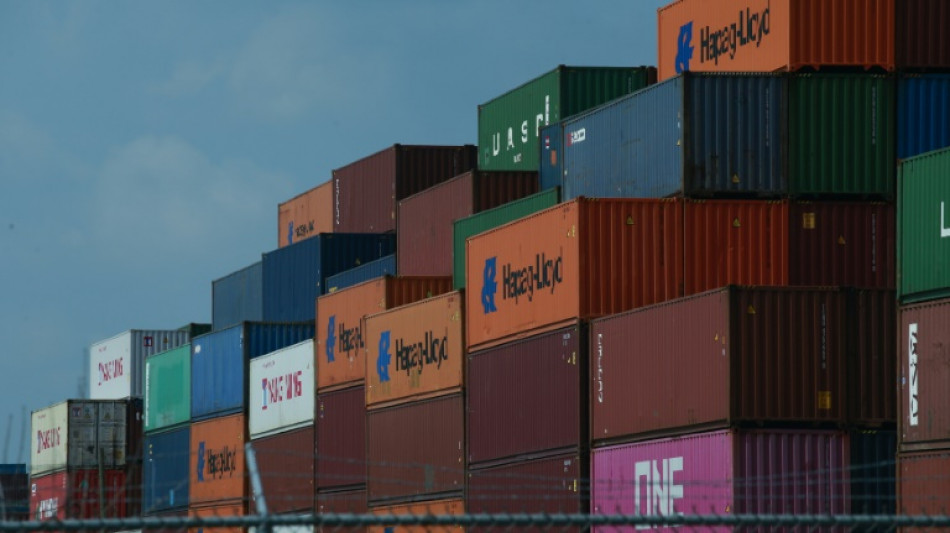
US trade flows are realigning on the back of pandemic shocks and tensions with China, but efforts to reduce interdependence between the superpowers have not brought a swift decoupling.
While security concerns have escalated and US imports from China fell after Washington and Beijing imposed tit-for-tat tariffs, trade has since climbed again.
The numbers could rise further when 2022 trade data is released next month, pointing to how interlaced the world's two biggest economies are.
But experts say tensions have left their mark in other ways.
"US imports from China are well below the trend that they were on before the trade war started," said Mary Lovely, senior fellow at the Peterson Institute for International Economics (PIIE).
"There is definitely a turn away from China in US imports, especially or primarily in those goods on which the US raised tariffs," she told AFP.
After the trade war started, the value of America's goods imported from China dropped from $506 billion in 2017 to around $450 billion in 2019.
Bilateral relations are not the only factors affecting trade. The pandemic taook a heavy toll as well.
Last November, China saw its sharpest drop in exports since the start of Covid-19, with business activity slammed by a strict zero-Covid policy.
Also weighing on imports is an "ongoing shift in the US away from spending on goods," said Ryan Sweet of Oxford Economics.
Americans spent heavily on imported products during the pandemic, but "people are going back out and spending on services" as virus concerns ease, he said.
This cuts into demand for goods and can help explain why numbers have not surged more.
- Diversification, not decoupling -
For now, US government figures through to November show total US-China trade could approach or hit a high in 2022.
"Going forward, you're going to see more diversification," as opposed to a complete cut-off of shipments from China, said Sweet.
Auto manufacturers, for example, experienced supply chain problems during the pandemic.
Increasing climate-related disruptions are also "raising the risks of overconcentrated supply chains in one firm or one geographic area," said Robert Koopman, a lecturer at American University and a former World Trade Organization chief economist.
Meanwhile, the US is trying to be more self-reliant in specific sectors like semiconductors.
"The recent (Inflation Reduction Act) and Chips Act, and related sanctions are clear indicators of the Biden administration's efforts to decouple from China" in these areas, said Koopman.
Emily Benson, senior fellow at the Center for Strategic and International Studies (CSIS), added: "As companies reassess risk and review the current state of their supply chains, one consistent outcome is movement... away from China to other countries."
These could be countries in Southeast Asia or closer to the United States.
"While this trend is growing, it resembles sand leaking out of a bag more than it does a tsunami," she told AFP.
It is likely "too early" for definitive comments on industries, but US export controls "are going to force some decoupling" over time in technology or areas where semiconductors are key, Benson said.
- 'Substitution' -
Lovely of PIIE noted that some business has moved from China to countries like Vietnam or Mexico.
"There's definitely been some substitution of suppliers," she said, adding that is fueled partly by Chinese investors who have opened factories outside their home country.
"In Mexico, it's a different story," Lovely added. "There has been some Chinese investment, but a lot of it is multinationals who were moving closer to the US."
But Koopman cautioned that countries like Mexico will need domestic reforms to boost competitiveness and lower implicit trade costs, to reap greater benefits.
US goods imports from the European Union are also catching up, with year-to-date numbers for 2022 reaching $504.4 billion in November. This was above the $499.5 billion worth of goods from China over the same period.
But economists point to a post-Covid uptick in commercial activity worldwide to explain the trend.
"These figures are a small snapshot and are more likely representative of the global economy returning to pre-pandemic levels than any specific decoupling movement," said Benson.
As China recovers from an infections surge after easing Covid-19 rules, it too expects a noticeable rise in imports, said Vice Premier Liu He, speaking this month in Davos, Switzerland.
H.Seidel--BTB