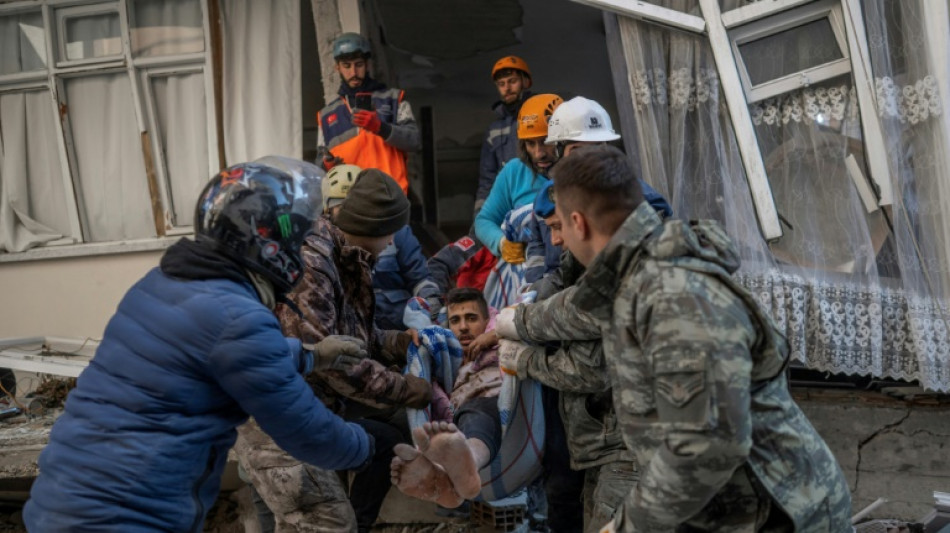
Hopes fade as Turkey-Syria quake toll at 17,500 / Photo: © AFP

 Former Peru minister last-minute contender for UN labour agency helm

 Messi legacy will 'live forever', says Beckham
 'Literally tasting the smoke': Malaysians suffer as haze worsens

 Kyiv's defences, 'hybrid' threat from Moscow headline EU talks
 Oil extends gains, stocks mostly down as Trump issues fresh Iran warning
 ThinkMarkets Expands Weekend Trading Offering, Launches Weekend League Competition

 Tibet activists accuse China of downplaying floods
 Afghanistan war victims left 'without justice', UN says

 Iran president offers US olive branch before Putin meeting

 China-Nepal flood toll tops 1,000 as tunnel rescue offers last hope
 Japan to relax overtime regulation under workaholic PM
 Thwarted Niger mutiny exposes junta's Russia dependence
 Illegal mining ravages S.Africa's economic hub
 Nepal's wall of missing offers last hope after Himalayan flood

 US to press G20 on light-touch AI regulation

 2 die in Grand Canyon flash flood, only 1 person unaccounted for

 US Army Secretary Driscoll submits resignation: White House
 Oil extends gains, stocks drop as Trump issues fresh Iran warning
 Tsitsipas says Kyrgios's positive cocaine test 'kind of expected'

 In Japan's mountains, a different way to manage bears

 Middle East war a boon for UAE defence giant with global ambitions
 Former gang member found guilty of murdering Tupac Shakur
 Top-seeded Zverev opens US Open campaign
 US regulator, 22 states accuse Amazon of 'manipulating' ad auctions: lawsuit

 TRON Founder Justin Sun Shares Outlook on Bitcoin, Stablecoins and Global Finance at Bitcoin Asia 2026

Hopes were fading Thursday for rescuing survivors of the earthquake in Turkey and Syria, which has killed over 17,500 people in one of the deadliest tremors in decades.
Bitter cold has hampered the four-day search of thousands of flattened buildings and the 72-hour mark that experts consider the most likely period to save lives has passed.
Relatives were left scouring body bags laid out in a hospital car park in Turkey's southern city of Antakya to search for missing relatives, an indication of the scale of the tragedy.
"We found my aunt, but not my uncle," said Rania Zaboubi, a Syrian refugee who lost eight members of her family, as other survivors sought loved ones' bodies among the corpses.
The 7.8-magnitude quake struck as people slept early Monday in a region where many people had already suffered loss and displacement due to Syria's civil war.
An official at the Bab al-Hawa border crossing told AFP that an aid convoy reached rebel-held northwestern Syria Thursday, the first since the earthquake that has left survivors sleeping outdoors due to aftershock risks.
A decade of civil war and Syrian-Russian aerial bombardment had already destroyed hospitals, collapsed the economy and prompted electricity, fuel and water shortages.
- Freezing temperatures -
Temperatures in the Turkish city of Gaziantep plunged to minus five degrees Celsius (23 degrees Fahrenheit) early Thursday, but thousands of families spent the night in cars and makeshift tents -- too scared or banned from returning to their homes.
Parents walked the streets of the city -- close to the epicentre of Monday's earthquake -- carrying their children in blankets because it was warmer than sitting in a tent.
Some people have found sanctuary with neighbours or relatives. Some have left the region. But many have nowhere to go.
Gyms, mosques, schools and some stores have opened up at night. But beds are still at a premium and thousands spend the nights in cars with engines running to provide heat.
"When we sit down, it is painful and I fear for anyone who is trapped under the rubble in this," said Melek Halici, who wrapped her two-year-old daughter in a blanket as they watched rescuers working into the night.
Turkish President Recep Tayyip Erdogan, after mounting criticism online over the initial disaster response, visited one of the hardest-hit spots, Kahramanmaras, and acknowledged problems.
"Of course, there are shortcomings. The conditions are clear to see. It's not possible to be ready for a disaster like this," he said Wednesday.
- Racing against the clock -
Officials and medics said 14,351 people had died in Turkey and 3,162 in Syria from Monday's 7.8-magnitude tremor, bringing the confirmed total to 17,513. Experts fear the number will continue to rise sharply.
"We are now racing against the clock to save lives together," EU chief Ursula von der Leyen said on Twitter.
Despite the dimming hopes for rescues, thousands of local and foreign searchers have not given up in the hunt for more survivors.
Two dozen children and some of their parents from northern Cyprus -- 39 Turkish Cypriots in all -- were on a school trip to join a volleyball tournament when the quake hit their hotel in southeast Turkey's Adiyaman.
Their home region's government has declared a national mobilisation, hiring a private plane so they could join the search-and-rescue effort for the children.
Ilhami Bilgen, whose brother Hasan was on the volleyball team, looked at the frightening pile of concrete slabs and heavy bricks that used to be the hotel.
"There's a hollow over there. The children may have crawled into it," Bilgen said. "We still haven't given up hope."
Dozens of nations, including China and the United States have pledged to help, and search teams as well as relief supplies have already arrived.
- International aid -
In Brussels, the EU is planning a donor conference in March to mobilise international aid for Syria and Turkey.
The European Union said the conference would be held in coordination with Turkish authorities "to mobilise funds from the international community in support for the people" of both countries.
The bloc was swift to dispatch rescue teams to Turkey after the massive 7.8-magnitude earthquake struck the country on Monday close to the border with Syria.
But it initially offered only minimal assistance to Syria through existing humanitarian programmes because of EU sanctions imposed since 2011 on the government of President Bashar al-Assad in response to his brutal crackdown on protesters, which spiralled into a civil war.
The Turkey-Syria border is one of the world's most active earthquake zones.
Monday's quake was the largest Turkey has seen since 1939, when 33,000 people died in the eastern Erzincan province.
In 1999, a 7.4-magnitude earthquake killed more than 17,000.
burs-jmm/jm
Y.Bouchard--BTB