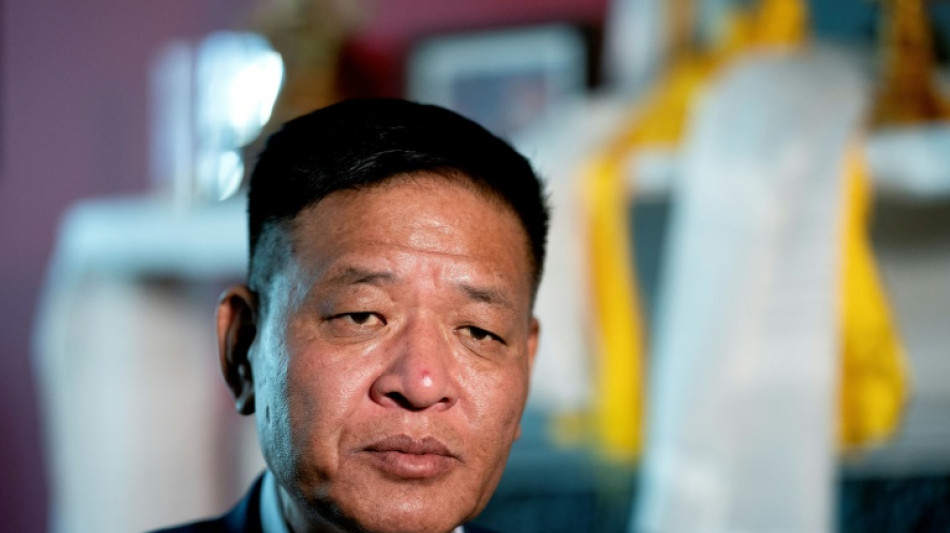
Exiled Tibetans place hopes in history / Photo: © AFP

 Former Peru minister last-minute contender for UN labour agency helm

 Messi legacy will 'live forever', says Beckham

 'Literally tasting the smoke': Malaysians suffer as haze worsens

 Kyiv's defences, 'hybrid' threat from Moscow headline EU talks

 Oil extends gains, stocks mostly down as Trump issues fresh Iran warning

 ThinkMarkets Expands Weekend Trading Offering, Launches Weekend League Competition

 Tibet activists accuse China of downplaying floods
 Afghanistan war victims left 'without justice', UN says

 Iran president offers US olive branch before Putin meeting

 China-Nepal flood toll tops 1,000 as tunnel rescue offers last hope

 Japan to relax overtime regulation under workaholic PM

 Thwarted Niger mutiny exposes junta's Russia dependence

 Illegal mining ravages S.Africa's economic hub
 Nepal's wall of missing offers last hope after Himalayan flood

 US to press G20 on light-touch AI regulation

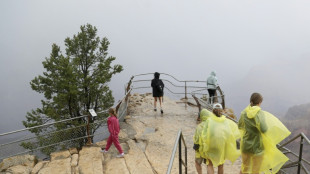
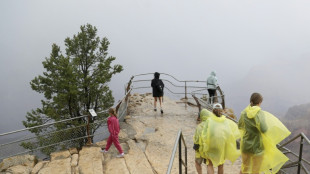 2 die in Grand Canyon flash flood, only 1 person unaccounted for

 US Army Secretary Driscoll submits resignation: White House
 Oil extends gains, stocks drop as Trump issues fresh Iran warning

 Tsitsipas says Kyrgios's positive cocaine test 'kind of expected'

 In Japan's mountains, a different way to manage bears

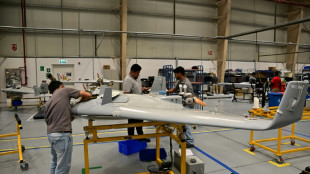 Middle East war a boon for UAE defence giant with global ambitions

 Former gang member found guilty of murdering Tupac Shakur

 Top-seeded Zverev opens US Open campaign
 US regulator, 22 states accuse Amazon of 'manipulating' ad auctions: lawsuit

 TRON Founder Justin Sun Shares Outlook on Bitcoin, Stablecoins and Global Finance at Bitcoin Asia 2026

As China shows no compromise and the Dalai Lama ages, the elected leader of Tibetans in exile is looking to history as he plans for the future.
Penpa Tsering was elected in 2021 as the second-ever leader, or sikyong, of the Tibetan government-in-exile in India, part of a plan by the now 87-year-old Dalai Lama -- the globally recognizable face of Tibet -- to pass the baton.
On a visit to Washington, Tsering met lawmakers about a bill that would recognize that Tibet -- ruled with an iron fist by China since the 1950s -- was historically an independent country and that its current status is "unresolved."
"We have adopted a different tactic to gain the right leverage," Tsering, who has spent his whole life in exile since his birth in 1967 in India, told AFP in an interview.
Tsering insists he is not seeking independence for Tibet, in line with the "Middle Way" of the Dalai Lama who believes that pushing demands beyond autonomy would be suicidal against a vastly more powerful China.
But the Dalai Lama has also rejected Beijing's longstanding demands to say that Tibet was historically part of China, a refusal cited by Beijing in declining dialogue with his representatives since 2010.
An independent Tibet, Tsering explained, would have been an occupied country when it formalized Chinese rule in 1951, making the agreement "null and void."
"We tell governments that if you keep repeating the statement that Tibet is part of People's Republic of China, then you're going against international law," Tsering said.
Tsering hoped more countries would follow the United States on the historical position. Britain, which reached a 1911 accord with Chinese and Tibetan envoys when it ruled India, had uniquely said that China had "suzerainty" over Tibet but in 2008 joined the rest of the world in recognizing Beijing's sovereignty.
China's embassy in Washington denounced the legislation, which has been introduced with bipartisan support, saying, "Tibet is part of China."
"We urge the US side to take concrete actions to honor its commitment of recognizing Tibet as part of China, not supporting 'Tibetan independence,' and stop using Tibet-related issues to interfere in China's internal affairs," an embassy spokesperson said.
- China 'is going to change' -
Tsering acknowledged it was "difficult" to see a resumption soon of talks with China but did not give up hope.
"As Buddhists we don't believe in permanence. Change is the only constant," he said.
"China is definitely going to change. But the issue is how long will it take."
China, however, has increasingly brushed off criticism. It has clamped down on Hong Kong, carried out major military drills off Taiwan and has been accused by the United States of "genocide" against the Uyghur people in its northwest.
Many observers believe China shut off the Tibet dialogue in anticipation that the cause would shrivel away without the Dalai Lama, the charismatic Nobel Peace Prize-winning monk whose once frenetic international travel schedule has slowed down in recent years.
Tsering quipped that the Dalai Lama has spoken of living another 30 years. But he also credited the monk with creating one of the few successful examples of a democracy in exile.
The Dalai Lama's initiatives will help "make sure that our struggle will have the strength to continue for another few decades, if need be."
Exiled Tibetans have also started to speak, gently, of coordination with Western governments once the 14th Dalai Lama dies. The United States has already said it would not recognize any choice of Beijing.
The Dalai Lama has spoken of breaking tradition by choosing a reincarnation, possibly a girl, before dying or even of declaring the institution over.
Such musings have outraged Beijing which, while officially atheist, has insisted that the Dalai Lama reincarnate in line with Buddhist tradition.
In 1995, Beijing selected its own child as the Panchen Lama, another influential Tibetan religious figure, and detained a Dalai Lama-recognized six-year-old, described by rights groups as the world's youngest political prisoner.
Tsering said that the decision on reincarnation would be left solely to the Dalai Lama.
"China has all the resources, both human and financial, and they are very good at propaganda and forcing countries to take positions," Tsering said.
"But they cannot handle uncertainty. So right now, His Holiness' decision of not disclosing all the processes is, I think, very wise."
R.Adler--BTB