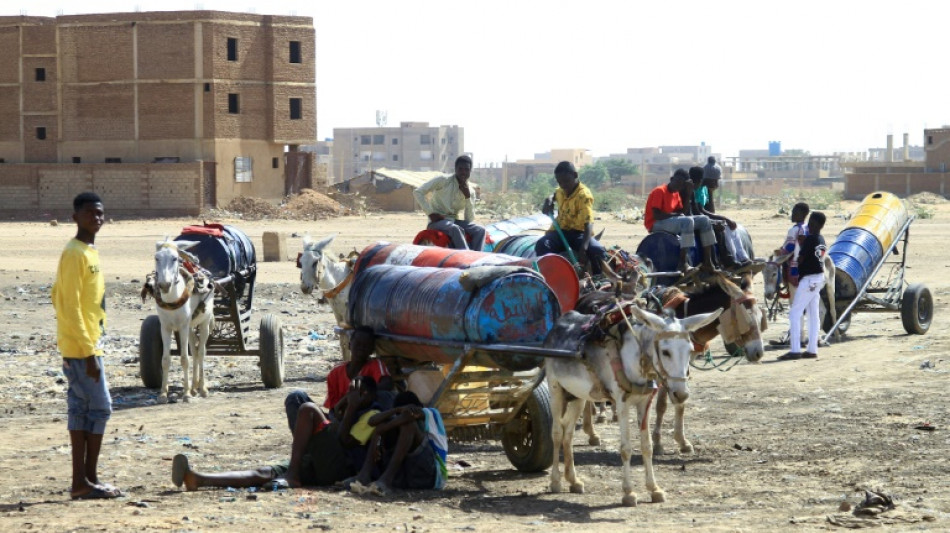
US takes leading role on Sudan but faces limited leverage / Photo: © AFP/File

 How a Dostoevsky novella took TikTok by storm

 Zverev goes the distance again to reach US Open third round

 German AfD's love for Simson mopeds dismays Jewish family behind brand

 Two trapped tunnel workers rescued in Nepal 'miracle'

 Ex-Pakistan coach Gillespie tells Javed 'look in the mirror' over sackings

 Monfils falls to Tien in US Open in Grand Slam farewell

 Arsenal brace for Chelsea test as Spurs seek spark
 Efficient Rybakina reaches US Open third round

 Taiwan boxer Lin considered 'graceful exit' after Paris Games gold

 'I miss my home': Cambodians displaced by conflict start over

 Ailing Auger-Aliassime falls at US Open as Swiatek, Osaka and Gauff advance

 Tesla launches self-driving 'Cybercab' in Texas

 'Wallace & Gromit' creators turn 50 with spook-tacular Shaun yarn

 New York's Muslims reclaim their city after 9/11 backlash

 Premier League transfer windfall a lifeline for ailing French clubs

 Chile protesters see shades of Pinochet in new security plan
 Carreras reverts to fullback as Argentina change four for Australia Test

 Wilson back to lead Australia as Kiss rotates team for Argentina

 Yen surges on new intervention talk, US stocks rally

 Japan's Ueda fires Lille top of Ligue 1 on debut

 Arsenal chief executive reveals 'dynasty' ambition

 Spanish PM says no 'solid proof' Morocco planned migrant rush

 Iran war is not a war, US VP Vance says

 Khachanov stuns third-seeded Auger-Aliassime in US Open second round

 Bordeaux facing sixth-tier football after French federation upholds relegation

The United States has taken a lead in trying to end a burst of violence in Sudan but it faces a tough road ahead with limited power to rein in warring generals.
Secretary of State Antony Blinken spearheaded efforts to broker a three-day ceasefire that took effect Tuesday and has largely held in the capital Khartoum, although scattered clashes persisted elsewhere in Africa's third largest country.
Previous truces quickly disintegrated over 10 days of round-the-clock fighting that have pitted paramilitary forces against the army, into which the powerful unit was supposed to be integrated.
State Department spokesman Vedant Patel said that US diplomats remained "deeply engaged" with all sides to try to extend the ceasefire and making it permanent, with hopes of a path to civilian rule.
Molly Phee, the top US diplomat for Africa, and John Godfrey, the US ambassador to Sudan who was evacuated on Saturday, have been involved in detailed negotiations with the two generals in coordination with Saudi Arabia and the United Arab Emirates, regional heavyweights that have major investments in Sudan.
- Historic US role -
The United States for decades has been the key diplomatic player in Sudan, negotiating a 2005 agreement that ended the civil war and brought independence to South Sudan and later taking the forefront in efforts to stop a scorched-earth campaign in Darfur.
But Washington, seeking to preserve bridges, had hesitated in the run-up to the violence to take direct action against the dueling generals. US diplomats are also now reduced to coordinating by telephone after President Joe Biden ordered an evacuation of the embassy out of safety concerns.
"Whether or not we have the leverage, we are looked upon as having the leverage" due to the history, said Cameron Hudson, an Africa expert at the Center for Strategic and International Studies.
The United States can still build diplomatic coalitions but its leverage in Sudan has "substantially declined," Hudson said.
Hudson said she was pessimistic that the ceasefire would hold and pointed to anecdotal reports that the paramilitary Rapid Support Forces have used the lull to bring in supplies from their Darfur stronghold.
Army chief Abdel Fattah al-Burhan and the RSF leader Mohamed Hamdan Daglo both still hope for military victory but had an interest in a pause in fighting, which also served to please international interlocutors, Hudson said.
"These guys have been fighting for 10 days, 24 hours a day, flat out. They're tired. They need a break. They need to regroup. They need to resupply," he said.
"So I think that this ceasefire has the potential to backfire."
- Waning pressure -
The United States had loosened pressure on Sudan since 2019 when a coup d'etat ousted dictator Omar al-Bashir, a nemesis of the United States for much of his three decades in power which included welcoming Al-Qaeda founder Osama bin Laden in the 1990s.
In late 2020, then president Donald Trump removed Sudan from a blacklist of state sponsors of terrorism after leaders tentatively agreed to recognize Israel and to compensate US victims of Al-Qaeda terrorism.
The Biden administration froze a $700 million aid package a year later after another military coup thwarted a transition to civilian rule.
But some lawmakers had pressed for further action. Senator Chris Coons, a Democrat close to Biden, ahead of the latest violence had called for targeted sanctions against coup leaders to disrupt their streams of revenue -- seen as a key reason why they were clinging to power.
Susan Stigant, Africa director at the US Institute of Peace, said that greater instability in Sudan held major risks due to the country's strategic location between North and sub-Saharan Africa and on the Red Sea, a major artery for global trade.
She said it was crucial that any US strategy not involve just the two generals but the broad range of Sudanese society that has clamored for change.
"We have to be very careful we don't create a false binary choice between the two generals," she said. "There has to be a third way."
Y.Bouchard--BTB