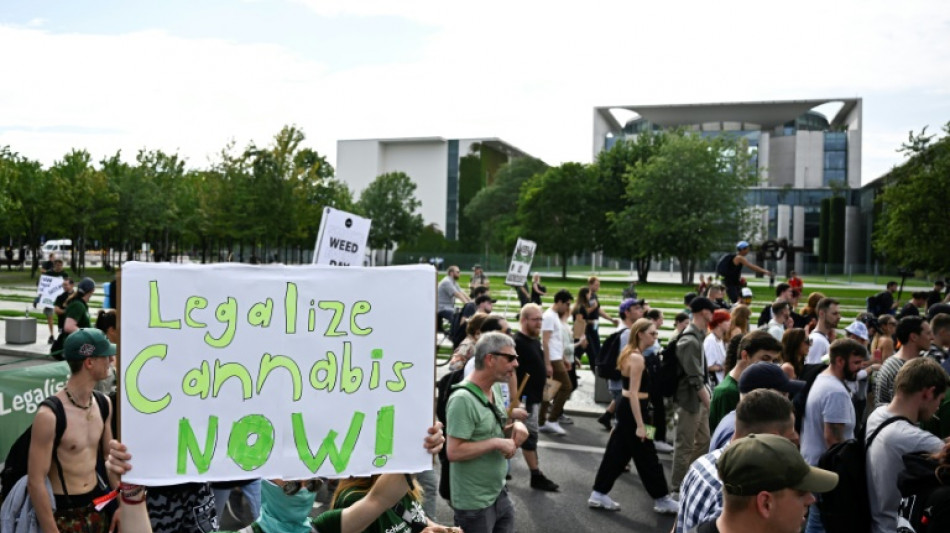
German govt okays 'controlled' use of cannabis / Photo: © AFP

 Yemen's Houthis seize key city on Red Sea: military source

 Oil prices extend gains as markets await ECB rate outlook

 Wars pose a test as India hosts BRICS summit with China, Russia, Iran leaders

 Messi to buy second Spanish lower league club
 Pochettino calls for Chelsea to lose 2016-17 Premier League title

 North Korea leader's daughter believed to have younger sibling: Seoul

 Wars pose a test as India hosts BRICS summit with Russia, Iran leaders

 Alessio Vinassa Unveils an Emerging Technology Investment Approach Shaped by Financial Challenges
 Stocks drop as oil spike fans inflation and interest rate fears

 Portugal harvests grapes at night to beat the heat
 Philippine ferry fire kills 5, dozens missing

 Oil prices flare as Iran tightens grip on Hormuz

 Japan gymnasts under injury cloud for home Asian Games

 India trailblazer won't 'let go' of chance for Asian weightlifting glory

 Zverev cruises past van de Zandschulp into US Open semis

 Myanmar tin mega-mine restarts operations: think tank

 Online and undercover: saving trafficked wildlife in Thailand

 Antonelli faces new challenge after stirring triumph in Monza

 Korda leads US bid to win first away Solheim Cup since 2015
 Eurozone rate-setters to hike borrowing costs as energy prices jump

 As oceans warm, Florida scientists hunt for heat-resistant coral

 Trump takes center stage as Republicans fight midterm tide

 Gauff takes inspiration from Tiafoe in US Open fightback win

 Ralph Lauren opens fur-free New York Fashion Week

 Arteta lauds in-form Odegaard as 'remarkable' Arsenal edge Napoli

The German government approved a draft law Wednesday legalising the purchase and possession of cannabis for recreational use, with the health minister pushing back against criticism of the controversial plans.
The legislation would allow adults to possess up to 25 grams (0.9 ounces) of cannabis and grow up to three plants for personal use.
People would also be allowed to join non-profit "cannabis clubs" of up to 500 members where the drug can be legally cultivated and purchased.
The bill still needs to be approved by lawmakers in the German parliament, who return from their summer break on September 4.
Health Minister Karl Lauterbach called the draft law "a turning point" in Germany's attitude towards cannabis.
The more relaxed approach would crack down on the black market and drug-related crime, ease the burden on law enforcement and allow for safer consumption of marijuana, he said at a Berlin press conference.
Minors will still be prohibited from using the drug, and the government will launch a campaign warning of the health risks for young people especially, he added.
"The concept we're presenting is one of controlled legalisation," he told reporters.
"We want to limit consumption and make it safer," Lauterbach said.
The proposed legislation is a flagship project of Chancellor Olaf Scholz's centre-left-led coalition and would leave Germany with one of the most liberal cannabis policies in Europe.
But the draft law is less ambitious than what was originally envisioned.
Plans to allow the widespread sale of cannabis in licensed stores were dropped in April after the European Commission raised concerns.
- 'Irresponsible' -
The current proposal has nevertheless run into strong opposition from conservative politicians, doctors and law enforcement officials.
Bavaria's regional health minister Klaus Holetschek from the opposition, centre-right CDU party called the plans "irresponsible". Examples from abroad had shown that liberalisation does little to curb the black market, he said.
The Professional Association of Pediatricians in Germany issued a joint statement with other youth healthcare associations "firmly" condemning the plans, saying they could encourage cannabis consumption among young people.
Police unions and judges have also criticised the legislation as too bureaucratic, fearing it will add more stress to the judicial system rather than relieving it.
Lauterbach said he welcomed the "controversial discussions" sparked by the plans, but said critics weren't putting forward any solutions.
Decriminalising the drug while imposing a number of restrictions and spelling out the dangers of cannabis use "will work", Lauterbach insisted.
The government's public health campaign in particular will highlight the harmful impact of regular cannabis use on the still-developing brain of people under the age of 25, Lauterbach added, a topic he said was still "taboo" among parents and in schools.
The legislation also prohibits marijuana use within 200 metres (218 yards) of a school, youth organisation, playground, sports grounds or "cannabis club".
If the bill goes through, the government aims to review the societal impact of the new legislation after four years.
A string of countries have already relaxed rules around cannabis use.
Uruguay became the first country in the world to legalise the production, distribution and consumption of marijuana in 2013.
In the United States, dozens of states including California have changed their laws in the past decade to allow people to light up.
Malta became the first European Union member to legalise recreational cannabis in 2021, while the Netherlands has tolerated the sale and use of cannabis in so-called coffee shops since the 1970s.
After studying the examples from other countries, Lauterbach said he was convinced the German plan in its current form was "the best attempt at cannabis legislation so far".
W.Lapointe--BTB