Will Israel's right exploit sanctions in run-up to vote? / Photo: © AFP

 Yemen's Houthis seize key city on Red Sea: military source

 Oil prices extend gains as markets await ECB rate outlook
 Wars pose a test as India hosts BRICS summit with China, Russia, Iran leaders

 Messi to buy second Spanish lower league club

 Pochettino calls for Chelsea to lose 2016-17 Premier League title

 North Korea leader's daughter believed to have younger sibling: Seoul
 Wars pose a test as India hosts BRICS summit with Russia, Iran leaders

 Alessio Vinassa Unveils an Emerging Technology Investment Approach Shaped by Financial Challenges
 Stocks drop as oil spike fans inflation and interest rate fears

 Portugal harvests grapes at night to beat the heat
 Philippine ferry fire kills 5, dozens missing

 Oil prices flare as Iran tightens grip on Hormuz

 Japan gymnasts under injury cloud for home Asian Games

 India trailblazer won't 'let go' of chance for Asian weightlifting glory

 Zverev cruises past van de Zandschulp into US Open semis

 Myanmar tin mega-mine restarts operations: think tank
 Online and undercover: saving trafficked wildlife in Thailand
 Antonelli faces new challenge after stirring triumph in Monza

 Korda leads US bid to win first away Solheim Cup since 2015
 Eurozone rate-setters to hike borrowing costs as energy prices jump

 As oceans warm, Florida scientists hunt for heat-resistant coral

 Trump takes center stage as Republicans fight midterm tide
 Gauff takes inspiration from Tiafoe in US Open fightback win

 Ralph Lauren opens fur-free New York Fashion Week

 Arteta lauds in-form Odegaard as 'remarkable' Arsenal edge Napoli

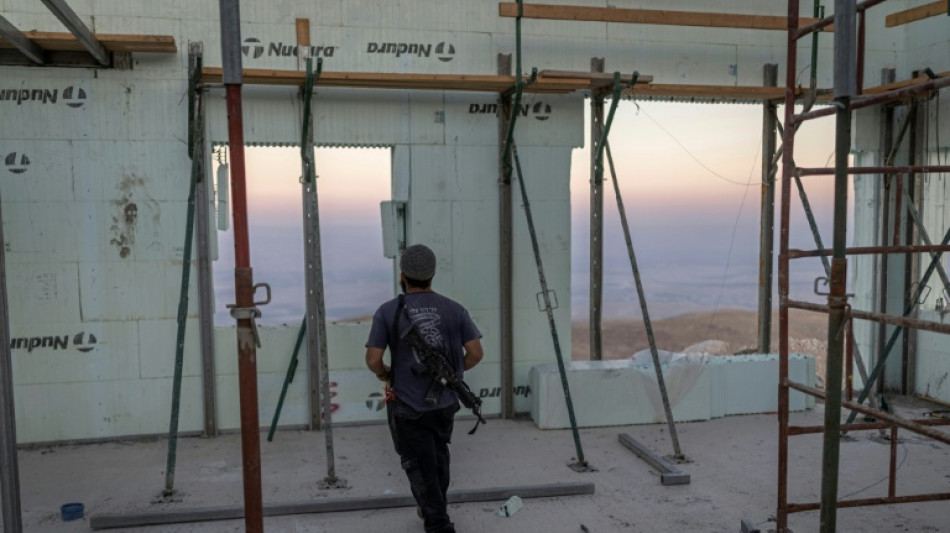
British-led sanctions over settlement expansion in the West Bank may have the unintended effect of emboldening the Israeli right ahead of elections, analysts and a diplomatic source told AFP.
Israeli Prime Minister Benjamin Netanyahu is looking to shore up his right-wing base ahead of October 27 elections, while in the UK Prime Minister Andy Burnham wants to bring back leftists who believe his predecessor was too timid on the war in Gaza.
Burnham said Britain would ban trade with Israeli settlements in the occupied West Bank, which are illegal under international law and which have rapidly expanded under Netanyahu's rule despite extremist settlers' near-daily attacks and theft against Palestinians.
France and Canada joined the sanctions and nine other Western nations voiced support.
But one European diplomat said that while Europeans broadly agreed with Britain's position, there was concern that the sanctions could play into the Netanyahu government's hands.
"I wasn't entirely convinced by the timing of it," the diplomat told AFP on condition of anonymity.
"In terms of the justifications for doing this, there are strong ones. But I wonder in the run-up to the elections whether this won't be instrumentalised by the government."
- 'Backfire spectacularly' -
Israel responded swiftly with countermeasures including ordering the closure of Britain's consulate in Jerusalem.
With patriotic fervour still strong following Hamas's attack on October 7, 2023, criticism over the sanctions crossed party lines.
Former centrist prime minister Yair Lapid called Britain's move "serious and misguided" but accused Netanyahu of diplomatic failure in not preventing Israel's isolation.
Sara Yael Hirschhorn, a historian at the University of Haifa who has written a book on the settler movement, expected the sanctions to energise voters for right-wing parties, including smaller ones that may otherwise not reach the threshold to enter parliament.
"It seems to me that this has the potential to backfire spectacularly," she said.
"If the UK government had waited until after the election, I'm not saying that you would have people embracing their goals, but I think there could have been more openness and more constructive conversation around this very serious escalation in the West Bank.
"But they didn't. They seemed to be responding more to their own domestic politics," she said.
West Bank settlements account for a small fraction of Israel's economy, which has posted soaring growth despite the war.
Esteban Klor, an economist at the Institute for National Security Studies, said it would be difficult to implement the sanctions as Israel does not readily distinguish between goods -- mostly agriculture -- from the settlements and Israel proper.
"I don't expect these sanctions to have strong economic consequences for the country," he said.
- Marker to next government? -
Surprising many observers, US President Donald Trump did not criticise the move, with Secretary of State Marco Rubio declining to endorse warnings to Britain from the US ambassador in Jerusalem, Mike Huckabee, an evangelical pastor and longtime settler ally.
Britain argued that action was imperative as Israel was quickly removing any feasibility of an independent Palestinian state, especially with the green light for the E1 project that would split the northern and southern West Bank.
Foreign Secretary Ed Miliband described the Israeli settlers' violence as "ethnic cleansing".
Mairav Zonszein, senior analyst on Israel for the International Crisis Group, said that while it was true Netanyahu will not shift course, the sanctions -- and Trump's refusal so far to criticise them -- sent a message to the next government.
Gadi Eisenkot, a former military leader who is Netanyahu's main rival, may not make a major policy shift in the West Bank but would not want international friction, she said.
A new government would likely want to rein in settler violence and "at least do the minimum to repair the image of Israel in the West", Zonszein said.
The sanctions set "a marker for whatever government does come in after October that there might be a price to be paid, and that you probably need to make certain choices", she said.
C.Meier--BTB