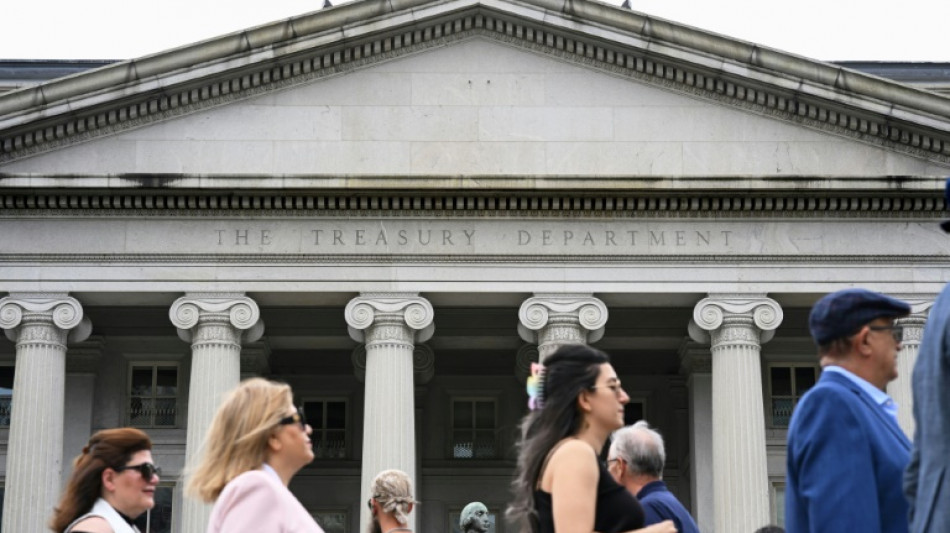
Why a surprisingly strong US economy is pushing up bond yields / Photo: © AFP

 Yemen's Houthis seize key city on Red Sea: military source

 Oil prices extend gains as markets await ECB rate outlook

 Wars pose a test as India hosts BRICS summit with China, Russia, Iran leaders

 Messi to buy second Spanish lower league club

 Pochettino calls for Chelsea to lose 2016-17 Premier League title

 North Korea leader's daughter believed to have younger sibling: Seoul

 Wars pose a test as India hosts BRICS summit with Russia, Iran leaders

 Alessio Vinassa Unveils an Emerging Technology Investment Approach Shaped by Financial Challenges

 Stocks drop as oil spike fans inflation and interest rate fears

 Portugal harvests grapes at night to beat the heat

 Philippine ferry fire kills 5, dozens missing

 Oil prices flare as Iran tightens grip on Hormuz

 Japan gymnasts under injury cloud for home Asian Games

 India trailblazer won't 'let go' of chance for Asian weightlifting glory

 Zverev cruises past van de Zandschulp into US Open semis

 Myanmar tin mega-mine restarts operations: think tank

 Online and undercover: saving trafficked wildlife in Thailand

 Antonelli faces new challenge after stirring triumph in Monza

 Korda leads US bid to win first away Solheim Cup since 2015

 Eurozone rate-setters to hike borrowing costs as energy prices jump

 As oceans warm, Florida scientists hunt for heat-resistant coral

 Trump takes center stage as Republicans fight midterm tide

 Gauff takes inspiration from Tiafoe in US Open fightback win

 Ralph Lauren opens fur-free New York Fashion Week

 Arteta lauds in-form Odegaard as 'remarkable' Arsenal edge Napoli

Yields on the 10-year US government bond are flirting with a 15-year high this week, amid growing fears that strong growth and low unemployment could keep interest rates higher for longer.
The US Federal Reserve has raised interest rates 11 times since March 2022, and has hinted it may have to do so again in the coming months if inflation remains above its long-term target of two percent.
The 10-year US government bond, or Treasury note, is considered to be an especially safe investment, and is closely scrutinized due to its use as a benchmark for pricing everything from home mortgages to commercial loans.
US Treasury note yields are seen as a proxy for interest rates, and often increase when the Federal Reserve raises rates to tackle inflation.
Yields have risen sharply since the Fed began an aggressive campaign of interest rate hikes in March last year to tackle a sharp rise in consumer prices.
The impact of these higher yields is already being felt: on Thursday, the interest rate on the popular 30-year fixed-rate mortgage in the United States hit its highest level in more than two decades.
Against this backdrop, a stronger economy could cause headaches for the Fed, and the financial markets.
- Stronger economy -
A recent spell of surprisingly positive economic data has diminished fears that the US could enter a recession later this year.
Economic growth in the second quarter beat expectations due in large part to resilient consumer spending, while the unemployment rate has remained close to historic lows.
Although this is good news for millions of Americans, it also raises the likelihood that interest rates will need to remain higher for longer to tackle inflation.
"The economy has proven to be quite resilient, and durable," Citigroup Global Chief Economist Nathan Sheets told AFP.
- Fed rate hikes -
Although inflation has fallen sharply in recent months, it remains stuck above the Fed's long-term target of two percent.
The Fed has already raised interest rates 11 times since March, most recently in July, when it lifted its benchmark lending rate by a quarter percentage-point to a range between 5.25-5.5 percent.
This decision brought the interest rate to its highest point in more than two decades.
On Wednesday, the Fed said "most participants" at its recent rate decision continued to see significant risks that price increases will persist, and that this could require further tightening of monetary policy.
Yields on US government bonds rose following the announcement, as markets digested the likelihood of additional rate hikes.
"The bottom line is that the Fed has continued to kind of lean in to rhetoric that says 'look, we'll do what we need to do, and we very well may need to do more in order to achieve our inflation objectives,'" Sheets said.
"It doesn't seem like there's any imminent cutting of rates that's anywhere in sight," he added.
- Poor fiscal management -
While the strong economy and the Fed's interest rate policy have played a significant role in pushing up bond yields, other factors are also at play.
Yields on longer-dated bonds have risen sharply since the beginning of August, when the US Treasury Department announced it was increasing its issuance of longer-dated bonds to help pay for increased government spending.
And a day earlier, the ratings agency Fitch surprised the financial markets by downgrading US debt, blaming rising government debt levels and the recent tussle over raising the debt ceiling.
"The repeated debt-limit political standoffs and last-minute resolutions have eroded confidence in fiscal management," Fitch said in a statement.
While both factors played a role in pushing up bond yields, their impact is likely to be short-lived.
"Issuance can create, you know, short-term headwinds and challenges, but rarely is a driver over longer term horizons," Sheets from Citi said.
- 'Attractive' yield, negative equities -
Despite the recent downgrade from Fitch, US Treasuries are still seen as one of the safest places to invest money, due to the US government's long history of paying its debts.
In recent months, demand for Treasuries has been boosted by the combination of high interest rates and falling inflation.
This put real, inflation-adjusted interest rates on US bonds firmly in positive territory.
"It makes us attractive around the world," Cumberland Advisors' cofounder David Kotok told AFP.
But while bond yields have soared, the US stock markets have stumbled, as the prospect of a higher interest rate environment has come into focus.
"I think it's kind of a flashing yellow light, reflecting some uncertainties about where we're headed," Sheets from Citi said.
"But it's not a broad kind of pulling back, because it is against the backdrop of a surprisingly resilient US economy," he added.
C.Kovalenko--BTB