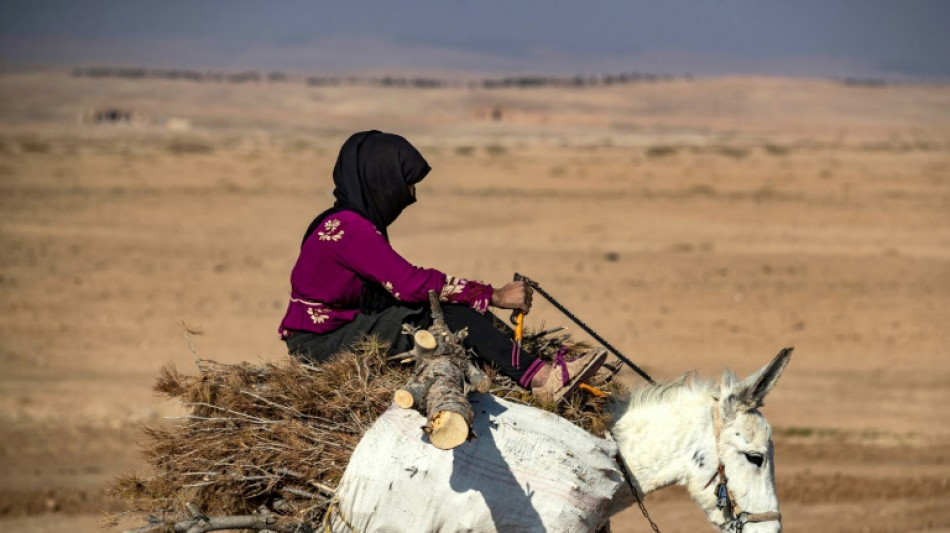
Illegal logging turns Syria's forests into 'barren land' / Photo: © AFP

 Defiant Iran seeks to bruise Trump ahead of midterms

 France withdraws support for Infantino in FIFA presidential election

 Evolution Metals & Technologies Provides Initial Revenue Guidance of $400-460mm for Fiscal Year 2027

 Clark-led USA thrash Hungary to move into women's World Cup semi-finals

 Vance takes spotlight as Republicans close Trump-heavy convention
 Russian skater Valieva loses neutral status
 Will Israel's right exploit sanctions in run-up to vote?

 'Metal Gear' creator moves to Xbox after Playstation cancellation

 Indonesia rescues six orangutans from fires in a week

 Macron urges Europe to develop 'crewed spaceflight' programme

 Deals worth billions to be signed as UAE leader visits Germany

 Zamanat Targets GCC’s $250 Billion SME Financing Gap With Up to $100 Million Tokenized Private Credit Fund

 Sri Lanka court revokes monk's pardon, orders return to prison
 'Hopeless, stuck, afraid': US deportees in limbo in Cameroon
 Mount Fuji ends hiking season with landslide, two rescues

 Seahawks beat Patriots again in NFL opener
 Asian Games begin with Qatar basketball win, nine days before opening ceremony

 Stocks sink as oil rally fans inflation and rate hike fears

 Argentine industry reels from Milei's free-market revolution

 Women quit South Korea's grind for diving tradition
 Bayeux Tapestry 'mania' sweeps UK as sold-out exhibition opens
 August hottest month ever recorded globally: EU monitor

 Duplantis leads creme de la creme at 'game-changing' Ultimate Championship

 Sjobo, cradle of Sweden's now-mainstream anti-migrant sentiment

 Israeli-made film about Gaza civilian deaths to debut in Venice

On a riverbank in war-ravaged Syria's north, felling has reduced what was once a lush forest to dispersed trees and decimated trunks poking out from dry, crumbly soil.
Twelve years of conflict that led to a spike in illegal logging, along with the effects of climate change and other factors, have eroded Syria's greenery.
The dwindling forest on the shores of the Euphrates river "is shrinking every year", said Ahmed al-Sheikh, 40, a supermarket owner in the village of Jaabar, in the Kurdish-held part of Syria's Raqa province.
Before, "the forest would attract tourists, birds, purify the air and protect the area from dust storms", he said.
But fuel shortages and rampant poverty during the war have pushed many Syrians to chop the trees to sell or use for heating, dealing a blow to the nature surrounding Jaabar.
Its ancient citadel had made the village a popular pre-war tourist attraction, with a reforestation project launched in the mid-1990s offering rare respite from the searing heat.
"Some people cut down the trees to sell them and earn money, others to keep warm during the winter," Sheikh said.
"If this goes on, desertification will follow."
Residents told AFP they hear loggers riding motorbikes into the forest at night to cut down trees.
Even in broad daylight, young men sneak into the woods to chop trees, evading the handful of forest guards patrolling the vast, green spaces.
- 'No shade left' -
Syria's war has killed more than 500,000 people and displaced millions.
It has also devastated the environment, triggering an "alarming" loss of forest cover across the country, Dutch peacebuilding group PAX warned in a report earlier this year.
The country has witnessed a "26-percent decrease in tree cover since 2000", according to data from Global Forest Watch.
Ten kilometres (six miles) from Jaabar, the same fate has befallen the trees of Tuwayhina.
"In my childhood, we used to come here with friends to sit under the shade of eucalyptus and pine trees," said Mohammed Ali, surrounded by tree trunks scattered across the sun-scorched earth.
"But now it is a barren land," said the 30-year-old nurse. "Now, there is no shade left, only the heat of the sun everywhere."
"The dust storms never stop, the lake is drying up and there are no trees left," Ali said, referring to Lake Assad, Syria's largest freshwater dam reservoir.
Water levels have dropped and pollution has worsened in the Euphrates and the reservoir it feeds, with the river's flow further impacted by upstream dams in Turkey.
Deforestation in Syria is largely attributed to logging and thinning for firewood, according to the PAX report.
"Soaring fuel prices combined with massive displacement form the main driver for large-scale deforestation throughout Syria," it said.
"Civilians are cutting down trees for cooking and heating, while there are clear indications that armed groups also use illegal logging and wood sales as a source of income."
- 'Blanket of greenery' -
The once-dense forests of Syria's west "have suffered the most degradation caused by the war", mostly from tree felling and wildfires, PAX said.
Latakia, Hama, Homs and Idlib provinces lost at least 36 percent of their trees in the decade following 2011, when the conflict erupted, according to PAX.
In the northeast, authorities have "no precise data" about the damage but its impact is "obvious", Ibrahim Asaad, who co-chairs the Kurdish semi-autonomous administration's environment body, told AFP.
The area was the country's breadbasket in pre-war times, but has witnessed severe droughts and reduced rainfall in recent years.
On the outskirts of Hasakeh, a city further east, the Mount Abdulaziz reserve has been plagued by dry spells and some illegal logging.
The trees had provided a "blanket of greenery", said Hussein Saleh al-Helou, a 65-year-old resident of the village of Al-Naseri.
But now "there is no water, the trees near the village have withered... and people have started cutting them", he told AFP, surrounded by vast barren lands and hills.
"Logging has had a huge impact on the village," Helou said.
"The temperature has risen, and the weather is not the same any more."
M.Ouellet--BTB