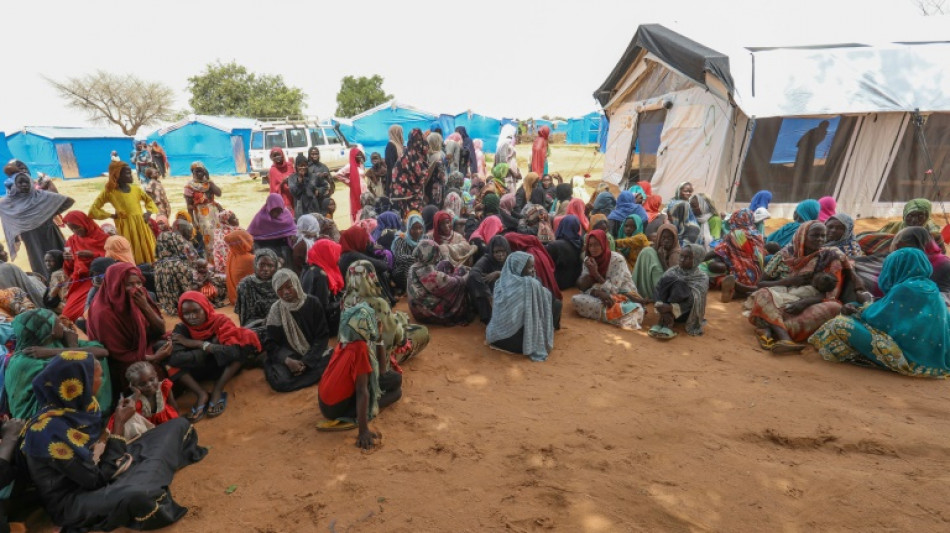
Safe in Chad after fleeing Sudan's horrors, on foot / Photo: © AFP

 USA and France ease into women's Basketball World Cup semis

 ECB lifts borrowing costs amid energy shock, opens door for more hikes

 France defeat China to reach women's basketball World Cup semis
 Tribal Launches Campfire, Letting Business and Technical Teams Build on Salesforce Together

 Yemen's Houthis seize key city on Red Sea

 US producer inflation tops expectations as diesel costs jump

 Rubio ends South America swing with Peru security talks

 Defiant Iran seeks to bruise Trump ahead of midterms

 France withdraws support for Infantino in FIFA presidential election

 Evolution Metals & Technologies Provides Initial Revenue Guidance of $400-460mm for Fiscal Year 2027

 Clark-led USA thrash Hungary to move into women's World Cup semi-finals

 Vance takes spotlight as Republicans close Trump-heavy convention
 Russian skater Valieva loses neutral status

 Will Israel's right exploit sanctions in run-up to vote?

 'Metal Gear' creator moves to Xbox after Playstation cancellation

 Indonesia rescues six orangutans from fires in a week

 Macron urges Europe to develop 'crewed spaceflight' programme
 Deals worth billions to be signed as UAE leader visits Germany

 Alessio Vinassa Unveils an Emerging Technology Investment Approach Shaped by Financial Challenges

 Sri Lanka court revokes monk's pardon, orders return to prison

 'Hopeless, stuck, afraid': US deportees in limbo in Cameroon

 Mount Fuji ends hiking season with landslide, two rescues
 Seahawks beat Patriots again in NFL opener
 Asian Games begin with Qatar basketball win, nine days before opening ceremony

 Stocks sink as oil rally fans inflation and rate hike fears

After hiding at home for weeks, Sudanese refugees evaded militias in Darfur and fled on foot to neighbouring Chad with children on their backs and safety their destination.
Now at Aura camp in Adre, eastern Chad, bordering Sudan's vast western region of Darfur, they shelter in tents supplied by international aid groups.
After four months of a bloody power struggle between Sudan's army and its former ally the paramilitary Rapid Support Forces (RSF), these refugees are among the nearly 430,000 people -- mostly Sudanese women and children -- who have managed to cross the border into Chad.
Hawa Mousa, 30, sits on the earthen floor of the tent, her newborn resting in her lap.
She tells AFP of one day in June when the fighting in West Darfur state was raging. Its governor had been assassinated, and the people feared summary execution by Arab militiamen allied to the RSF.
Mousa and her children slipped away in the middle of the night.
"I was still pregnant then," she said. "I tied my youngest to my back and took the eldest by the hand."
An ethnic conflict is again stalking Darfur.
In 2003, the then-government of Omar al-Bashir in Khartoum unleashed the feared Janjaweed -- forerunners of the RSF -- on ethnic minority rebels and civilians suspected of supporting them.
That conflict killed more than 300,000 people and displaced 2.5 million, the United Nations estimates.
The International Criminal Court charged Bashir and others with war crimes but only one suspect, who surrendered, is on trial.
Now, Arab militias are once more hunting civilians simply because they are non-Arab, according to survivors.
- Wounded on the way -
A quarter of Sudan's 48-million population lived in Darfur, an area the size of France, before the fighting erupted on April 15.
Some of the refugees have now become homeless for a second time after suffering a similar fate in the earlier conflict.
With fears that history is repeating itself, the International Criminal Court is again probing alleged war crimes.
Most of the Aura refugees fled from El Geneina, the capital of West Darfur state where the United Nations has said more than 1,000 people were killed in a few days, attacks which could amount to crimes against humanity.
But that toll is probably far higher, because even more than elsewhere in Sudan, communication links have been cut and news is slow to emerge.
Bodies have been abandoned and left in the streets of now-deserted communities to decompose in the heat.
Human Rights Watch (HRW) and other watchdogs have reported beatings, summary executions, looting and homes and businesses burned to the ground.
"We were told of a route out, but despite that four of us were wounded. We wandered barefoot round El Geneina for seven days," said Souad Ibrahim, 41, speaking through tears as she sat on the sand outside a blue tent.
"We had no water and no food. Even though I was seven months pregnant, I had to carry my four-year-old boy on my back and my girl who is six followed on foot" for the 35-kilometre (20-mile) walk to Adre, she said.
- 'Janjaweed attacked them' -
The journey is particularly dangerous for women, who in addition to militia attacks and stray gunfire also fear rape, a violent tactic used for decades in Sudan.
"Human Rights Watch documented 78 victims, or survivors, of rape between April 24 and June 26" in El Geneina and on the road to Chad, HRW said.
It said the attackers would target women who were of Massalit ethnicity, the non-Arab majority in El Geneina.
Fleeing the awful prospect of rape in their home town also exposed women to other dangers outside El Geneina.
"My wife and children left before me to head for Chad," Adam Haroun told AFP, having now rejoined his family.
"Janjaweed attacked them on the way when they were in a wadi and a bullet hit my wife in the leg," the 39-year-old said.
"Now an aid group is looking after her in a clinic."
Haroun and his family are now safe in Chad across the border from Darfur, but others have not been able to escape.
The fighting is now concentrated around Nyala, the capital of South Darfur state and Sudan's second-largest city.
From Nyala, the nearest safe haven is across the border in South Sudan. And that's a distance of 200 kilometres (124 miles).
B.Shevchenko--BTB