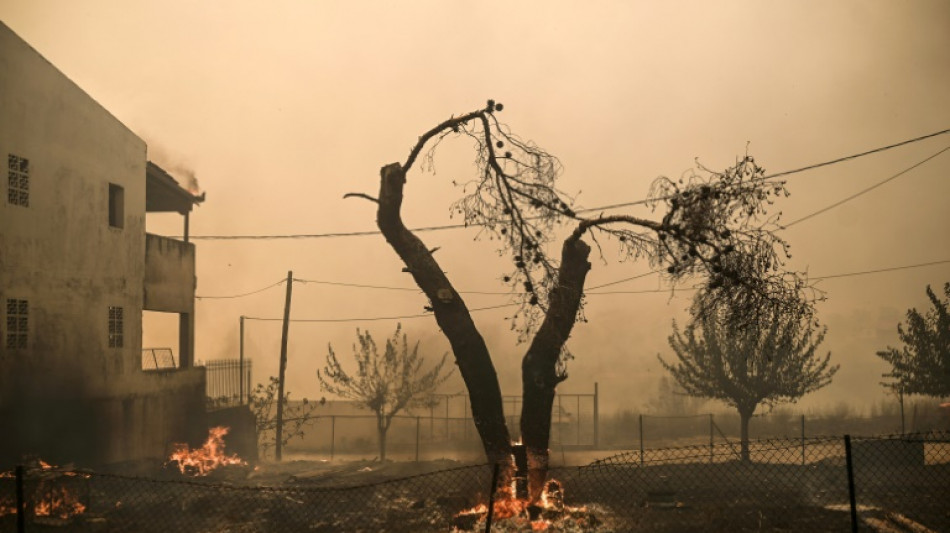
Climate change could bring year-round heatwaves: UN researcher / Photo: © AFP

 USA and France ease into women's Basketball World Cup semis

 ECB lifts borrowing costs amid energy shock, opens door for more hikes

 France defeat China to reach women's basketball World Cup semis

 Tribal Launches Campfire, Letting Business and Technical Teams Build on Salesforce Together

 Yemen's Houthis seize key city on Red Sea

 US producer inflation tops expectations as diesel costs jump
 Rubio ends South America swing with Peru security talks

 Defiant Iran seeks to bruise Trump ahead of midterms

 France withdraws support for Infantino in FIFA presidential election

 Evolution Metals & Technologies Provides Initial Revenue Guidance of $400-460mm for Fiscal Year 2027

 Clark-led USA thrash Hungary to move into women's World Cup semi-finals

 Vance takes spotlight as Republicans close Trump-heavy convention

 Russian skater Valieva loses neutral status

 Will Israel's right exploit sanctions in run-up to vote?

 'Metal Gear' creator moves to Xbox after Playstation cancellation

 Indonesia rescues six orangutans from fires in a week

 Macron urges Europe to develop 'crewed spaceflight' programme

 Deals worth billions to be signed as UAE leader visits Germany

 Alessio Vinassa Unveils an Emerging Technology Investment Approach Shaped by Financial Challenges

 Sri Lanka court revokes monk's pardon, orders return to prison

 'Hopeless, stuck, afraid': US deportees in limbo in Cameroon

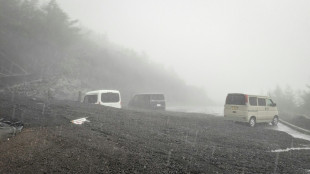 Mount Fuji ends hiking season with landslide, two rescues

 Seahawks beat Patriots again in NFL opener

 Asian Games begin with Qatar basketball win, nine days before opening ceremony

 Stocks sink as oil rally fans inflation and rate hike fears

As Europe and other regions swelter, a UN researcher cautioned that climate change was enabling increasingly intense and long-lasting heatwaves, which in some areas could soon begin to hit year-round.
Extreme heat has dominated the headlines in recent weeks, from the current "heat dome" cooking much of Europe, to heat-fuelled wildfires raging in Greece, Spain, Canada and Hawaii, and soaring temperatures in the middle of the South American winter.
Heatwaves are beginning earlier, lasting longer and becoming more intense, John Nairn, a senior extreme heat advisor at the UN's World Meteorological Organization (WMO), told AFP in an interview.
"It's the most rapidly emerging consequence of global warming that we are seeing in the weather systems," he said, stressing that this was in line with scientific predictions.
"People are far too relaxed about the signs," he lamented.
"The science has been saying this is coming your way. And this is not where it stops."
"It will only get more intense and more frequent."
- 'Parked' heat -
One reason, he explained, was that global warming appears to be leading to a weakening of the global jet streams -- air that flows high in the Earth's atmosphere.
As the jet stream waves grow slower and wavier, they allow weather systems to "become parked" in one spot for longer.
"You can get a summertime situation where you get persistent heatwaves, and the heat just builds and builds and builds, because the wave is not moving on," Nairn said.
If you look at the planet as a whole, he said you could see that "these heatwaves are appearing in each of those same wavelengths around the globe".
"The slowing down and parking of the weather patterns is setting us up so that North America, parts of the Atlantic ocean, Europe and Asia are simultaneously sitting in the (wave) ridges, getting caught."
Heatwaves are among the deadliest natural hazards, with hundreds of thousands of people dying from preventable heat-related causes each year.
- 'More dangerous' -
Nairn called for the conversation around heat to become "smarter".
Among other things, he said, there should be far more focus on rising overnight minimum temperatures than on the maximum day temperatures that grab headlines.
Repeated high nighttime temperatures are particularly dangerous for human health, since the body is unable to recover from the heat it suffers through during the day.
Higher overnight temperatures also mean that the energy accumulated during the day has nowhere to go, pushing temperatures even higher the next day.
The fact that minimum temperatures are rising faster than maximums is thus pushing excess energy "into longer periods of higher temperatures", Nairn said.
"It's cumulative... So heatwaves are becoming much more dangerous."
And as the climate continues to change, the situation is due to get worse, Nairn said.
He voiced particular concern over the situation in the tropics and subtropics, pointing to the record heat seen in South America, with temperatures up towards 40 degrees Celsius in the middle of what is supposed to be their winter.
Looking forward, he cautioned that "we're going to see a lot more heatwaves across a much longer period of the year".
In the tropics and subtropics, "unfortunately, the indications are that severe and extreme heatwaves are likely to be able to occur anytime (of year) before the end of the century".
Less sunlight means year-round extreme heatwaves are not expected at other latitudes, but Nairn stressed that there too we will be seeing more "unseasonably warm periods" even in winter.
Asked what could be done to rein in the rampant heat, Nairn stressed that "all of us have the capabilities to actually turn this around".
"We need to electrify everything... and stop burning fossil fuels. It's not harder than that."
F.Müller--BTB