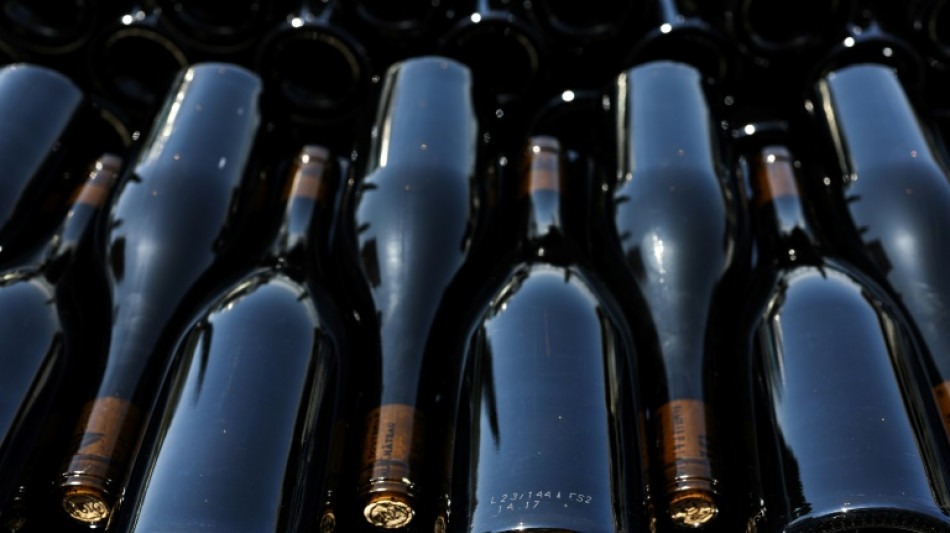
France, EU to spend 200 mn euros on destroying excess wine / Photo: © AFP

 F1 drivers expecting crashes, chaos at new Spanish GP circuit

 NGO chief sees 'hypocrisy' in Afghan women's rights calls amid aid cuts

 Latin America could see fresh disinformation after Meta changes

 UAE to invest 40 billion euros in Germany, including for data centres: Berlin

 2030 Winter Olympics chief Grospiron quits

 AI Risks to Enter 60–80% of Liability and Cyber Insurance Underwriting by 2028, ScienceSoft Predicts

 Ultimate Championship as big as Olympics - and more lucrative, says Bolt

 Diana's 'revenge dress' to go up for auction in New York
 England dominate Pakistan, close in on Test series sweep

 Russia trafficking foreigners to fight in Ukraine, Amnesty says

 Global Tokenized Real Estate Market to Hit up to $3 Trillion by 2030, ScienceSoft Predicts

 Stocks fall as fresh oil surge fans inflation fears
 August hottest month ever recorded globally as huge El Nino emerges

 'Bragging rights' up for grabs at game-changing Ultimate Championship, says Coe

 ECB hikes borrowing costs to combat Mideast energy shock
 England turn screw in 3rd Test against Pakistan

 France will not support Infantino in FIFA election: federation chief

 In their words: Israeli forces describe AI-backed Gaza killing in new film

 Yemen's Houthis seize key city on Red Sea: military source

 Oil prices extend gains as markets await ECB rate outlook

 Wars pose a test as India hosts BRICS summit with China, Russia, Iran leaders

 Messi to buy second Spanish lower league club

 Pochettino calls for Chelsea to lose 2016-17 Premier League title
 North Korea leader's daughter believed to have younger sibling: Seoul

 Wars pose a test as India hosts BRICS summit with Russia, Iran leaders

The French government announced Friday that 200 million euros ($216 million) would be set aside to fund the destruction of surplus wine production in a bid to support struggling producers and shore up prices.
Several major wine-producing regions in France, particularly the famed Bordeaux area, are struggling because of a cocktail of problems from changes in consumption habits, the cost-of-living crisis and the after-effects of Covid-19.
A fall in demand for wine has led to over-production, a sharp fall in prices, and major financial difficulties for up to one in three wine makers in the Bordeaux region, according to the local farmers' association.
An initial European Union fund of 160 million euros for wine destruction has been topped up to 200 million euros by the French government, Agriculture Minister Marc Fesneau told reporters at a press conference on Friday.
The money was "aimed at stopping prices collapsing and so that wine-makers can find sources of revenue again," but he stressed that the industry needed to "look to the future, think about consumer changes ... and adapt."
The southwest Languedoc region, the country's largest wine area known for its full-bodied reds, has also been hit hard by the fall in wine demand.
The alcohol from destroyed wine can be sold to companies for use in non-food products such as hand sanitiser, cleaning products, or perfume.
"We're producing too much, and the sale price is below the production price, so we're losing money," Jean-Philippe Granier from the Languedoc wine producers' association told AFP earlier this month.
The agriculture ministry also announced 57 million euros in June to fund the pulling up of around 9,500 hectares of vines in the Bordeaux region, while other public funds are available to encourage grape-growers to switch into other products, such as olives.
- Output up, sales down -
Europe last suffered a so-called "wine lake" in the mid-2000s, which forced the European Union to reform its farm policy to reduce the massive overproduction of wine which was being stimulated by its own subsidies.
The 27-member bloc still spends 1.06 billion euros annually on the sector, according to EU figures.
As well as a long-term trend of consumers switching into beer and other alcohols, the industry was badly hit by the Covid-19 crisis which shut restaurants and bars worldwide, leading to a sharp fall in sales.
Recent rises in the price of food and fuel, linked to rocketing global energy prices and the invasion of Ukraine, have also seen buyers reduce their spending on non-essential goods such as wine.
While approving emergency help for the sector in June, the European Commission said that wine consumption for the current year was estimated to have fallen 7 percent in Italy, 10 percent in Spain, 15 percent in France, 22 percent in Germany and 34 percent in Portugal.
Wine production in the bloc, the world's biggest wine-making area, rose 4.0 percent.
The Commission said the worst affected vineyards were those producing red and rose wines from certain regions of France, Spain and Portugal.
B.Shevchenko--BTB