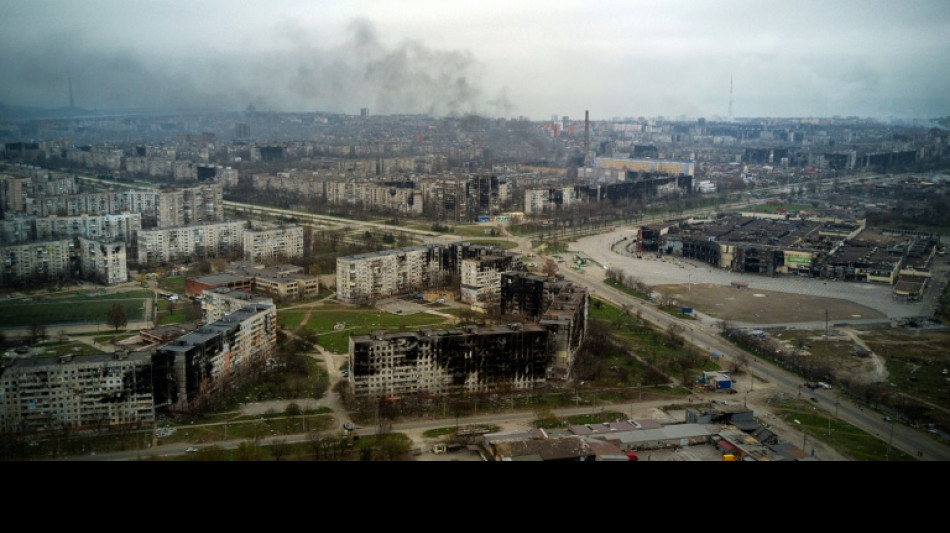
Mariupol's tunnel warriors seek to slow Russian onslaught / Photo: © AFP

 Huge questions loom over Prince Harry's shock return to UK

 BYDFi Joins Coinfest Asia 2026, Connecting with Institutions, Builders and Traders in Bali

 Max Verstappen: Natural-born winner
 Van Dijk urges Liverpool to make amends for 'unacceptable' season

 All Blacks replace Tuipulotu with Holland for Springboks Test

 Rain delays start of second day's play in England-Pakistan opener

 Russian strikes kill 16 in Kyiv, surrounding region

 'It is tough': Indonesia battles wildfires, bracing for worse to come

 Seoul detects North Korean missile launches after Trump says to meet Kim

 Thai, Myanmar military chiefs meet as post-coup thaw progresses
 Asian stocks rally as US Treasury steps in to ease bond fears

 Verstappen signs new Red Bull contract until 2030: team

 What property giant Evergrande's sentence means for China's economy

 Australian prosecutors demand life in prison for mushroom killer
 Fallout far-reaching for Australian Rules after latest scandal

 Rafts on Rome's Tiber River cool down overheated tourists

 Top seeds Sabalenka, Zverev stunned in Cincinnati fourth round

 Australia says relations with Israel 'difficult' after aid worker death

 PSG start Ligue 1 defence with eye on Champions League hat-trick

 Arsenal can become world's best club: Arteta
 Japan's King Kazu, 59, scores twice from spot to make cup history

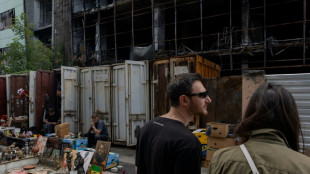 Kyiv's desperate vendors persevere outside obliterated flea market

 Australia races to shield little penguins from H5N1 bird flu

 Messi scores first goal since father's death

 US national debt exceeds $40 trillion for first time

As Russian forces close in on the southern Ukrainian port city of Mariupol, a small number of resistance fighters hope to slow them down using a tunnel system below a vast industrial site as their base.
Experts say the fall of the city, seen as strategically vital for Russian plans to attack eastern Ukraine, is inevitable.
But holdouts in their underground bases hope to make conquering the Sea of Azov port as hard as possible for the attackers.
The urban landscape where the Ukrainian resistance plans to take on the invaders seems almost tailor-made for guerrilla warfare, with sprawling rail lines, warehouses, coal furnaces, factories, chimneys and tunnels.
The maze-like area is a metal works complex, Azovstal, owned by Metinvest, which is run by Ukraine's richest man Rinat Akhmetov.
It has been the focus of urban fighting in Mariupol, just like the nearby Azovmash factory which makes rail components, cranes and other large metal structures.
"It's a city within a city," said Eduard Basurin, a representative for pro-Russian separatists in the eastern Donetsk region.
"There are several underground levels that date back to Soviet times which you can't bombard from above. You have to go underground to clean them out, and that will take time."
Entering the tunnels would be all but impossible for Russian troops, according to Alexander Grinberg, analyst at the Jerusalem Institute for Strategy and Security.
- 'They can try' -
"They can try, but they'll be slaughtered because the defenders of the tunnel will absolutely have the tactical upper hand," he told AFP.
Fighters have in the past used tunnel systems to great effect in their struggle against superior forces.
The Viet Cong made the vast Cu Chi tunnel system near Saigon a base for attacks against US troops and Hamas has used tunnels in their fight against the Israeli army.
The Islamic State group's tunnel system in Mosul, Iraq, allowed its fighters to surprise American troops with sudden appearances seemingly out of nowhere.
But the most memorable example dates back to World War II and the battle of Stalingrad with its fierce fighting in the Red October industrial complex.
"The Soviets used underground passages, sewers and tunnels to get behind German lines," a French military source told AFP.
A sapper unit discovered a former factory used by German troops, stacked three tonnes of explosives underneath and blew up the entire complex, burying the Germans in the rubble, the source said.
The astute use of tunnels has lost none of its effectiveness in the 80 years since, rendering enemy artillery, air strikes and snipers virtually useless.
Satellite surveillance is also of limited use against combatants hiding below ground, as is technical intelligence, the spying on enemy weapons.
However, as analysts point out, the underground system only works if the network is vast and fighters have enough ammunition, food and water, which requires meticulous advance planning.
Soldiers deployed underground also need extremely good training to be operational in this unusual combat environment, said James Rands at British defence intelligence specialists Janes.
- 'Inherent dangers' -
"The enclosed spaces mean engagements occur at shorter ranges, limiting the effectiveness of some small arms," he said.
Close-range use of weapons also carries "a significant risk of tunnel collapse and inherent dangers to the forces employing them", he said.
In addition, commanding troops underground is difficult because standard communications do not work well, and tunnel networks are not usually well mapped, he said.
The evacuation of wounded soldiers is also very cumbersome, Rands added.
Despite all the advantages for the defenders, the tunnel network can possibly still be taken if, as is likely, the Ukrainians lack key equipment in sufficient quantity, such as night-vision gear, analysts said.
It may also be difficult to counter the potential use by the Russians of large quantities of water to flood the tunnels, or of gas or chemical products to force the Ukrainians to the surface.
Although Russian President Vladimir Putin said Tuesday that Russia was pursuing its Ukraine operation "calmly", there is a chance that the tunnel wars will be anything but -- and last for some time.
F.Pavlenko--BTB