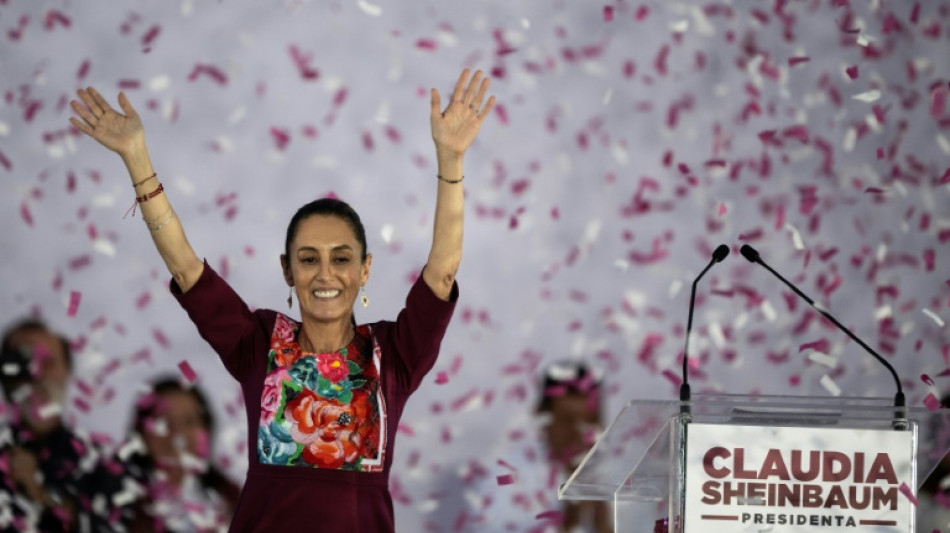
What's behind Claudia Sheinbaum's election victory? / Photo: © AFP/File

 Latest developments on Europe's heatwave

 Keir Starmer: downfall of UK's unpopular PM

 MEXC Lists Arcium (ARX) with 70,000 USDT in Airdrop+ Rewards

 Europe scorched by latest heatwave

 UK's Starmer resigns as prime minister

 Rightist leaders congratulate Colombian president-elect

 Kenya labour minister accused over Russian forced recruitment

 Some France schools closed for day of searing heat

 Frankfurt to All Blacks: New Zealand pick first German-born player

 Ageless Messi has World Cup scoring record in his sights

 Trump-backed populist wins razor-tight Colombia vote, sparking protests

 'Progress', say mediators, after Iran-US talks towards ending war

 European countries close schools, cancel trains as heatwave set to intensify

 'Progress', say mediators, after Iran-US talks on ending war

 Clark wins despite hecklers but hopes not to be 'heel of the PGA'

 Father's Day near-miss at US Open brings Burns to tears

 Scheffler praises Clark's resolve in gutsy US Open triumph

 Cape Verde fight back for second World Cup draw against Uruguay

 Ore Energy and Budget Thuis to Deploy 1 GWh of Multi-Day Iron-Air Energy Storage in a First for European Energy Suppliers

 Iran-US talks to continue through the night
 Clark edges Burns by one stroke for second US Open title

 Curacao firmly on the map after World Cup heroics
 Trump say repairs to begin 'immediately' for Washington pool renovation

 Rune 'not ready' to put a date on tennis return

 Polls close in Colombia runoff pitting pro-Trump hardliner against leftist

Former Mexico City mayor Claudia Sheinbaum became the first woman to be elected president of the Latin American nation on Monday.
In October, the 61-year-old will replace President Andres Manuel Lopez Obrador, who enjoys an approval rating of more than 60 percent, largely thanks to his social programs for poorer Mexicans.
Here are some of the keys to Sheinbaum's victory, according to analysts.
- Intelligence, experience -
Sheinbaum is a pragmatic scientist by training who had several crises thrown at her as both a local politician and Mexico City mayor, including a devastating earthquake, the Covid-19 pandemic and a deadly metro accident.
Supporters and critics alike recognize her intelligence and commitment to the left-wing ideals at the center of Lopez Obrador's reform agenda.
Sheinbaum's popularity "can in part be attributed to her intelligence and sharpness, her commitment to popular issues such as renewable energy and education, and her experience in leading Mexico City's government," said Michael Shifter, an expert at the Inter-American Dialogue think tank in Washington.
- Loyalty to Lopez Obrador -
Sheinbaum repeatedly told voters that she would follow the same path as Lopez Obrador, an anti-establishment leftist who won a landslide victory in 2018 in a country fed up with corruption, crime and poverty.
"It was an easy-to-understand, strong message that, through repetition and discipline, really managed to get through," said academic Carlos Bravo Regidor.
Sheinbaum also benefited from the extensive network of the ruling Morena party, as well as the support of state machinery.
Since decades of dominance by the Institutional Revolutionary Party ended in 2000, "Morena has probably become the most successful party model at the national level," said Gustavo Urbina, an academic at the College of Mexico.
But it is premature to talk about a new era of hegemony, experts said.
Founded in 2014, Morena is still a young party whose strength has been largely based on loyalty to Lopez Obrador, widely known by his initials AMLO.
"The president continues to fulfill a symbolic, moral and decision-making role that is fundamental," Urbina said.
While Sheinbaum won an internal party poll to represent Morena, she was always seen as the outgoing president's favorite.
"AMLO supporters trust his judgement and have rallied around his handpicked successor," Shifter said.
- Unpopular opposition -
The unpopularity of the traditional Mexican parties -- the centrist PRI, the right-wing PAN and the leftist PRD -- was a major disadvantage for the main opposition candidate, Xochitl Galvez.
"They have a very bad reputation," Bravo Regidor said.
"That was a burden that greatly hindered Xochitl's potential," he added.
In contrast, Morena, of which Lopez Obrador and Sheinbaum are co-founders, is seen more positively by voters as "relatively new and different," Bravo Regidor said.
The opposition's "big mistake" was not paying attention to the "real, current and genuine discontent" of many Mexicans, said writer and analyst Jorge Zepeda Patterson.
Instead, Lopez Obrador's opponents sought to underline problems such as violence or difficulties accessing healthcare.
Faced with such an approach, "people will say, 'maybe, but at least they're trying,' while the traditional parties don't even try," Zepeda Patterson said.
E.Schubert--BTB