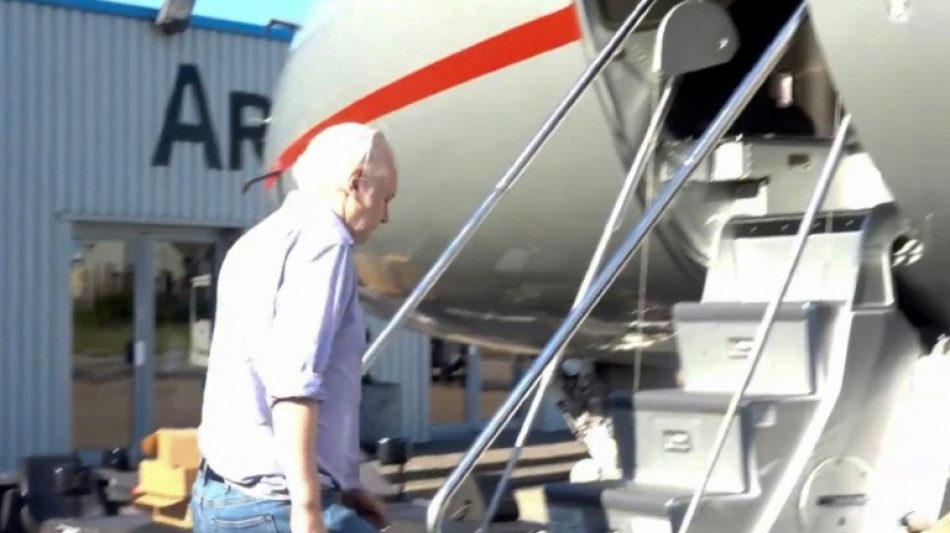
Unseen diplomatic manoeuvres helped unlock Assange deal / Photo: © WikiLeaks/AFP

 Inside the Venezuelan prison meant to 'drive you insane'

 UK king braces as memoir by Diana's brother goes on sale

 No green light to lift EU sanctions on Russian oligarchs, talks to resume

 UK agrees support for Saudi in struggle with Houthis: reports

 EU foreign policy chief calls for continued sanctions on Russia

 Flights scrapped, evacuations urged as Typhoon Dujuan wallops Japan

 Fonseca to take break from tennis

 A Cuban zoo, and its animals, in epic battle for survival

 Infantino proposes consulting federations to reform FIFA

 El Nino weather pattern enters record territory: scientist
 OpenAI calls for US to lead global effort on AI standards

 South African ostriches plucked alive for luxury fashion: report
 US networks halt Trump coverage in revolt over White House ban

 Paramount settles with US states to clear Warner Bros. mega-merger
 Climate crisis a job for world leaders, not just activists: UK FM

 US networks halt Trump coverage over White House ban
 French singer accuses Miley Cyrus of plagiarism

 EU fines Google 403 mn euros for location data breach

 'Best is yet to come,' says De la Fuente after Spain extension

 Why diesel prices are rising more than crude oil

 COP31 host says AI's climate footprint to be a summit priority

 Renewables hit record in 2025, but world must move faster: report
 US media outlets to sue Trump administration after White House ban
 Global stocks rally on lower oil prices, US-China hopes

 EU proposes energy rating for data centres
Behind closed doors, an Australia-US-UK diplomatic dance opened the way for a plea deal to free WikiLeaks founder Julian Assange, analysts and a diplomat previously involved in the case told AFP.
The 52-year-old Australian citizen walked out of his five-year visit to London's high-security Belmarsh prison on Monday after agreeing to plead guilty to a single count of revealing US national defence secrets.
Assange's release had been under discussion "for a little while now", said Jared Mondschein, director of research at the University of Sydney's United States Studies Centre.
"It's been a few months in the making," he told AFP on Tuesday.
US Ambassador to Australia Caroline Kennedy -- late president John F. Kennedy's daughter -- "has been talking about this in the last few months," Mondschein said.
"She was flagging there is a way to resolve this."
Under the plea agreement, Assange is flying from London to Saipan, capital of the Pacific US territory of Northern Mariana Islands, for a Wednesday morning court appearance.
He is expected to be sentenced to five years and two months in prison, with credit for the same amount of time spent behind bars in Britain -- allowing him to return to his native Australia.
The United States did not want to drop the charges, Mondschein said.
- 'Winds were shifting' -
"They wanted him to plead guilty and they had to figure out how to do that without being in the United States," he added.
"With that all said, it is not a fully done deal. It appears they have come to a plea deal but if there is anything we have learned in this long saga now, we should not make assumptions and see where we land in 24 to 48 hours."
The tide shifted strongly in Assange's favour after Prime Minister Anthony Albanese was elected in May 2022 and made his release a priority, said a diplomat who did not want to be named so that they could speak freely.
Assange and his family had been advised previously that he should plead guilty and strike a deal because it would be difficult for the United States to drop the charges, said the diplomat, who worked on the case several years ago.
"The political winds were shifting and that also played a role in convincing people in the US that this had to be dealt with more urgently than it would have otherwise," the diplomat told AFP.
Australian Prime Minister Anthony Albanese has repeatedly called for an end to Assange's legal ordeal, saying: "Enough is enough".
The country's parliament even passed a motion this year with the prime minister's support, calling for Assange to be allowed to return to his family.
The government had been working "behind the scenes diplomatically" with the US administration to advocate for his release, said Emma Shortis, senior researcher in international and security affairs at The Australia Institute thinktank.
- 'Clear threat' -
"I think part of the reason this has happened today is because it was becoming a significant issue for the relationship," Shortis told AFP, notably since London, Washington and Canberra agreed on a nuclear-powered submarine pact, AUKUS.
"To be told fairly consistently that Australia's relationship with the United States is based on shared democratic values served the argument that the AUKUS submarine deal is critical to that relationship," Shortis said.
"And then to have the Assange case alongside that, with its clear threat to international free speech rights, was just really irreconcilable."
Johan Lidberg, head of journalism at Monash University, noted that US President Joe Biden had let slip in April that his administration was "considering" an Australian request to drop the Assange prosecution.
"I think the momentum just built to a point where both sides -- both Australia and the US, partly with the aid of the intermediary of the UK -- were trying to find a way out of it," Lidberg said.
All sides were seeking to back out of "this stalemate that wasn't really going anywhere -- and no one was really benefiting from it."
D.Schneider--BTB