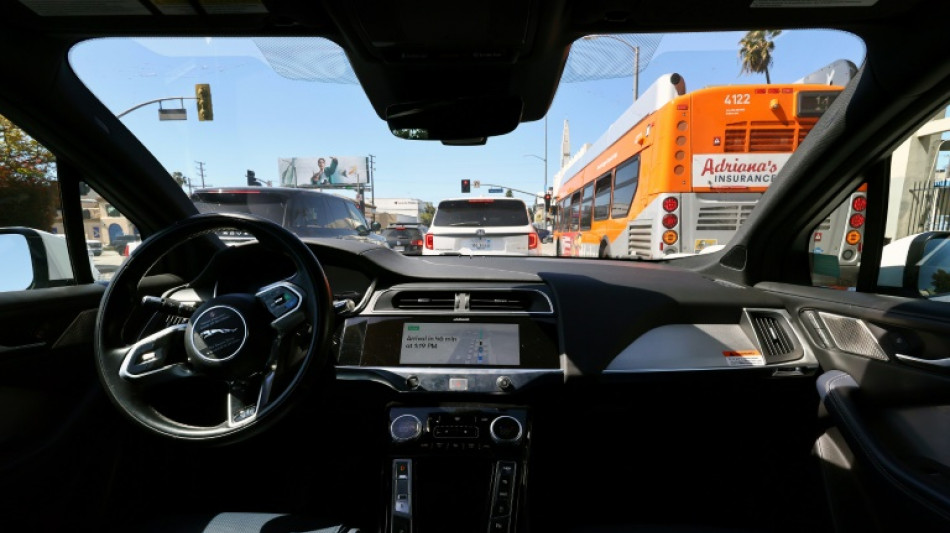
Autonomous car rules advancing faster than the vehicles themselves: UN / Photo: © GETTY IMAGES NORTH AMERICA/AFP

 Rams bounce back as Giants reel from Dart injury

 In Bangladesh, Pakistan's Jinnah photo stirs anger

 Two New Zealand naval ships transit Taiwan Strait

 Zidane gets down to work as France start new era

 Inside the Venezuelan prison meant to 'drive you insane'

 UK king braces as memoir by Diana's brother goes on sale

 No green light to lift EU sanctions on Russian oligarchs, talks to resume

 UK agrees support for Saudi in struggle with Houthis: reports

 EU foreign policy chief calls for continued sanctions on Russia

 Flights scrapped, evacuations urged as Typhoon Dujuan wallops Japan

 Fonseca to take break from tennis

 A Cuban zoo, and its animals, in epic battle for survival

 Infantino proposes consulting federations to reform FIFA

 El Nino weather pattern enters record territory: scientist

 OpenAI calls for US to lead global effort on AI standards

 South African ostriches plucked alive for luxury fashion: report

 US networks halt Trump coverage in revolt over White House ban

 Paramount settles with US states to clear Warner Bros. mega-merger

 Climate crisis a job for world leaders, not just activists: UK FM

 US networks halt Trump coverage over White House ban

 French singer accuses Miley Cyrus of plagiarism

 EU fines Google 403 mn euros for location data breach

 'Best is yet to come,' says De la Fuente after Spain extension

 Why diesel prices are rising more than crude oil

 COP31 host says AI's climate footprint to be a summit priority

Fully autonomous cars are still years away from hitting the streets, but internationally-agreed rules on their use could be ready by mid-2026, the United Nations has said.
Safety concerns and the cost of developing next-level systems have slowed down progress on autonomous vehicles, but work on regulations is motoring ahead, said the UN.
"While the hype may be slowly disappearing, the actual serious work on regulation is advancing," UNECE agency's deputy executive secretary Dmitry Mariyasin told reporters.
Established in 1952, the World Forum for Harmonisation of Vehicle Regulations meets three times a year, bringing together countries, carmakers and technology giants. This week's gathering in Geneva is the main annual session.
The forum takes place under UNECE, the UN Economic Commission for Europe, which shapes the legal framework for inland transport.
- Rules of the road -
Richard Damm, chair of the Working Party on Automated/Autonomous and Connected Vehicles (GRVA), said new UN regulations for driver control assistance systems were adopted in February and would come into force in September.
Furthermore, "we are planning to have a globally harmonised regulation on Automated Driving Systems (ADS) ready for mid-2026", he said.
Unlike some fields where regulation comes long after the roll-out of new technology, GRVA secretary Francois Guichard said getting the rules settled first was in line with previous advances in motoring.
He said regulations for electric vehicles was ready before they hit the market, and the framework is also now in place for hydrogen vehicles, should the industry move towards mass production.
- Five levels -
There are five levels of automation, with the lower levels already becoming commonplace.
At Level 2, drivers are expected to keep their attention on traffic.
At Level 3, the driver is not driving when the automated systems are engaged, but can step in at any time and must take over at the system's request.
At Level 4, a driver need not be ready to intervene quickly, at least in limited areas, while Level 5 vehicles are fully autonomous.
Guichard said Level 1 and 2 technology was probably in half of all new vehicles; "Level 3 is still rare, and Level 4 doesn't exist for sale as a mass production product", he said.
Damm said the systems on Levels 3 and 4 were "much more costly", so deeper driver assistance technology at Level 2 is likely to come first, as a bridge towards the next levels.
- Road safety -
"Is there a future for autonomous cars? I can clearly answer this with a 'yes'," said Damm.
"This technology will come, and it's partly on the road, even if it's not penetrating the mass market yet. It is still some years ahead before we see it in the mass market, because we have to resolve several issues."
Public safety concerns remain the top priority in setting the regulatory framework.
There are approximately 1.2 million road traffic deaths per year, with a further 50 million people injured.
"We don't know yet whether autonomous vehicles will be more of a problem or more of a solution," said Mariyasin.
K.Thomson--BTB