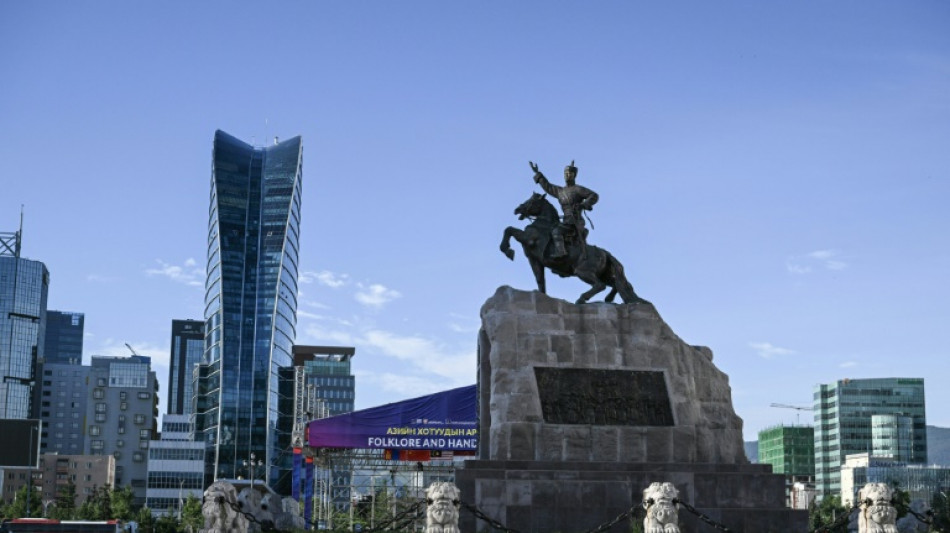
Five things to know about Mongolia / Photo: © AFP

 Rams bounce back as Giants reel from Dart injury
 In Bangladesh, Pakistan's Jinnah photo stirs anger

 Two New Zealand naval ships transit Taiwan Strait

 Zidane gets down to work as France start new era
 Inside the Venezuelan prison meant to 'drive you insane'
 UK king braces as memoir by Diana's brother goes on sale
 No green light to lift EU sanctions on Russian oligarchs, talks to resume
 UK agrees support for Saudi in struggle with Houthis: reports
 EU foreign policy chief calls for continued sanctions on Russia

 Flights scrapped, evacuations urged as Typhoon Dujuan wallops Japan
 Fonseca to take break from tennis
 A Cuban zoo, and its animals, in epic battle for survival
 Infantino proposes consulting federations to reform FIFA
 El Nino weather pattern enters record territory: scientist
 OpenAI calls for US to lead global effort on AI standards
 South African ostriches plucked alive for luxury fashion: report
 US networks halt Trump coverage in revolt over White House ban
 Paramount settles with US states to clear Warner Bros. mega-merger
 Climate crisis a job for world leaders, not just activists: UK FM
 US networks halt Trump coverage over White House ban
 French singer accuses Miley Cyrus of plagiarism
 EU fines Google 403 mn euros for location data breach
 'Best is yet to come,' says De la Fuente after Spain extension
 Why diesel prices are rising more than crude oil
 COP31 host says AI's climate footprint to be a summit priority
Mongolians go to the polls Friday in parliamentary elections, with the ruling Mongolian People's Party widely expected to retain its majority despite public discontent over corruption.
Here are five things to know about Mongolia:
- China's democratic neighbour -
Landlocked Mongolia is sandwiched between Russia and China, the latter being its close economic partner.
Unlike its massive neighbours, Mongolia is democratically governed, with the US-based advocacy group Freedom House describing the country's political system as "free" -- albeit saddled with widespread corruption.
Mongolia's head of state is President Ukhnaagiin Khurelsukh, a former prime minister and member of the ruling party, elected to his current office in 2021.
Head of the government is Prime Minister Luvsannamsrain Oyun-Erdene, a 43-year-old Harvard graduate who also serves as chairman of the Mongolian People's Party.
Despite their differences, Ulaanbaatar has been careful not to upset the regional powers.
Eighty-six percent of Mongolia's total exports go to China, half of which is coal.
And Mongolia is among a handful of countries that have not explicitly condemned Russia's invasion of Ukraine.
- Mineral-rich -
Traditionally dependent on agriculture, the country has experienced rapid economic growth on the back of a mining boom.
Profits from coal made up a quarter of Mongolia's gross domestic product in 2022.
Mongolia is also a major exporter of copper and iron ore, as well as having rich deposits of uranium.
Its capital Ulaanbaatar's population has quadrupled since the 1990s, with skyscrapers sprouting up across the sprawling city.
But poverty reduction in the middle-income country has stalled in recent years and economic inequality remains high.
The women's employment rate has dropped from 72 percent in 1992 to 53 percent, largely due to a lack of childcare options.
And the mining boom and other factors has made Ulaanbaatar often one of the most polluted capitals on the planet.
- Endemic corruption -
The governing party has promised to crack down on corruption since unrest in late 2022, when hundreds took to the streets of Ulaanbaatar to protest against "coal theft" by officials linked to state mining firms.
But under its rule, Mongolia has plummeted in Transparency International's Corruption Perceptions Index.
Public officials are frequently accused of seeking to profit from their positions and often face criminal investigations.
In March, the United States said it would attempt to seize two luxury apartments in New York owned by former prime minister Sukhbaatar Batbold that it said were bought with the proceeds of a corrupt scheme.
- Communist past -
The once-Communist nation enshrined its first democratic constitution in 1992, when it emerged from the Soviet orbit after a popular revolution two years earlier.
It is still heavily reliant on Russian fuel, and nostalgia for Soviet times remains strong in some quarters.
But the country has sought to distance itself from its recent past, tearing down statues of Stalin and Lenin and instead turning to celebrations of Genghis Khan, who led history's largest contiguous land empire in the 13th century.
Mongolia's government adopted the Cyrillic alphabet eight decades ago when it was ruled by the Soviet-dominated regime, but now it is also backing the revival of the traditional Hudum script following a surge of interest in the nation's cultural heritage.
- Vast grasslands -
The country's landscape is dominated by high-altitude grasslands and populated by 3.4 million residents spread across an area three times the size of France.
Its people have historically been nomadic, with a third of the population still living in communities characterised by portable yurt dwellings.
Mongolia's steppes are home to the rare Przewalski's horse, an ancient equine subspecies brought back in recent years from the brink of extinction through breeding programmes at zoos worldwide.
M.Odermatt--BTB