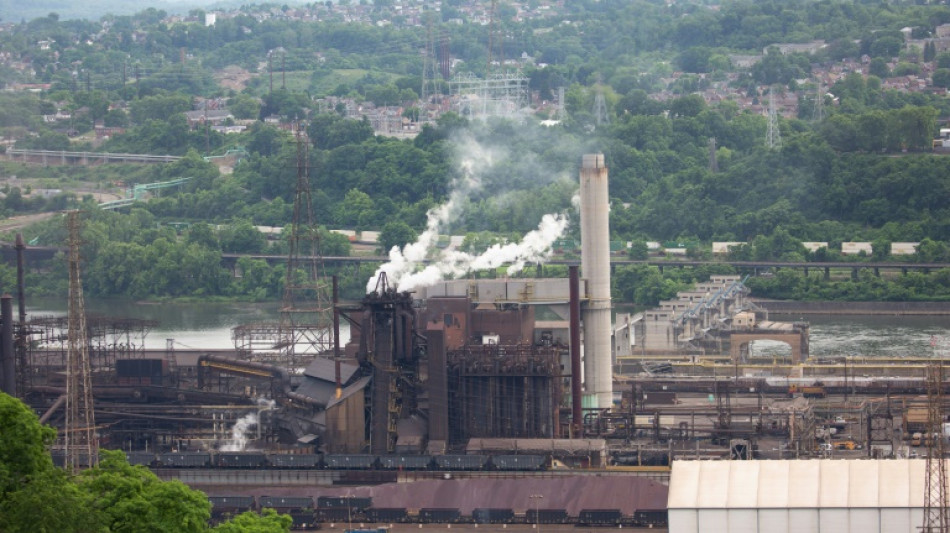
Nippon Steel fight points to industry's uncertain future in Pennsylvania / Photo: © AFP

 Rams bounce back as Giants reel from Dart injury

 In Bangladesh, Pakistan's Jinnah photo stirs anger

 Two New Zealand naval ships transit Taiwan Strait

 Zidane gets down to work as France start new era

 Inside the Venezuelan prison meant to 'drive you insane'

 UK king braces as memoir by Diana's brother goes on sale

 No green light to lift EU sanctions on Russian oligarchs, talks to resume

 UK agrees support for Saudi in struggle with Houthis: reports

 EU foreign policy chief calls for continued sanctions on Russia

 Flights scrapped, evacuations urged as Typhoon Dujuan wallops Japan

 Fonseca to take break from tennis

 A Cuban zoo, and its animals, in epic battle for survival

 Infantino proposes consulting federations to reform FIFA

 El Nino weather pattern enters record territory: scientist
 OpenAI calls for US to lead global effort on AI standards
 South African ostriches plucked alive for luxury fashion: report
 US networks halt Trump coverage in revolt over White House ban

 Paramount settles with US states to clear Warner Bros. mega-merger
 Climate crisis a job for world leaders, not just activists: UK FM
 US networks halt Trump coverage over White House ban

 French singer accuses Miley Cyrus of plagiarism

 EU fines Google 403 mn euros for location data breach

 'Best is yet to come,' says De la Fuente after Spain extension

 Why diesel prices are rising more than crude oil

 COP31 host says AI's climate footprint to be a summit priority
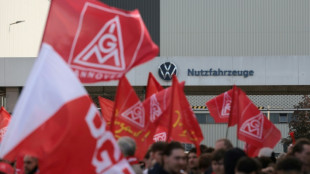
Nippon Steel's proposed acquisition of United States Steel has been a source of unease in Pittsburgh, where the metal once dominated the economy and still looms large in the collective psyche.
Critics such as the United Steelworkers (USW) see the transaction as the latest threat to come along in a years-long struggle to keep the industry alive after plant closures in 1970s and 1980s battered the American rustbelt.
"There's just so much history here and a lot of pride that comes with that," said the USW's Bernie Hall, a 4th generation metals worker. "It wouldn't be western Pennsylvania without steel."
In December, US Steel sealed a $14.9 billion deal to sell itself to Japan's Nippon Steel, which has promised investments to keep Pennsylvania factories competitive with foreign producers and newer "mini mills" in the American South that are less taxing on the environment.
But Hall, head of the Pennsylvania chapter for the USW, said the Japanese company had been evasive about specific plans for Pittsburgh-region plants in an area called the Mon Valley, the earliest of which dates to 1875.
Both President Joe Biden and challenger Donald Trump have vowed to annul the deal as the two compete for blue-collar votes, putting the transaction into limbo, probably until after the November election at least.
At stake are the Pittsburgh region's last remaining steel factories, located just outside the city.
- City transformed -
For most Americans, Pittsburgh remains virtually synonymous with steel, partly owing to the prominence of the Pittsburgh Steelers American football team.
But the complexion of a metropolis once known as the Smoky City changed fundamentally after the last plants shuttered in the 1980s.
Steel "is still part of our identity, but we're disconnected from that identity," said former steelworker Edward Stankowski Jr., whose memoir "Memory of Steel" details his exit from the industry with thousands of others in the early 1980s.
Stankowski, whose childhood Pittsburgh home looked out onto steel plants, started in the industry out of high school in the 1970s when many young men viewed the job as a ticket to the middle class, trading hard labor in a hazardous setting for good wages and a solid retirement.
The land where Stankowski's factory once stood in Pittsburgh's South Side has been repurposed and now includes apartments named "Hot Metal Flats" and a Cheesecake Factory restaurant.
"I do not miss it," said Stankowski, who went to university after leaving steel and is now a professor at La Roche University. "I like having clean air. I like having clean water."
Steel was well suited to western Pennsylvania, a region with waterways and an abundant supply of coal, but "there's been a fundamental, almost tectonic shift in the geography of steel," said regional economist Chris Briem of the University of Pittsburgh.
The Mon Valley plants "have been around a long time," Briem said. "If they don't get a lot of new reinvestment, they probably won't be competitive much longer."
Locals see symbolism in the renaming of US Steel tower downtown as the UPMC building after the region's biggest employer, the University of Pittsburgh Medical Center.
- Long-term commitment? -
Once owned by Andrew Carnegie, the Edgar Thomson plant in Braddock is one of three western Pennsylvania factories that US Steel manages together with a fourth plant in eastern Pennsylvania in an operation known as "Mon Valley Works."
Nippon has promised to keep the plants open and invest $1.4 billion in USW-represented facilities through 2026 when the current labor contract expires. The company has also vowed to keep US Steel's 1,000-worker office in downtown Pittsburgh.
"You cannot tell the story of US Steel without Pennsylvania playing a leading role, and Nippon Steel will keep it that way," Nippon vice chairman Takahiro Mori wrote in a June 9 op ed in the Pittsburgh Post Gazette.
Nippon has hinted that odds for US approval could improve after November. Backers of the transaction argue that US Steel could be broken up if the deal dies, adding more uncertainty to US Steel's 3,000 hourly workers in Pennsylvania.
But the USW says Nippon's plans are vague and give the company an out in a downturn.
"They're saying they're going to invest in the plants," Hall said. "What does that mean?"
Workers want a sign that whoever runs Mon Valley "is interested in running these mills for the long-term and really investing in this community," Hall said. "That's exactly what they're not hearing from either Nippon or US Steel."
Some Mon Valley workers interviewed by AFP slammed the deal as a money grab by US Steel management, expressing fear about their jobs. But others are open to it.
Alex Barna, a machinist at the West Mifflin plan, described himself as "on the fence" as he weighs his hopes and worries, saying of Nippon, "they might be in it for the long haul."
N.Fournier--BTB
