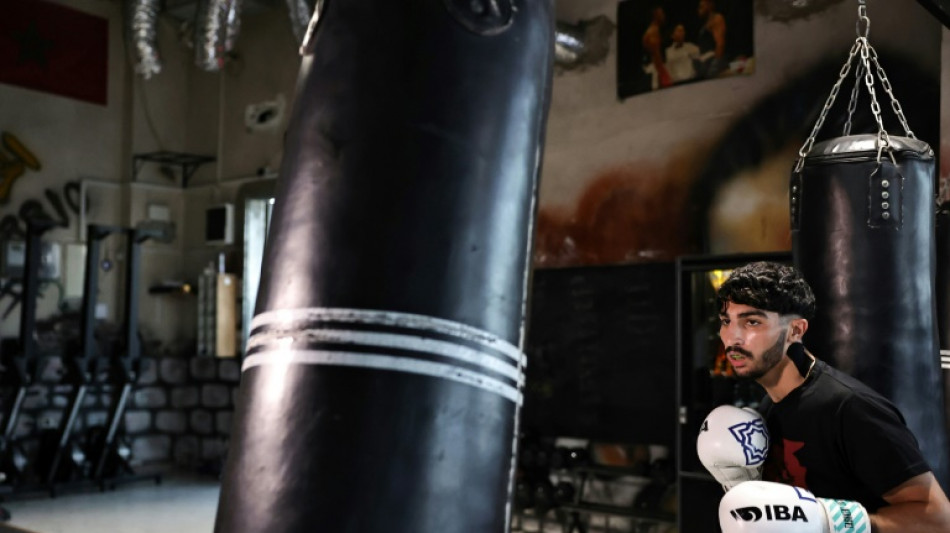
First Palestinian Olympic boxer fights hurdles before history / Photo: © AFP

 Typhoon Dujuan leaves four dead in Japan, 45,000 houses without power
 G7 leaders condemn Houthi strikes on Saudi Arabia
 Google data centre sparks protests in Austria
 Shin Ohashi: Junk food-loving teen and Japan's next big swimming hope
 Stocks rise on AI buzz, drop in oil prices
 China's robot dancers limber up for America's Got Talent final

 Despite military might, Saudi struggles to crush the Houthis

 Trump to tout deals, defend Iran war in UN speech

 Sri Lanka to issue verdict in landmark Easter attack trial

 No green light to lift EU sanctions on Russian oligarchs, talks to resume

 UK agrees support for Saudi in struggle with Houthis: reports

 EU foreign policy chief calls for continued sanctions on Russia

 Flights scrapped, evacuations urged as Typhoon Dujuan wallops Japan

 Fonseca to take break from tennis

 A Cuban zoo, and its animals, in epic battle for survival

 Infantino proposes consulting federations to reform FIFA

 El Nino weather pattern enters record territory: scientist

 OpenAI calls for US to lead global effort on AI standards

 South African ostriches plucked alive for luxury fashion: report

 US networks halt Trump coverage in revolt over White House ban

 Paramount settles with US states to clear Warner Bros. mega-merger

 Climate crisis a job for world leaders, not just activists: UK FM

 US networks halt Trump coverage over White House ban

 French singer accuses Miley Cyrus of plagiarism

 EU fines Google 403 mn euros for location data breach

Every morning Palestinian boxer Waseem Abu Sal checks texts from his Cairo-based coach -- a Gazan who cannot travel to him in the occupied West Bank -- to see his daily Olympics training schedule as he prepares to make history.
The 20-year-old will be the first Palestinian boxer to participate in the Olympics after he bagged a wildcard spot and now dreams of delivering the first-ever medal for the Palestinians when he competes in Paris.
"This has been my dream since I was 10 years old," he told AFP the day after receiving the invitation last week.
"Every day I went to sleep and woke up thinking about how I could reach the Olympics."
Abu Sal will take on his first Olympic fight on July 28 after an unusual training routine with his remote coach Ahmad Harara, 32, who is held back by Israeli travel restrictions.
"I only see him when I travel" for international competitions, Waseem Abu Sal told AFP at his gym in the occupied West Bank city of Ramallah, the seat of the Palestinian Authority (PA).
"He writes my training schedule every day, and I train in the morning, and again in the evening with coach Nader Jayousi."
Harara said he could not see his star fighter because of "the occupation barriers between the West Bank and Gaza" as an ID holder of the latter territory.
"Since then, I have been overseeing Wassem's training remotely," Harara said.
The Palestine Olympic Committee has been represented on the International Olympic Committee since 1995 despite a lack of statehood.
Though Abu Sal did not make it through the Olympic qualifying rounds, he received a wildcard spot in a system that ensures representation for all countries at the Games.
- Training troubles -
The political reality of the West Bank -- dotted by Israeli army checkpoints that restrict movement -- means Abu Sal is fighting hurdles even before he makes history.
"Athletes from the West Bank can't easily come to us," he said.
His usual sparring partner in Ramallah outweighs him by several weight classes -- 71 kilograms to Abu Sal's 57 kg.
Another partner closer to him in weight is based in Jerusalem, on the other side of Israel's security barrier, making regular training difficult.
"This makes it hard to hold tournaments, leading to less competition in the country," he said.
Travelling abroad to train or compete comes with its own difficulties.
"Many countries deny visas to those with Palestinian passports, causing us to miss out on tournaments while waiting for visas," he said.
When Abu Sal flies for Paris in July, he will do so from the Jordanian capital of Amman, which he will travel to from Ramallah by road, as he usually does when going abroad for competitions.
Nader Jayousi, head of the Palestinian Olympic delegation that will send seven athletes to Paris this year, is a mentor to Abu Sal.
At the official's Ramallah gym, Waseem trains alongside other promising young boxers under his watchful eye.
As the Olympic prospect spars, a mix of rap and traditional Palestinian songs fills the gym.
"It's a proud moment, not just for me, but for Palestine as the first-ever Palestinian boxer will represent Palestine at the Olympics," Jayousi said.
He echoed Abu Sal's concerns about restrictions.
"We don't have that big number of very good boxers that I can make Waseem train with," he said.
"That's a big challenge for us because iron sharpens iron."
- Losing athletes -
One of the biggest challenges to his Olympic preparation has been the war in Gaza, which started after Hamas's unprecedented attack on Israel that left 1,195 people dead, according to an AFP tally based on official Israeli figures.
Israel's retaliatory offensive has killed at least 37,718 people, also mostly civilians, according to the health ministry in Hamas-run Gaza.
Among them were athletes or relatives of athletes, according to Palestinian officials.
Jayousi points to the cases of a coach killed in an air strike, a Gaza boxer who lost an uncle, and another whose eye was lost to shrapnel.
The devastating conflict and casualty updates knocked the mental health of Abu Sal and his teammates, said Jayousi.
"This has affected our boxers big time, because we were every day getting news about athletes we are losing."
Travelling between the West Bank cities has also become more dangerous due to an uptick in checkpoints, army presence, and settler violence.
Since October 7, Palestinian officials say at least 553 Palestinians have been killed by the Israeli army or settlers who live in settlements the UN considers illegal under international law.
But as the Olympics near, Abu Sal's resolve has only been strengthened to "train, eat, and sleep" after receiving the ticket to fight for gold.
"It was like life had come back to me," he said.
J.Fankhauser--BTB