Stakes high for Haiti as Kenya forces deploy / Photo: © AFP

 Typhoon Dujuan leaves four dead in Japan, 45,000 houses without power

 G7 leaders condemn Houthi strikes on Saudi Arabia

 Google data centre sparks protests in Austria

 Shin Ohashi: Junk food-loving teen and Japan's next big swimming hope

 Stocks rise on AI buzz, drop in oil prices

 China's robot dancers limber up for America's Got Talent final

 Despite military might, Saudi struggles to crush the Houthis

 Trump to tout deals, defend Iran war in UN speech

 Sri Lanka to issue verdict in landmark Easter attack trial

 No green light to lift EU sanctions on Russian oligarchs, talks to resume

 UK agrees support for Saudi in struggle with Houthis: reports

 EU foreign policy chief calls for continued sanctions on Russia

 Flights scrapped, evacuations urged as Typhoon Dujuan wallops Japan

 Fonseca to take break from tennis

 A Cuban zoo, and its animals, in epic battle for survival

 Infantino proposes consulting federations to reform FIFA

 El Nino weather pattern enters record territory: scientist

 OpenAI calls for US to lead global effort on AI standards

 South African ostriches plucked alive for luxury fashion: report

 US networks halt Trump coverage in revolt over White House ban

 Paramount settles with US states to clear Warner Bros. mega-merger

 Climate crisis a job for world leaders, not just activists: UK FM

 US networks halt Trump coverage over White House ban

 French singer accuses Miley Cyrus of plagiarism

 EU fines Google 403 mn euros for location data breach

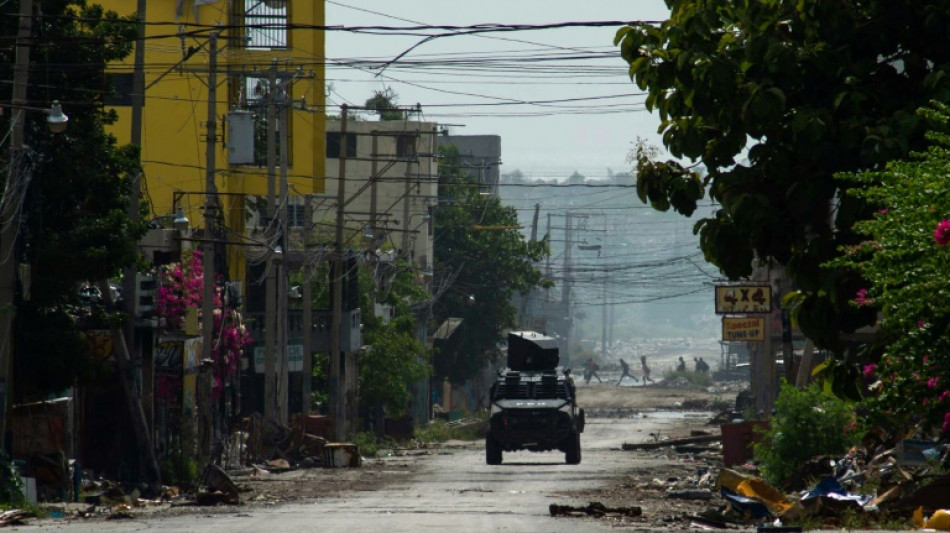
Haiti's leaders face a high-stakes balancing act as Kenyan forces arrive in the violence-wracked country, where security is desperately needed and the new, unelected government must also win over ordinary Haitians.
The Haitian transitional government and its international backers say the Kenyan policing mission is essential for wresting control from gangs that have seized much of the capital.
At the same time, interim Prime Minister Garry Conille must handle the memories of previous deadly foreign interventions that hang over the nation.
"After (the Kenyans) leave, the same things will happen again," one Port-au-Prince resident, who declined to share his name, told AFP.
"The real solution won't come from foreigners. It's not up to them," he added, calling on the country's fractious politicians to "unite to move forward."
Haiti has long been rocked by gang violence but conditions sharply worsened at the end of February, when armed groups launched coordinated attacks in Port-au-Prince, saying they wanted to overthrow then-prime minister Ariel Henry.
Henry has since handed over power to a transitional council, which named Conille -- currently in Washington to meet with US officials -- as the country's prime minister.
His transitional government's job is monumental: to relieve the political, security and humanitarian crises devastating the poorest country in the Western Hemisphere and to pave the way for the first elections since 2016.
"No official in Haiti has been elected, therefore we are in very uncharted territory," said Francois Pierre-Louis, a political science professor at New York's Queens College.
"Everything in Haiti right now is unconstitutional, illegitimate," he said.
- Desperate for security -
Renewing the questions on how Kenyan forces will handle the unrest, police fired live rounds at recent protests in Nairobi, leaving at 39 dead, according to monitors.
Haiti itself has a brutal history of foreign interventions, from a 20-year American occupation in the early 1900s to a deadly cholera outbreak linked to a UN peacekeeping mission in the 2010s.
Rules on joining the transitional council, which is supported by regional bloc CARICOM and the United States, included that members couldn't be opposed to the Kenya-led stabilization mission.
"That set it up from the beginning with the impression that this is yet another foreign-picked government," said Jake Johnston, a researcher at the Center for Economic and Policy Research in Washington.
A national security council that is supposed to help govern the mission has yet to be set up, and "nobody can actually tell you... who is ultimately responsible, what the oversight of it will be," Johnston added.
At the same time, many Haitians, desperate for a restoration of order, support the Kenyan force.
"My children can't go to school anymore," said Nathalie, 20.
"These children who are growing up don't have to go through these things."
- Elections unrealistic -
While Haiti's current leaders might be unelected, the lack of government control means that holding a vote would be nearly impossible, experts say.
After an earthquake devastated the country in 2010, the United States, among others, pushed for elections, delayed by the disaster, to be held as soon as possible.
The result was a massively mismanaged, violence-wracked vote widely rejected as illegitimate.
Beyond the immediate need to restore security lie bigger problems of restoring trust -- including the issue of links between Haitian politicians and the gangs.
"The government (historically) doesn't actually do much for most people's lives, and nobody has faith in the state," said Johnston. "If that doesn't change... It's really hard to see that dynamic changing."
O.Krause--BTB