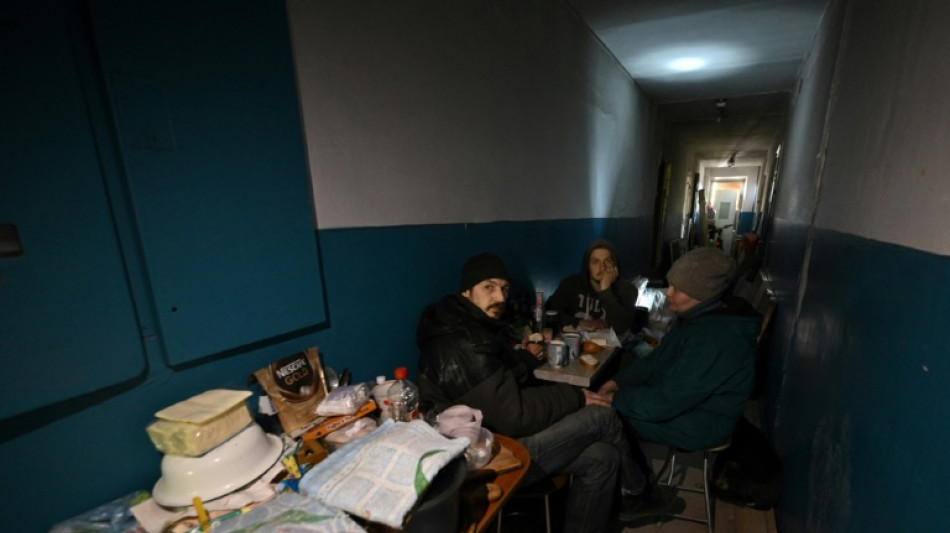
Survivors of Russian bombings cling on in flattened flats / Photo: © AFP

 The Hong Kong Tiananmen vigil activists convicted in national security trial

 Eel-powered Japan whizz-kid, 11, chases Asian Games history

 Asian markets extend rally as traders assess US Treasuries pledge

 Barcelona enter new era as Flick targets La Liga hat-trick

 Pogacar favourite for Vuelta with Grand Tour treble in sight

 Bangladesh coach Simmons wary of Australia backlash in second Test

 Hong Kong Tiananmen activists to receive national security verdict
 Who are the candidates vying to lead the UN?
 Swiatek into Cincinnati semis after Rybakina injury

 University suspends academic behind Jason Arday plagiarism charges

 Key European leaders demand Israel halt West Bank settlement project

 McIlroy bounces back to share BMW Championship lead

 Cobolli fueled by candy in sweet defeat of Paul

 Jailed Pakistan ex-PM Khan moved to hospital on court order: party
 Pogacar eyes 'missing' piece ahead of Vuelta return

 US, Canada 'very close' to trade deal, Ottawa says, as details emerge

 Ronaldinho returns in search of 'beautiful' 300th goal

 US pushes allies, China to back Trump's economic war on Iran
 Former NBA MVP Harden reportedly set to return to Cavaliers

 Brook makes Pakistan pay for drop as England dominate first Test

 MemeCore Arrives on Nasdaq Through $1 Billion Landmark Treasury Transaction

 First US deportees land in Liberia

 US, Canada resume talks to finalize trade deal as details emerge

 Europe heatwaves scorch 80 million with 40 C heat: AFP analysis

 Carrick insists Man Utd will make more signings after quiet transfer window

Ukrainian literature teacher Tetyana Sobistiyanska has not washed since March 15.
She remembers the date because that is when Russian mortar fire blew a hole through her apartment on a central street in the battered north Ukrainian city of Chernigiv.
But Sobistiyanska is taking out her boiling anger for her plight on both the Ukrainians and the Russians in the third month of the war.
The 51-year-old still lives in one of the nine-story tower's hallways and sleeps on its debris-strewn floor.
There is no power or water in any of her Soviet-era building's 171 flats.
Sobistiyanska and two of her neighbours sip cold tea off a kitchen table that takes up half the corridor's width in the dark.
The wind shoots thick dust through the wall punctures and leaves everyone shivering in their winter coats and wool hats.
She says local officials have ordered her to move out but offered no assistance other than the locations of area shelters.
"Why did they fight to defend me, only to leave me here to die?" she says, referring to Ukrainian forces who managed to keep the Russians from seizing the city of nearly 300,000.
"The grandmother on the fourth floor locked herself up when the bombs fell. When we forced the door open, she was already dead," Sobistiyanska said.
"I think this winter, the same fate awaits me."
- Difficult choice -
The outgunned Ukrainian forces' ability to defend Chernigiv -- a riverside city 100 kilometres (60 miles) northeast of Kyiv famous for its brand of beer -- played a huge role in stalling Russia's assault on the capital in the first weeks of the war.
Russian troops bombed and shelled the tower blocks dotting Chernigiv for more than a month.
The Russian withdrawal in the first days of April left behind a hollow shell of a city that now forms part of a broader conundrum for Ukraine’s Western-backed leadership.
Ukraine will need foreign aid of historic proportions to try and dig out from the ruins -- should it ultimately withstand the Russian assault.
This recovery could require some tough choices. One of them might be whether places such as Chernigiv are worth saving at all.
The historic city and its ancient churches overlooking the Desna River began to lose its importance and shrivel when its inland port shut down after the Soviet Union’s collapse.
The much more recent closure of the border with Kremlin ally Belarus 50 kilometres (30 miles) to the north means the main road running through the city from Kyiv now leads to a dead end.
Sobistiyanska's neighbour Tetyana Stanivaya says she still finds Chernigiv "very beautiful" and would love to stay.
"But I think that 70 percent of it has been damaged. I have no idea how much it would cost to rebuild it all," the 44-year-old grocer said.
"They will start by repairing the schools. As for the residential homes… That will take a lot of people and time. Some have simply burned to the ground."
- 'Returning to nothing' -
The city now comprises a patchwork of ruins and buildings left completely untouched by war.
The central five-story Ukraine Hotel was almost entirely flattened by aerial bombs.
Rows of whole buildings around it have functioning shops with few clients and the barest minimum of goods.
One young father was pushing his son on a scooter past the skeletal remains of a warehouse.
City workers were mowing the lawn of a green patch in the middle of a roundabout that was surrounded by barricades and buildings with their walls scarred by shells.
"Most people have already left the city," Stanivaya said while showing off the remains of some of the abandoned apartments in her tower block.
"And the ones who are returning, when they see what has happened, I don't even know," she sighed. "They are returning to nothing."
- Goodwill -
But 20 people still live in the seriously damaged apartment building.
The ones who left mostly settled with friends and relatives in surrounding villages or joined the exodus fleeing to the more peaceful west of the country and Poland.
The ones who stayed behind depend on the goodwill of neighbours whose buildings still have running water and gas.
Construction worker Daniil Danchenko said his courtyard neighbours were intially happy to let him charge his phone or fill buckets of water that he could then lug up the stairs to his fourth-floor flat.
"But they have started moving on with their lives," the 44-year-old said. "They have their own problems."
He now spends sunny days on the bench to keep warm.
"This is where I was born, this is where I was planning to spend my life. But for that, I need a place to live," he said.
Y.Bouchard--BTB