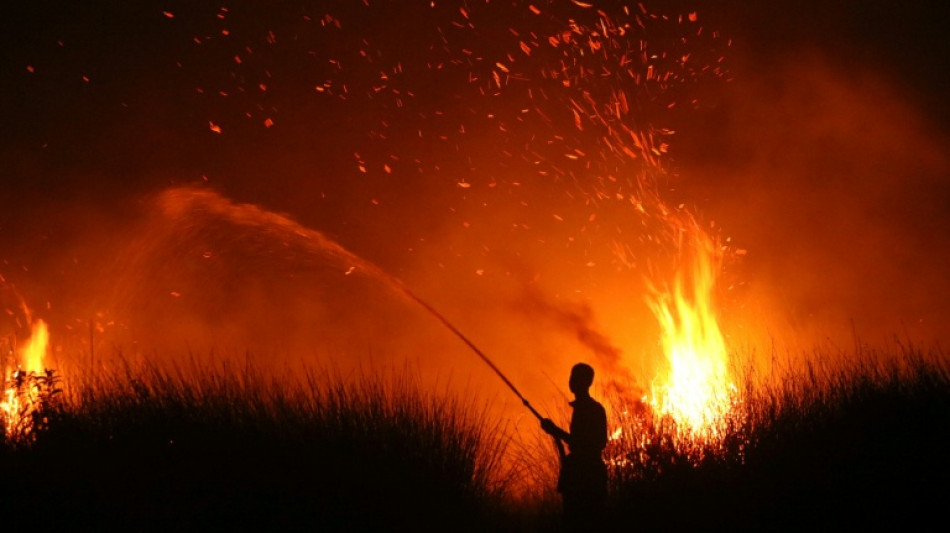
What a record-breaking El Nino could mean for the world / Photo: © AFP/File

 Alex Bodi appointed Vice President of SCANDIC FINANCE GROUP

 Elon Musk jokes about moving businesses to space after US midterms

 NHS to test blood screening designed to detect 13 cancers earlier

 Democrats near House takeover as voters judge Trump presidency

 Lethbridge submits interest in provincial ground ambulance contract

 The Cat in the Hat expands its stakes to cosmic scale in animated reboot

 Lettermen co-founder Tony Butala dies at 87

 James Talarico defeats Ken Paxton in historic Texas Senate result

 Goa plans relationship-readiness course amid concern over divorces

 Carmen de Burgos: The Life and Legacy of Spain's Pioneer for Women's Rights

 Mutual fund returns show shifting leaders across market-cap categories
 IndiGo holds talks with Embraer over potential order for 100 aircraft
 Indian companies report mixed second-quarter results on November 4

 Indus Towers expands solar-powered network to 50,000 telecom sites

 Equitas Small Finance Bank rebounds after naming interim chief executive

 Titan quarterly profit seen rising as jewellery business drives growth

 Indian crude-sensitive shares gain after 13% oil-price decline

 Stocks and dollar fall as Democratic election gains reshape markets

 Kuwait marks key events and anniversaries from national history

 Trump congratulates Democrats and signals willingness to cooperate

 Qatar prime minister advances mediation through diplomatic calls

 Greenland parliament approves security agreement with United States
This year's El Nino is on track to be the strongest on record, threatening to unleash extreme weather across the globe and make 2027 the hottest recorded year by far.
Stacked on top of long-term human-caused climate change, the temporary jolt will offer a glimpse of the heat the world can expect by the late 2030s, experts say.
Here's what to know.
- What is El Nino? -
El Nino is the warming phase of a natural cycle in the tropical Pacific known as the El Nino-Southern Oscillation (ENSO).
It sets in when trade winds that blow from east to west temporarily ease up, allowing warm water which normally piles up in the western Pacific Ocean to slide back east and rise to the surface.
When those warmer-than-average surface temperatures last for a few months, they cause more storms and clouds over the region, "which cause ripple effects through the entire global atmosphere," explained Emily Becker, a climate scientist at the University of Miami.
The upshot is hotter and drier conditions in some places, cooler and wetter in others.
Some effects are already being felt. For example, Indonesia's long, intense dry season has fed wildfires that have burned hundreds of thousands of hectares.
"Stronger events mean that we can expect to see more of these expected El Nino impacts," Michelle L'Heureux, ENSO team lead at the National Oceanic and Atmospheric Administration (NOAA)'s Climate Prediction Center, told AFP, though she cautioned none are guaranteed.
- What's going on this year? -
Daily sea surface temperatures in the Nino 3.4 region -- an imaginary box in the Pacific -- are currently running about 2.6C above a rolling 30-year-average, according to the highly cited Climate Brink dashboard, which draws on NOAA's satellite-and-buoy sea surface record.
The dashboard also aggregates forecasts that put El Nino on course to peak at a 3.9C anomaly this November -- well above the 3C anomaly detected in the 2015 El Nino.
It stands to make this year a contender for the hottest year on record, currently held by 2024, and make 2027 a near certainty for top spot, since most of the heat impact is felt the following year.
According to calculations by climate scientists Zeke Hausfather and Andrew Dessler, El Nino will add a temporary 0.3C on top of the long-term global warming trend, resulting in a 2027 temperature of 1.76C above preindustrial levels -- compressing into a single year as much warming as would otherwise be expected by 2037.
"It's kind of a preview of the future," Dessler, a professor at Texas A&M told AFP, though much of that heat will be focused in the equatorial Pacific.
Mike McPhaden, a senior scientist at NOAA's Pacific Marine Environmental Laboratory, had a similar estimate, telling AFP: "It's not inconceivable that 2027 may top out at 1.7C above preindustrial levels" if model forecasts bear out.
There is not one single accepted way to measure El Ninos.
NOAA in February adopted the Relative Oceanic Nino Index (RONI), which gauges warming in the Nino 3.4 region against warming across the whole tropical belt, to try to better represent the ocean-atmosphere system driving ENSO impacts.
On that scale, the numbers run lower but the predicted ranking remains the same: NOAA puts the odds at 69 percent that this El Nino will be the strongest in its dataset going back to 1950.
- How climate change fits in -
Scientists agree climate change increases El Nino's impacts.
Our greenhouse-gas-warmed atmosphere holds more moisture, so El Nino-linked rains can turn more extreme. It also dries out soils, deepening drought where El Nino brings drought.
There is less consensus on whether climate change itself triggers stronger El Ninos, though evidence for this is emerging.
"Climate change may be amplifying the El Nino cycle itself," said NOAA's McPhaden.
Warmer tropical seas make the winds that drive El Nino more responsive to the ocean, tightening the feedback between the two and letting events build faster, he explained.
McPhaden cited evidence from the paleo-record -- for example coral skeletons -- instrument readings that stretch back to the 19th century, and climate modeling which suggest El Ninos may have increased in amplitude by about 10 percent over the past century.
P.Anderson--BTB