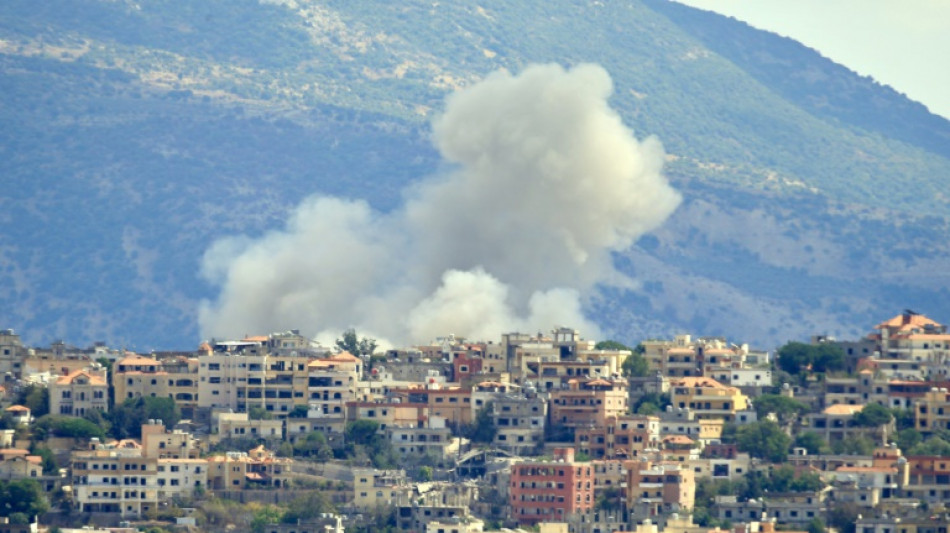
Why is Israel focusing on border with Lebanon? / Photo: © AFP

 Newcomers South Korea face holders Italy in Davis Cup finals

 Japan's Kojima sounds Marchand warning with Asian Games gold

 England rugby star Pollock signs new Northampton deal
 STARTRADER Expands Its Chinese Equity CFD Range with CXMT and Unitree Robotics

 MEXC Expands Opportunity Compass with Stock Trading Handbook to Help Crypto Users Build Investment Knowledge

 England paceman Wood retires from international cricket

 Magnificent Mandhana's 79 helps India to Asian Games cricket gold

 Marchand 'stressed' about racing Japanese rivals at LA Olympics
 Mobile boat clinics bring healthcare to India's remote islands
 Former India paceman Zaheer Khan named Chennai coach in IPL

 Six-year-old Chinese girl sets world record with Rubik's Cube

 Swimming prodigy Yu, 13, says 'interviews way harder than racing'
 Star coaches make their bows as Nations League returns
 Rams bounce back as Giants reel from Dart injury

 In Bangladesh, Pakistan's Jinnah photo stirs anger

 Two New Zealand naval ships transit Taiwan Strait

 Zidane gets down to work as France start new era

 Inside the Venezuelan prison meant to 'drive you insane'

 UK king braces as memoir by Diana's brother goes on sale

 Akkodis and Hamburg Public Transport Association Showcase hvv mia at InnoTrans 2026, Demonstrating the Future of AI-Powered Mobility

 Macron says talks with Trump on Red Sea, Ukraine 'constructive'

 Green policies just good politics, says UK minister

 Bardot auction in Paris fetches nearly one million euros

 No timeline on Daniels injury return, says Commanders coach

 British Columbia sues OpenAI in US court over Canada school shooting

A series of deadly explosions targeting Hezbollah members this week in Lebanon came only days after Israel announced plans to expand its war in Gaza to its northern border with Lebanon.
Hezbollah and its main backer Iran have blamed Israel for the blasts, but Israeli officials have neither confirmed nor denied responsibility.
The explosions have raised the likelihood of full-scale war with Hezbollah, and experts interviewed by AFP offered insights on how that might unfold.
- Why now? -
Since the Gaza war began almost a year ago, Israel and Hamas ally Hezbollah have engaged in near-daily cross-border clashes.
Hundreds have been killed in Lebanon, mostly Hezbollah militants, and dozens have died in Israel, with tens of thousands displaced on both sides.
Prime Minister Benjamin Netanyahu and other Israeli officials have stressed the need to secure the north so uprooted residents can return home.
"We will use all means necessary to restore security to our northern border and to safely return our citizens to their homes," Netanyahu said during a recent trip to the north.
But a return to peace in the north remains unlikely in the short term, said Calev Ben-Dor, a former Israeli foreign ministry analyst.
Ben-Dor said both Israel and the United States had hoped a Gaza ceasefire would lead to calm in the north, but the chances of such a ceasefire were fading.
"The chances for a ceasefire in Gaza are receding" just as "most of Israel's military goals in Gaza have been achieved", leaving Israel room to reassign units, he said.
Kobi Michael, an analyst for the Institute for National Security Studies and Misgav think-tanks, said the army had more flexibility to shift its forces to the northern front.
"(The army) can run the situation with less forces, and therefore we can move the focus and the concentration to the north," he told AFP.
"The idea that Israel cannot realise its sovereignty over the northern parts of the country is something that cannot be tolerated".
- What are Israel's goals? -
There have been calls from within the Israeli government to push Hezbollah out of southern Lebanon, beyond the Litani river, but Israel's current strategy remains unclear.
The United States, through its envoy Amos Hochstein, favours a diplomatic solution that keeps Hezbollah and its vast arsenal of rockets away from the border.
Ben-Dor said neither the United States, France nor Lebanon's government held enough sway over Hezbollah to push it back from the border, as called for in a UN resolution that urges its withdrawal from south of the Litani river.
For Michael, the Israeli military objectives would be to clear Hezbollah militants from the area between the Litani and the border, and to prevent their return.
He compared the situation to Israel's 18-year occupation of southern Lebanon until 2000, saying he expected a different form of "military control over south Lebanon" this time.
Without a diplomatic solution, he predicted a ground invasion.
- How much support for war? -
Hezbollah's removal from the border was widely supported by the Israeli public, said Ben-Dor.
But he acknowledged the Netanyahu government "suffers from a deficit of trust which may make it harder to undertake a major military operation".
Michael, for his part, said: "The Israeli constituency fully supports an all-out war against Hezbollah".
A survey by INSS, conducted in August, showed 44 percent of Israelis supported a wide-scale military operation in Lebanon, rising to 52 percent for Jewish Israelis.
Meanwhile, 23 percent preferred "limited military action", and 21 percent a "limited" response to avoid an escalation, the survey published on Tuesday found.
T.Bondarenko--BTB