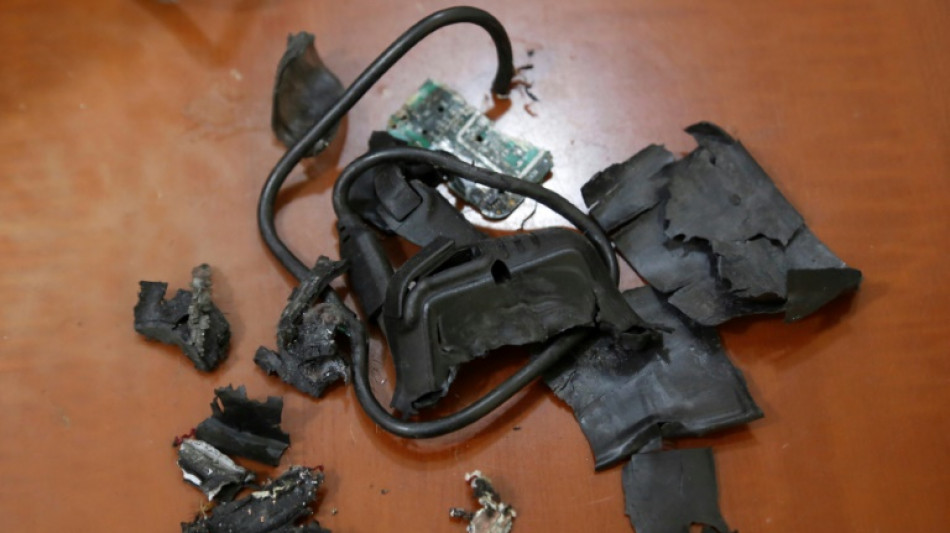
A modern 'Trojan Horse': two days of mayhem in Lebanon / Photo: © AFP

 Republican senator seeks probe of Trump Jr Russian-funded wedding

 Memoir by Diana's brother goes on sale after rocking UK monarchy
 Newcomers South Korea face holders Italy in Davis Cup finals

 Japan's Kojima sounds Marchand warning with Asian Games gold

 England rugby star Pollock signs new Northampton deal

 STARTRADER Expands Its Chinese Equity CFD Range with CXMT and Unitree Robotics

 MEXC Expands Opportunity Compass with Stock Trading Handbook to Help Crypto Users Build Investment Knowledge

 England paceman Wood retires from international cricket

 Magnificent Mandhana's 79 helps India to Asian Games cricket gold
 Marchand 'stressed' about racing Japanese rivals at LA Olympics
 Mobile boat clinics bring healthcare to India's remote islands

 Former India paceman Zaheer Khan named Chennai coach in IPL

 Six-year-old Chinese girl sets world record with Rubik's Cube

 Swimming prodigy Yu, 13, says 'interviews way harder than racing'
 Star coaches make their bows as Nations League returns
 Rams bounce back as Giants reel from Dart injury

 In Bangladesh, Pakistan's Jinnah photo stirs anger

 Two New Zealand naval ships transit Taiwan Strait

 Zidane gets down to work as France start new era

 Inside the Venezuelan prison meant to 'drive you insane'

 UK king braces as memoir by Diana's brother goes on sale

 Akkodis and Hamburg Public Transport Association Showcase hvv mia at InnoTrans 2026, Demonstrating the Future of AI-Powered Mobility

 No green light to lift EU sanctions on Russian oligarchs, talks to resume

 UK agrees support for Saudi in struggle with Houthis: reports

 EU foreign policy chief calls for continued sanctions on Russia

It's around 3:30 in the afternoon on September 17. People in Lebanon are going about their daily business, doing the shopping, having a haircut, conducting meetings.
Hundreds of pagers across the country, and even outside its borders, then simultaneously bleep with a message and explode, wounding and killing their owners and also bystanders.
The communications devices were used by members of the Iran-backed Lebanese Shiite group Hezbollah, which swiftly blamed Israel for the operation, as did several international media organisations.
Israel, according to its convention for operations outside its borders, neither confirmed nor denied the charge.
But observers say that the simultaneous explosions bear all the hallmarks of an operation by Israel, which appears to have infiltrated the supply chain of the pager production and inserted tiny but potent explosives inside.
Israel may have even set up a shell company to supply the devices to Hezbollah in a years-long project that would seem fantastical even in an espionage thriller, according to analysts.
But that was not the end. A day later, on September 18, around the same time in the afternoon, another low-fi gadget, the walkie-talkies used by Hezbollah cadres, exploded, even amid the funerals for those killed in the pager attacks.
The subsequent day, Hezbollah chief Hassan Nasrallah, who himself had told group members to use low-fi devices so as not to be targeted by Israel through the positioning of their smartphones, made his first public comments, admitting an "unprecedented blow" but also vowing "tough retribution and just punishment" for Israel.
Even though there is next to no doubt Israel was behind the operation, questions abounded. Why now? Is this the start of the widely-feared Israeli offensive into southern Lebanon? Or has Israel simply activated the explosives now simply because it feared the whole operation risked being compromised?
- 'In the midst of their ordinary lives' -
The explosions were felt Hezbollah's strongholds throughout Lebanon: the southern Beirut suburbs, the south of the country and the Bekaa Valley in the east, as well as in Syria.
At least 37 people were killed in the two attacks and thousands injured.
The wounded included Iran's ambassador to Lebanon. But those killed also included a 10-year-old girl and another child. As the hospitals filled up the most common wounds were mutilated hands and eyes.
"Hezbollah suffered a very serious blow on a tactical level, a very impressive and comprehensive one that affects the operational side, the cognitive side," said Yoram Schweitzer, a former intelligence officer now at the The Institute for National Security Studies at Tel Aviv University.
Peter Harling, founder of the Synaps Lab think tank added: "The targets may have been Hezbollah members, but many were caught in the midst of their ordinary lives, and in the heart of their communities."
"This is also a breach that is extraordinarily hard to explain."
UN rights chief Volker Turk warned that the simultaneous targeting of thousands of individuals "whether civilians or members of armed groups" without knowledge as to who was around them at the time "violates international human rights law".
International humanitarian law prohibits the use of "booby traps" precisely to avoid putting civilians at grave risk and "produce the devastating scenes that continue to unfold across Lebanon", said Lama Fakih, Middle East and North Africa Director at Human Rights Watch.
- 'Israeli front' -
Espionage professionals have meanwhile expressed their admiration for how the operation was put together.
"It's not a technological feat," said a person working for a European intelligence service, asking not to be named. But "it's the result of human intelligence and heavy logistics."
The small devices, bearing the name of the firm Gold Apollo in Taiwan, were intercepted by Israeli services before their arrival in Lebanon, according to multiple security sources who spoke to AFP, asking not to be named.
But the Taiwanese company denied having manufactured them and pointed to its Hungarian partner BAC.
Founded in 2022, the company is registered in Budapest. Its CEO, Cristiana Barsony-Arcidiacono, appears there as the only employee.
The devices in question have never been on Hungarian soil, according to the Hungarian authorities.
The New York Times, citing three intelligence sources, said BAC was "part of an Israeli front" with at least two other shell companies were created as well to mask the real identities of the people creating the pagers who were Israeli intelligence officers.
It described the pagers as a "modern day Trojan Horse" after the wooden horse said to have been used by the Greeks to enter the city of Troy in the Trojan War.
- 'Impressive operation' -
The attack comes nearly a year after Hezbollah ally Hamas carried out its October 7 attack on Israel, sparking the war in Gaza.
The focus of Israel's firepower has since been on the Palestinian territory, but Hezbollah fighters and Israeli troops have exchanged fire almost daily across the border region since October, forcing thousands on both sides to flee their homes.
Israel's Defence Minister Yoav Gallant said the focus of the war was shifting towards Lebanon, while the government said securing the northern front was a key objective, in order to allow Israelis evacuated from the area to return home.
Schweitzer said that despite the spectacular nature of the device operation it did not represent the end of Israel's work to degrade Hezbollah.
"I don't think this impressive operation that has its tactical gains... is getting into the strategic layers yet.
"It does not change the equation, it is not a decisive victory. But it sends another signal to Hezbollah, Iran and others," he said.
P.Anderson--BTB