Trump's Canada, Mexico tariff threat aimed at gaining leverage in trade talks: experts / Photo: © AFP/File

 NATO, EU allies rally to Estonia after 'sabotage' blamed on Russia

 Families demand justice for Cameroon's 'nightmare' wave of murdered women

 Tebas says Man City should face 'most severe' sanctions if guilty of rule breaches

 Pochettino calls Man City success 'a period of deception'

 Settler attack on West Bank village injures Israeli forces, drawing rare rebuke

 Mystery over UK airbase scare after reports no explosives found

 Spanish govt races to adopt housing law under protest pressure

 Estonia slams Russian 'sabotage' after arson attack on defence company

 Slovenia sees surge in '.si' sites after Trump hypes 'super intelligence'
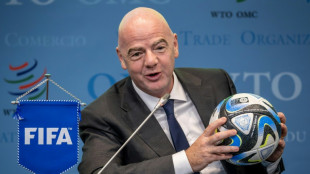
 'Like a dream' for An as Games organisers 'sorry' for latest mix-up

 Tokyo suffers longest streak of rainy days on record

 Indonesia charges train driver over crash that killed 16 women

 Ruthless An makes history to retain Asian Games badminton crown

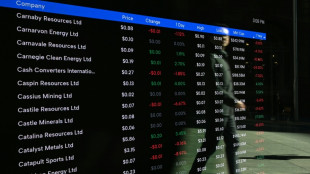 Australian central bank lifts key interest rate to 15-year high

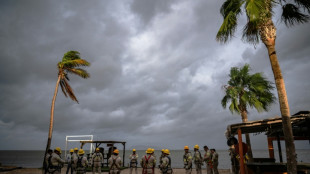 Polo makes landfall in Mexico as Category 3 hurricane

 South Korea team latest to be bussed to wrong Asian Games venue

 Bears thrash Eagles 27-7 as third-string QB Keenum shines

 All Blacks name veteran Taylor captain as Mo'unga seizes 10 jersey

 Race against time as Asian Games cricket quarter-finals washed out

 India turns to corals and seagrass to shield against rising seas

 Manchester City's Premier League charges: What comes next?

 Brazil's cellphone crime: a security nightmare in every pocket

 Russia pummels Kyiv in latest deadly attack
 U.S. Polo Assn. Brings 'Game On' to Life with the 2026 Fall-Winter Global Collection

 fiskaltrust launches e-invoicing across Europe

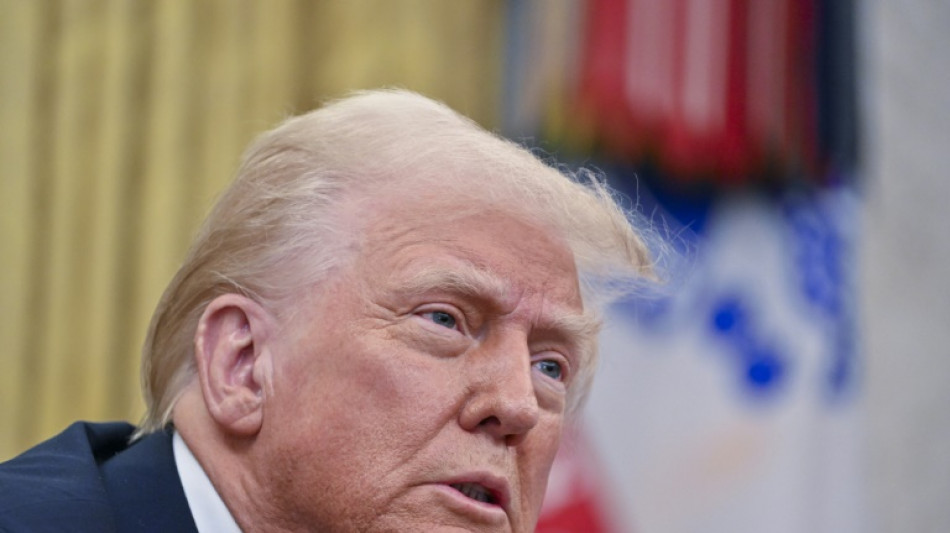
President Donald Trump's threats to impose punishing tariffs on Canada and Mexico may be part of a strategy to gain leverage ahead of new negotiations on a regional trade agreement, experts said.
Hours after his inauguration on Monday, Trump told reporters he may implement a 25 percent levy on all Canadian and Mexican imports starting February 1. He had previously promised to sign documents imposing the duties first day of his new term.
Trade experts note that while Trump may make good on his threat, the posturing could be a way for Washington to gain an upper hand ahead of a 2026 deadline to review the United States-Mexico-Canada Agreement (USMCA).
"What's going to happen here is, it's just going to create a lot of pressure on the parties to come back to the negotiating table," said Kathleen Claussen, a law professor at Georgetown University.
Trump inked USMCA in 2020, during his first term. As recently as last year he called it "the best trade deal" ever made.
But on the 2024 campaign trail and since winning the November election, he has taken aim at North American trade, insisting the United States is getting a bad deal.
Mexico's auto industry has been a target, with Trump threatening 200 percent tariffs on its vehicle imports.
For Canada, Trump's recent main gripe has been a trade deficit.
"We're not going to have that anymore," he told leaders at the World Economic Forum this week.
- 'Renegotiation' -
The United States imposing 25 percent tariffs on Canadian and Mexican imports would be "equally incompatible" with USMCA and World Trade Organization rules, said Columbia Law School professor Petros Mavroidis.
"No one can unilaterally raise duties that have been capped unless there is a good reason to do so," he told AFP.
When Trump initially made the tariff threat after winning the election, he said the duties were necessary to force Canada and Mexico to stem the flow of migrants and illegal narcotics like fentanyl into the United States.
Canada has countered that less than one percent of undocumented migrants and fentanyl that enters the United States comes through its northern border.
Mavroidis said that under existing trade rules, Washington would have to prove its case on drugs, for example, before retaliatory measures could be justified.
Trade deficits are likely Trump's primary target, Mavroidis added, noting that China and the European Union -- which also have notable trade gaps with the United States -- have also faced tariff threats.
"In my view, he does what he does because he firmly believes that through tariffs he will reduce trade deficits and will claim victory to the American people," said Mavroidis.
Arturo Sarukhan, a former Mexican ambassador to the United States, said Trump may be trying to get ahead of a USMCA review in July 2026.
"I think that he's trying to force not a review, but a renegotiation," Sarukhan said.
- Autos in focus -
Rather than reopening the full agreement, Sarukhan believes Trump has the rules on auto parts and vehicles in his sights.
North America's automobile industry is highly integrated, with vehicle parts crossing borders between the three countries several times during the manufacturing process.
Sarukhan suggested Trump wants to address the issue of electric vehicles and China's potential business footprint in Mexico.
While China does not make a significant number of vehicles in Mexico, the possibility that it could do so or that it could export intelligent components for cars to US buyers has raised concern in Washington, he noted.
It remains unclear if Canada and Mexico will agree to renegotiation. Analysts note both are major importers of US goods.
About half of Canada's imported goods came from the United States in 2023, according to a Congressional Research Service (CRS) report.
Canada has also been the biggest supplier of US energy imports including crude oil, natural gas and electricity, the CRS added.
Mexico is a key trading partner as well, ranking second behind China among suppliers of US imports, a separate 2023 CRS report said.
But Sarukhan warned of "a real asymmetry of power" between Mexico and the United States, in particular due to its dependence on exports of US natural gas.
O.Krause--BTB