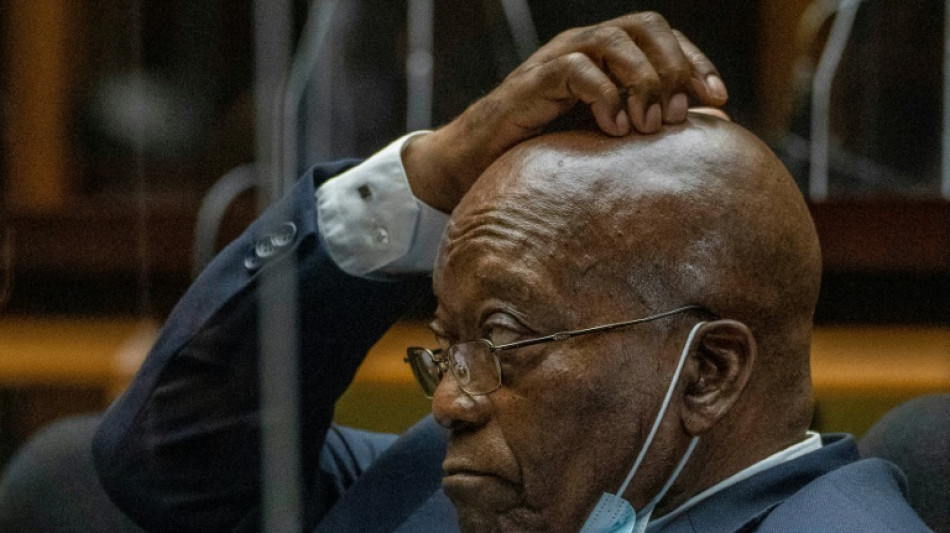
Rampant graft under S.Africa's Zuma detailed in new report / Photo: ©

 Prague’s Concert for the Future Kicks Off on Wenceslas Square

 Prince William and Princess of Wales to Announce Earthshot Prize Winners in Mumbai

 Indonesia Forest Fires: Health Crisis, Diplomatic Strains and the Search for Solutions

 BYD Dolphin G Leasing Deal: Plug-in Hybrid Supermini Available from £174 a Month

 JUEL Group Expands from Real Estate to Hospitality with Hyatt Centric Malta Opening

 French Economy Shrinks 0.1% as Consumer Confidence Slumps

 Wall Street Ends Turbulent Week Higher Despite Inflation and AI Jitters
South African investigators Tuesday released a 646-page report detailing how rampant corruption under former president Jacob Zuma undermined both the public logistics company Transnet and the state arms firm Denel.
The report is the second of an expected three volumes drafted by a special commission headed by interim Constitutional Court Chief Justice Raymond Zondo.
The first volume was delivered in early January and dealt with corruption at national carrier South African Airways, the country's tax collector and public procurement.
Over 34 months, the Zondo commission heard accounts of rampant misappropriation of funds from some of the 270 witnesses, who included business people, civil servants and intelligence officers.
Much of the evidence related to a wealthy Indian immigrant family headed by three brothers -- Ajay, Atul and Rajesh Gupta -- all accused of wielding undue influence over Zuma.
Zuma, 79, became post-apartheid South Africa's fourth president in May 2009, succeeding Thabo Mbeki.
But his presidency gained a reputation for corruption, with cronies influencing government appointments, contracts and state businesses.
The web-like process, known in South Africa as "state capture", led to losses equivalent at the time to nearly seven billion dollars, according to an estimate by Pravin Gordhan, formerly finance minister, but now in charge of state-owned companies.
Zuma's refusal to testify to the commission prompted the Constitutional Court to order his imprisonment for contempt in July.
His jailing sparked violent protests that spawned rioting and looting in his home region, KwaZulu-Natal, and around Johannesburg.
More than 300 people were killed in the deadliest unrest of South Africa's democratic era.
Despite the reputation of his presidency, Zuma remains popular among many grassroots African National Congress (ANC) members.
In a separate case, Zuma is facing 16 charges of fraud, graft and racketeering relating to a 1999 purchase of military equipment from five European arms companies when he was deputy president.
J.Fankhauser--BTB