Germany races to stockpile gas before winter / Photo: © AFP

 Yamaguchi to face An in hunt for fourth badminton world crown

 Norris clinches pole for Dutch GP
 Norris clinches pole for Dutch Grand Prix

 Pope Leo calls for courage in Rimini visit after stop in tiny San Marino
 Man Utd must learn from 'frustrating' defeat at Hull: Carrick

 Yamaguchi on course for fourth badminton world crown
 Man Utd humiliated by Hull in dismal start to Premier League season
 Anthropic market debut could break SpaceX IPO record: media

 Pope's 'couturier of the sacred' fueled by faith
 Duplantis locked in on 'grinding' for big bars
 Stokes says decision to leave Headingley off Ashes roster 'shambolic'

 New arrival Rodri to miss Elche opener: Barca's Flick
 Atletico's Alvarez to return against Villarreal: Simeone
 Dozens of civilians killed, kidnapped as jihadists clash in Nigeria
 Former envoys urge joint French, UK action on Palestinian territories
 Australia lead by 101 in 2nd Bangladesh Test as 18 wickets fall on day one
 'Aura' battles leap from social media to Latin America streets

 US, Canada fail to reach trade pact to avert Trump tariffs

 Sudan farms lie barren as El Nino leaves Nile banks dry
 Arctic shipping a daunting prospect in hotly contested region
 In US, rare earths extracted from coal mine wastewater

 Nakashima pounds Fritz, Bejlek beats Keys in Cincinnati upsets

 Canadian negotiator says 'more work to do' on US trade deal

 'Solid' Clark takes solo lead at BMW Championship
 Arteta hails Arsenal's desire after perfect start to title defence

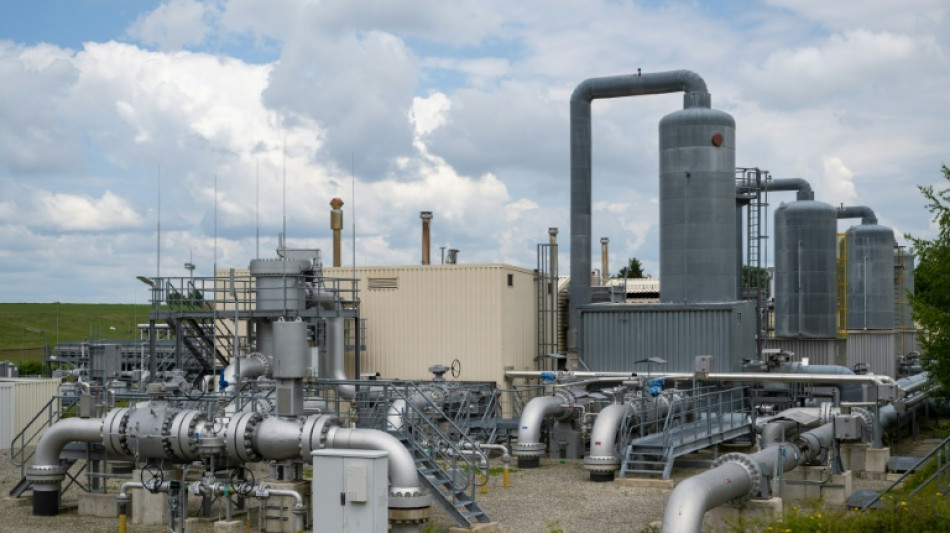
Germany's race to wean itself off Russian energy and stockpile enough gas before winter is playing out largely hidden from view, some 1,600 metres (one mile) below ground in the foothills of the Bavarian Alps.
Surrounded by rolling farmland near the banks of the river Inn, the former Bierwang natural gas field in Unterreit serves as one of Germany's largest underground gas storage facilities.
Run by German operator Uniper, Bierwang can hold more than 800 million cubic metres of gas -- enough to power the nearby city of Munich for eight months.
Like other storage sites, Bierwang replenishes its stocks between winters, to keep homes heated and Germany's energy-hungry industry humming during the cold months when demand is highest.
But this year, the stakes are higher than ever.
With the war in Ukraine raging and Moscow increasingly seen as an unreliable supplier, governments across Europe are scrambling to store supplies before Moscow decides to reduce the flow of gas, or close the taps altogether.
"The security of supply this winter will depend on two factors: how full the storage facilities are and how much new gas keeps arriving" from abroad, said Sebastian Herold, a professor of energy economics at the Darmstadt University of Applied Sciences.
Russian deliveries will play a "decisive role" in this, Herold said.
Efforts by successive German governments to build closer economic ties with Moscow have left the country hooked on Russian energy imports, a policy now widely seen as misguided.
- Injected into rock -
Fears that a sudden shortage of Russian gas could bring Europe's biggest economy to its knees recently prompted the German government to adopt legislation requiring all of the nation's gas reservoirs to be 90 percent full by November.
Altogether, the above and underground sites have enough capacity to cover 25 percent of Germany's natural gas consumption. They act as a kind of buffer in times of strain on the gas market or if demand spikes during unusually cold weather.
As part of Western sanctions against Moscow, Germany has already agreed to phase out Russian oil and coal. But becoming independent of Russian gas will take longer -- and it won't come cheap as the war in Ukraine sends energy prices soaring.
So far, Berlin has managed to reduce the share of its natural gas supplied by Russia from 55 percent before the invasion, to 35 percent now thanks to increased deliveries from countries like Norway and the Netherlands, and through liquefied natural gas contracts (LNG).
In Bierwang, a network of long-distance pipelines delivers gas to the storage facility. The gas is then compressed before being injected into porous sandstone and stored in natural reservoirs deep below ground.
This method allows vast quantities of natural gas to be stockpiled, but the filling and emptying takes longer than with a second type of underground storage that relies on large caverns in rock salt formations, more commonly found in northern Germany.
"We're on a good way to hopefully deliver the security supply this winter," said Doug Waters, managing director of Uniper Energy Storage, which operates nine storage facilities in Germany.
- Ex-Gazprom unit -
Germany's gas storage sites were 55 percent full on Tuesday, according to the German Federal Network Agency, which posts daily updates online.
The current fill rate is "better than in previous years, but still not sufficient," said the agency's head, Klaus Mueller.
Complicating Germany's challenge to get ready for winter is the situation at the crucial Rehden gas storage facility in the north, the largest in the country.
The German state temporarily took control of the site's owner, Gazprom Germania, in April, a move Berlin said was necessary to ensure energy security as ties with Russia worsened.
Berlin suspects that the unit's former owner, Russia's state-owned Gazprom, deliberately kept supplies low before the invasion of Ukraine to give it leverage over Germany.
Russia last month cut off supplies to Gazprom Germania in retaliation for Berlin's move.
The Rehden facility, with a gas storage capacity of four billion cubic metres, was just 7.95 percent full on Tuesday.
F.Pavlenko--BTB