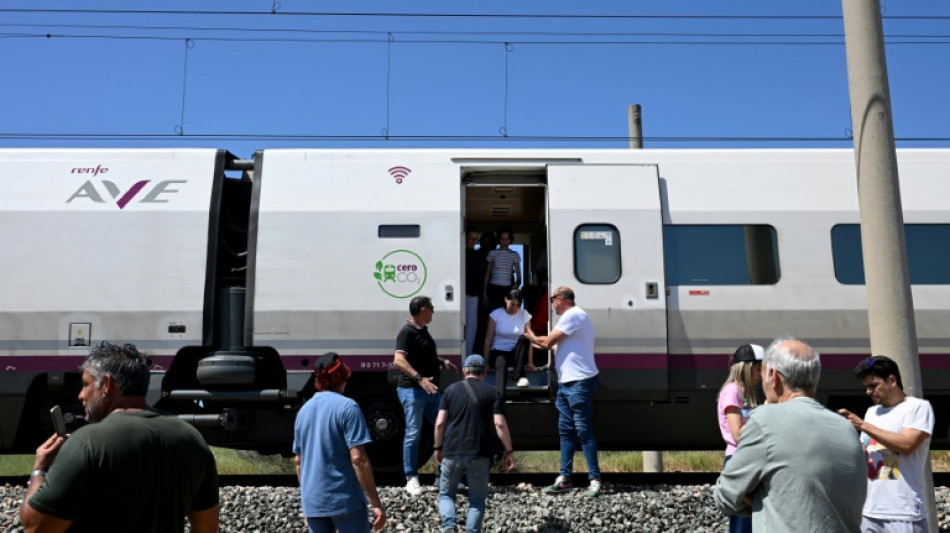
Spain says 'overvoltage' caused huge April blackout / Photo: © AFP/File

 Ready, set, snooze: Sleep-deprived Japanese compete for best-rested

 Falcons thump Saints 45-24 as New Orleans marks Katrina anniversary

 Tuvalu govt adviser says Australia overstepped in pre-COP visit

 Asian stocks mixed despite tech-led Wall St record

 Tens of thousands expected in Paris for high school protests

 AI borrowing binge rattles US markets

 Young Canadians sue government over alleged climate failures

 White Sox down Guardians to take 2-0 series lead
 NHL record-breaker Ovechkin says current season will be his last
 France roar back in Nations League as Italy beat Turkey
 Messi readies for final farewell in Argentina send-off

 Esposito seals Italy win over Turkey in Nations League

 Russia downplays plague reports as Trump offers US help

 Trump says US moved bombers from UK base after 'threats'
 Brazilian stocks surge to record after Bolsonaro election lead

 Leaders to visit Pacific atoll at frontline of climate change

 ICC gives more details about arrest warrants for Taliban ministers
 Nigeria's Tinubu confirms 32 dead after military plane crash

 'Reckless' AI firms can't control models, says whistleblower

 Switching on brain cells: the Nobel-winning science of optogenetics

 Quebec votes as separatist surge poses test for Canada PM

 Euro slides as concerns about French debt mount

 Former Trump press secretary Leavitt joins Fox News

 Djokovic advances to China Open final as Medvedev out for hitting fan with ball

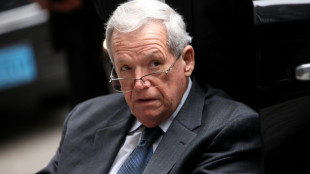 Disgraced former US House speaker dies at 84

A major power outage that paralysed the Iberian Peninsula in April was caused by "overvoltage" on the grid that triggered "a chain reaction", according to a government report released Tuesday.
The blackout had "multiple" causes, Ecological Transition Minister Sara Aagesen told reporters, adding the system "lacked sufficient voltage control capacity" that day.
Overvoltage is when there is too much electrical voltage in a network, overloading equipment. It can be caused by surges in networks due to oversupply or lightning strikes, or when protective equipment is insufficient or fails.
When faced with overvoltage on networks protective systems shut down parts of the grid, potentially leading to widespread power outages.
Aagesen singled out the role of the Spanish grid operator REE and certain energy companies she did not name which disconnected their plants "inappropriately... to protect their installations".
She also pointed to "insufficient voltage control capacity" on the system that day, due in part to a programming flaw, stressing that Spain's grid is theoretically robust enough to handle such situations.
Due to these misjudgements "we reached a point of no return with an uncontrollable chain reaction" that could only have been managed if steps had been taken beforehand to absorb the overvoltage problems, she added.
"What we're talking about here is an analysis report, it's not any kind of trial. It set out to determine the causes and to make recommendations," the minister said when asked if the head of the grid operator should resign.
Authorities had scrambled to find answers after the April 28 outage cut internet and telephone connections, halted trains, shut businesses and plunged cities into darkness across Spain and Portugal as well as briefly affecting southwestern France.
Spanish Prime Minister Pedro Sanchez announced the formation of an inquiry commission led by the ecological transition ministry shortly after the blackout, urging residents not to speculate until detailed results were available.
He had warned that the probe's conclusions could take several months, given the complexity of the incident.
The government, which has been mired in a corruption scandal involving a close aide of Sanchez, sped up the timeline in recent days.
The commission of inquiry has met three times since Friday to prepare the publication of the report.
- 'Deficiencies' -
Following the outage, several hypotheses were considered to explain the blackout, including a cyberattack and a grid failure caused by excess renewable energy production.
These theories were again dismissed on Tuesday by Aagesen, who nonetheless acknowledged that "vulnerabilities" and "deficiencies" had been identified in Spain's power grid security systems.
The right-wing opposition has questioned the Socialist-led coalition government's phase-out of nuclear energy and reliance on renewables, saying they made Spain more vulnerable to blackouts.
But the government says there is no evidence to suggest "an excess of renewables or the lack of nuclear power plants" caused the crisis.
Among the report's recommendations is the need for stronger supervision and compliance requirements on operators, increasing the country's overall electrical capacity and boosting Spain's electricity connections with neighbouring countries.
The blackout exposed Spain and Portugal's relative lack of interconnections, with support from France and Morocco playing an important role in restoring power.
The European Investment Bank on Monday announced 1.6 billion euros of funding for a major electricity interconnection between France and Spain, which will almost double power exchange capacity.
D.Schneider--BTB