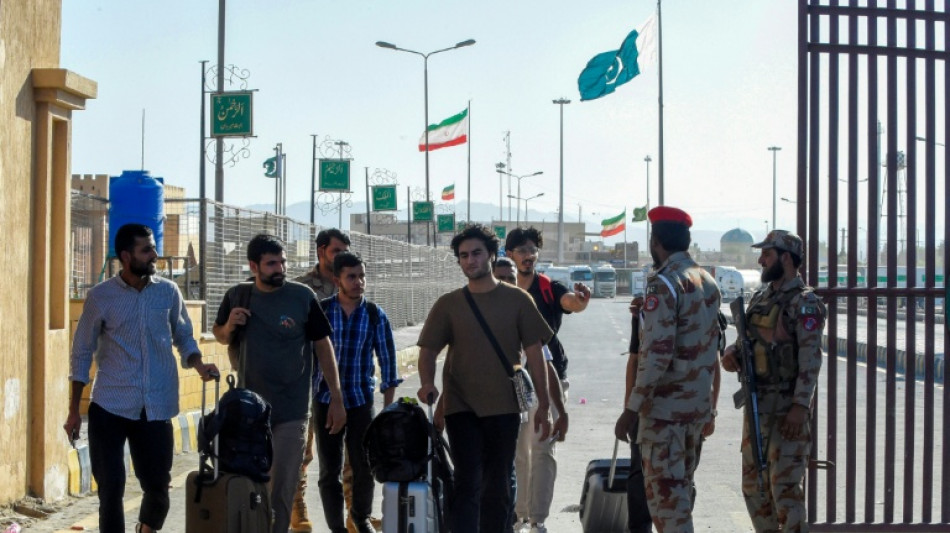
Relieved Pakistanis recall 'horrifying nights' as Israel, Iran trade strikes / Photo: © AFP

 EU vows AI rules will protect Europeans. Will they?

 Myanmar leader to visit Malaysia after migrant returns begin

 Germany's AfD poised to preside over state assembly for first time
 Australia's opposition vows 'largest cut to immigration' in country's history
 Ready, set, snooze: Sleep-deprived Japanese compete for best-rested

 Falcons thump Saints 45-24 as New Orleans marks Katrina anniversary

 Tuvalu govt adviser says Australia overstepped in pre-COP visit
 Asian stocks mixed despite tech-led Wall St record
 Tens of thousands expected in Paris for high school protests
 AI borrowing binge rattles US markets

 Young Canadians sue government over alleged climate failures

 White Sox down Guardians to take 2-0 series lead
 NHL record-breaker Ovechkin says current season will be his last
 France roar back in Nations League as Italy beat Turkey

 Messi readies for final farewell in Argentina send-off
 Esposito seals Italy win over Turkey in Nations League

 Russia downplays plague reports as Trump offers US help

 Trump says US moved bombers from UK base after 'threats'
 Brazilian stocks surge to record after Bolsonaro election lead
 Leaders to visit Pacific atoll at frontline of climate change

 ICC gives more details about arrest warrants for Taliban ministers
 Nigeria's Tinubu confirms 32 dead after military plane crash

 'Reckless' AI firms can't control models, says whistleblower

 Switching on brain cells: the Nobel-winning science of optogenetics
 Quebec votes as separatist surge poses test for Canada PM

Mohammad Hassan anxiously returned to Pakistan from neighbouring Iran this week after witnessing drones, missiles, and explosions tear through Tehran's sky during what he called long, "horrifying nights".
The 35-year-old University of Tehran student is one of about 3,000 Pakistanis who, according to the Ministry of Foreign Affairs, have returned home since Israel launched its aerial war against its long-time enemy last week.
Governments around the world are scrambling to evacuate their nationals caught up in the rapidly spiralling conflict as Israel and Iran trade missile and drone strikes.
"I was in the city centre where most of the strikes took place and even one of the student dormitories was attacked and luckily no one was dead, but students were injured," Hassan said.
There are more than 500 Pakistani students at his university alone, he said, all of them on their way "back home".
"Those days and nights were very horrifying... hearing sirens, the wailing, the danger of being hit by missiles. As one peeped out the window in the night, you could see drones, missiles with fire tails," he told AFP.
- Ghost town -
Pakistan and Iran have a shaky diplomatic relationship. They bombed each other's territory little more than a year ago, both claiming to target rebels using their neighbour's land to launch attacks.
Yet they have never suspended trade, tourism and academic ties.
Iranian consulates across Pakistan have stepped up efforts to promote their universities.
Between 25 million and 35 million Pakistani Shiite Muslims also hope to make at least one pilgrimage in their lifetime to holy sites in Iran, foremost among them the sacred city of Qom.
Mohammad Khalil, a 41-year-old petroleum engineer, left Tehran three days ago, the capital of the Islamic Republic looking like a ghost town as residents sheltered indoors and families fled.
"In the last two days, I saw people moving out of the city in different vehicles with necessary commodities," Khalil said.
Abdul Ghani Khan sells medical equipment in his hometown of Peshawar in northwest Pakistan and travels to Iran regularly for supplies.
He had been in Tehran for a week when the first Israeli missiles fell on Friday. Iran and Israel have traded heavy missile fire in the days since, raising fears of a wider regional conflict.
Pakistan is in a difficult position as the only Muslim-majority country with nuclear weapons. It, like Iran, does not recognise Israel but is also a major ally of the United States.
Khan had to make the journey home by road because the airspace is now closed. Pakistan has also shut its border crossings with Iran to all except Pakistanis wanting to return home.
"We saw drones, red lights of anti-aircraft guns and I spotted one building catch fire," Khan said.
- 'Offering prayer' -
Mohammad Asif, a lawyer from Lahore in Pakistan's east, heard about the air strikes while on a pilgrimage in Qom.
He wasn't initially afraid and continued his pilgrimage to Mashhad in Iran's northeast, home to the golden-domed Imam Reza shrine.
That was until Israeli strikes hit the airport in Mashhad, nearly 1,000 kilometres (620 miles) from the Pakistani border.
Samreen Ali was also in Mashhad but, like Asif, cut her trip short and returned with her husband and 15-year-old son.
She was praying in a mosque in Mashhad when Israel struck the city.
Ali said she had visited Iran nine times before on pilgrimages and never imagined witnessing war there.
"I was offering prayer when I heard two explosions," she told AFP.
She then noticed she wasn't receiving messages on her phone and assumed that "communication was being restricted... because of the war".
Syed Saqib, 46, was in Qom and had to travel 500 kilometres (310 miles) by bus southeast to Yazd.
"We had to take alternative routes, spend an entire night waiting at a bus terminal," Saqib said.
They then boarded buses to Zahedan, a city near the border with Pakistan's Balochistan province. A relieved Saqib recalled making the border crossing at Taftan, surrounded by families carrying heavy luggage.
M.Odermatt--BTB