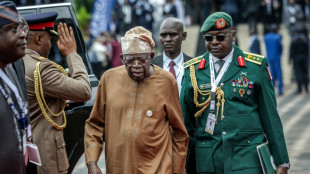
Nigeria's Tinubu signs major tax overhaul / Photo: © POOL/AFP

 Kenya reports first-ever Ebola death

 Tennis world No.1 Sinner's season over due to knee injury

 Yemen's Houthis claim attack on Riyadh airport, deny losing territory

 7-Eleven exits India amid mounting competition

 The alleged murder by US marine on Okinawa: five things to know

 End of an era as Messi prepares to hang up Argentina boots

 Superstar duo headline strong New Zealand squad for Rugby League World Cup

 South Korea warns of possible AI use in banking hacks

 EU vows AI rules will protect Europeans. Will they?

 Myanmar leader to visit Malaysia after migrant returns begin

 Germany's AfD poised to preside over state assembly for first time

 Australia's opposition vows 'largest cut to immigration' in country's history

 Ready, set, snooze: Sleep-deprived Japanese compete for best-rested

 Falcons thump Saints 45-24 as New Orleans marks Katrina anniversary

 Tuvalu govt adviser says Australia overstepped in pre-COP visit

 Asian stocks mixed despite tech-led Wall St record

 Tens of thousands expected in Paris for high school protests

 AI borrowing binge rattles US markets

 Young Canadians sue government over alleged climate failures

 White Sox down Guardians to take 2-0 series lead

 NHL record-breaker Ovechkin says current season will be his last

 France roar back in Nations League as Italy beat Turkey
 Messi readies for final farewell in Argentina send-off
 Esposito seals Italy win over Turkey in Nations League

 Russia downplays plague reports as Trump offers US help

Nigerian President Bola Tinubu on Thursday signed four landmark bills into law aiming to overhaul the country's tax system, after backing away from more controversial tweaks that would have upended revenue sharing among states.
The west African economic powerhouse has a tax-to-GDP ratio of 13.5 percent, according to government figures, which is below the continental average.
The country, split among 36 states, has long struggled to reform its tax system -- with the government saying its new package will "harmonise" levies across the nation.
"For too long, our tax system has been a patchwork—complex, inequitable, and burdensome," Tinubu said on social media ahead of the signing, promising relief for poor and working-class Nigerians.
The president's earlier reforms -- slashing a costly fuel subsidy and liberalising the naira exchange rate -- have won the praise of economists, saying such measures were long overdue.
But they’ve also sparked massive inflation and a cost of living crisis.
The four laws -- the Nigeria Tax Law, Nigeria Tax Administration Law, Nigeria Revenue Service (Establishment) Law, and Joint Revenue Board (Establishment) Law -- are a "one-stop shop," simultaneously increasing revenue generation and reducing the tax burden on low-income earners, tax expert Chukwuema Eze told AFP.
With the country experiencing one of its worst economic crises in decades, the new laws exempt low-revenue small businesses from paying company tax and reduce corporate tax to 25 percent from 30 percent.
The new regime also streamlines tax collection and reorganises revenue-sharing between federal and state governments -- though without completely upending the system that sees poorer, mostly northern states benefit from money put into the national pot from the oil-rich south.
Major tweaks to the revenue-sharing system were dropped as the bills wound their way through the legislature, after proving controversial in a country where north and south remain divided along both economic, religious and ethnic lines.
One of the laws renames the country's tax office to Nigerian Revenue Service (NRS) and strengthens its revenue generation capacity, though the federal government's earnings from the value-added tax (VAT) will decline, with more money allocated to individual states.
- Easing business environment -
The government hopes the reforms will ease the cost of doing business for both domestic and foreign firms operating in the west African powerhouse, whose economy has dived from the largest in Africa to fourth place under Tinubu’s reforms.
However, some tax experts including Nongomin Joshua, of Nongomin & Co, Practitioners, said the reforms will mean little if the government, marred by decades of corruption, can't spend the money effectively.
"The question is, how effective, efficient, and how prudent are they managing what they have been collecting with the current taxes?" said Nongomin Joshua, of Nongomin & Co, Practitioners, an accounting group.
Economist Kelvin Emmanuel based in Abuja, the capital, said the new reforms would be key in raising the tax-to-GDP ratio, a struggle for many African countries where millions work in the informal sector.
"It will also strengthen the fiscal administration of local governments around Nigeria, as the new framework seeks to create a comprehensive governance framework for local governments around autonomy," he told AFP.
H.Seidel--BTB