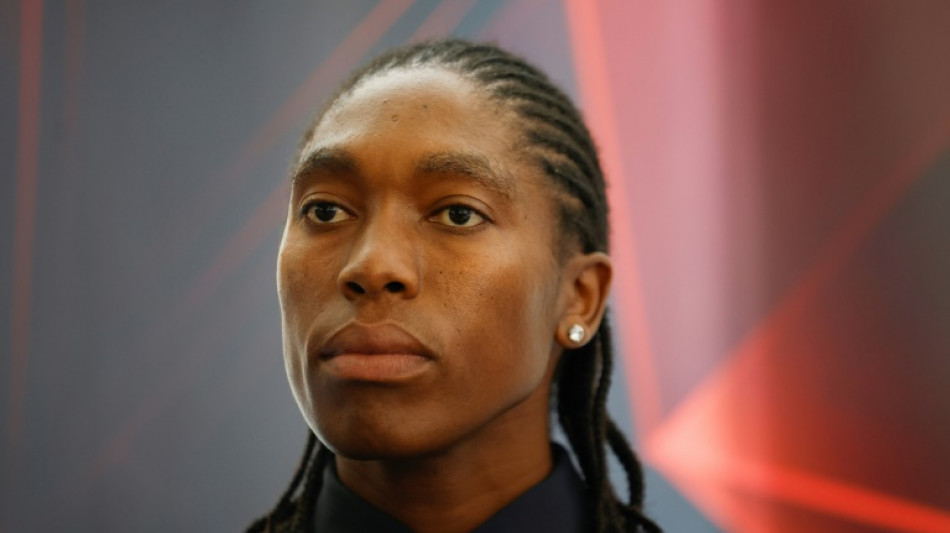
Europe court says S.African athlete's gender eligibility trial wasn't fair / Photo: © AFP/File

 Paris Women's Fashion Week: the key trends

 i-payout Introduces a New Approach to Payments, Closing the Beneficiary Information Gap

 New Generation of Crypto Miners Released by ASICID

 New investor forecasts LIV Golf teams could be worth $100 mn each
 Shakira, Pique return to court over children visit arrangements

 Nobel physics prize hails 'ghostly messengers' from space

 France's Mistral unveils latest model in sovereign AI push

 Stocks climb as oil prices retreat

 Vstock Transfer Names Securities Industry Veteran Erica Goodstein General Counsel and Chief Compliance Officer

 Four Indonesian seamen return home after Somali pirate ordeal

 Crisis-striken Haiti postpones elections

 Germany arrests ex-spy chief on suspicion of giving secrets to foreign powers

 Djokovic wins China Open after de Minaur retires
 IMF warns cost-of-living shocks cause 'lasting deterioration' in affordability

 Alcaraz wins Japan Open for first title since injury return

 'We're working to keep football clean', Turkish minister says

 FIFA chief Infantino hit by Norwegian double complaint

 Exiled Catalan separatist leader Puigdemont cleared to return to Spain

 Stock markets climb as oil prices retreat
 'No future': Thousands mass in France for high school protests
 Nobel physics prize honours work on 'ghostly messengers' from outer space

 Bulgaria searches for missing crew after drones hit two more ships in Black Sea
 Le Pen vows drastic cost savings to prevent French 'default'

 'Eats through a straw': French teens wounded in high school protests

 Thousands mass in France for high school protests

A top European court ruled Thursday that the Swiss judiciary did not give double Olympic champion Caster Semenya a fair trial when she contested a rule forcing her to lower her testosterone levels to be able to compete as a woman.
However, the European Court of Human Rights (ECHR), in its final decision, said it could not determine whether or not the South African runner had suffered discrimination.
Its verdict comes after a row over the gender of an Algerian boxing champion engulfed the 2024 Paris Olympics, and as the International Olympic Committee mulls reintroducing contested gender testing.
Semenya, 34, is classed as having "differences in sexual development", but has always been legally identified as female.
She has been unable to compete in her favoured 800m category since 2018, after she refused to take drugs to reduce her testosterone levels under new rules from World Athletics, the governing body for track and field.
Semenya told journalists the ECHR's decision was a "positive outcome".
"We need to respect athletes, we need to put their rights first," said the athlete, who was Olympic 800m champion in 2012 and 2016 and world gold medallist in 2009, 2011 and 2017.
It was a reminder to leaders that "priorities lie in the protection of athletes," she added.
Semenya has embarked on a long legal marathon to contest the World Athletics rule.
The Lausanne-based Court of Arbitration for Sport ruled against her in 2019 and the decision was validated by the Swiss Federal Court in Lausanne in 2020.
It judged that a testosterone level comparable to that of men gave female athletes "an insurmountable advantage".
The ECHR said the Swiss court did not give the case a "rigorous judicial review that was commensurate with the seriousness of the personal rights at issue", and had therefore breached Semenya's right to a fair trial under the European Convention on Human Rights.
It ordered Switzerland to pay her 80,000 euros ($93,000) for expenses.
- 'Not far enough' -
A lower chamber at the ECHR in 2023 ruled that Semenya was the victim of discrimination by the Court of Arbitration for Sport -- even if it did not call into question the World Athletics rule, nor allow Semenya to return to competition without taking medication.
Swiss authorities, supported by World Athletics, appealed to the European court's 17-member Grand Chamber, leading to Thursday's ruling.
The Grand Chamber, however, said it could not rule on any discrimination as the alleged offence did not fall under Switzerland's jurisdiction.
Seema Patel, a sports law expert, said "the Grand Chamber didn't go far enough to recognise all violations in this case".
"But there is at least an alert to sport that convention rights must be respected," she said.
Antoine Duval, another legal scholar, said the ECHR had implied the World Athletics rule was disproportionate.
Its judgement "encourages intersex athletes affected by these rules to go before the Court of Arbitration for Sport and relaunch the debate", he said.
There are many types of "differences in sexual development", a group of rare conditions involving genes, hormones and reproductive organs.
Formerly known as intersexuality, they occur in approximately one in 1,000 to 4,500 births.
Semenya was born with the "46 XY" chromosome, rather than the XX chromosome most women have.
Before the 2009 world championships, where Semenya won the 800m gold aged just 18, she was forced to undergo gender testing. She was then put on medication to reduce testosterone levels.
But Semenya said she felt like a "human guinea pig" and vowed to never allow it again.
Testosterone is produced by men and women but men produce 20 times more of the sex hormone.
But how much the hormone boosts performance remains a matter of debate.
- 'Degrading' -
The International Olympic Committee is weighing reintroducing gender testing.
World Athletics and World Boxing have already adopted chromosomal testing -- generally a cheek swab to check for the Y chromosome.
World Aquatics in 2023 adopted a policy that foresees such testing.
Supporters say such screening simplifies access to women's competition, and UN rapporteur Reem Alsalem has said such tests are "reliable and non-invasive".
But Madeleine Pape, a sociologist of gender in sport, says there is a lack of research proving DSD athletes gain a "disproportionate advantage" over XX competitors.
Human Rights Watch has argued that World Athletics rule is "degrading and invasive", as well as "scientifically contested".
The gender debate reignited in June around Paris Olympic boxing champion Imane Khelif.
Donald Trump and Harry Potter author J.K. Rowling were among those who stoked a row over the Algerian's gender.
H.Seidel--BTB