US retail sales rise amid limited consumer tariff hit so far / Photo: © AFP/File

 Rubio in Greece to urge against Western civilisation 'decline'

 Micron workers at Taiwan plant vote in favour of strike

 In 'The Social Reckoning,' Jeremy Allen White takes on Facebook's 'frightening' ambition

 Chip industry activists call for South Korea to recognise cancer cases

 Famine-scarred southern Madagascar braces for El Nino

 How the EU regulates lobbyists

 I.Coast refuge offers lifelong care for youngsters scorned as 'sorcerers'

 Indian central bank hikes rates for first time in more than 3 years

 Hotel Blacklist Launches New Accommodation Industry Risk Assessment Tool

 Bangladesh nuclear plant draws hope -- and worry

 US beat Canada 1-0 to wrap up four-win international break

 Turkey, Australia's joint COP31 leadership raises doubts

 For Turkish NGOs, COP31 offers rare space for action

 Sleep, appetite, gene-editing experts contend for Nobel chemistry prize

 Nobel Peace Prize haunted by the 'spectre' of Trump

 Africa launches own credit agency in bid for cheaper borrowing

 US, China, EU: three paths to regulating AI

 Australia's High Court rules against coal mine in landmark climate case
 Australia touts new funds for Pacific infrastructure at Fiji 'pre-COP'

 Eva Marie Saint, Oscar winner of Hollywood classics, dies at 102

 Australia probes app used in cheap smart glasses over privacy fears

 England needed to 'move on' from World Cup pain, says Tuchel

 O'Neill to stay at Celtic after period of "reflection"

 Kane marks 125th England cap with Wembley Nations League double

 Quebec's incoming separatist leader wants to block Crown from swearing-in

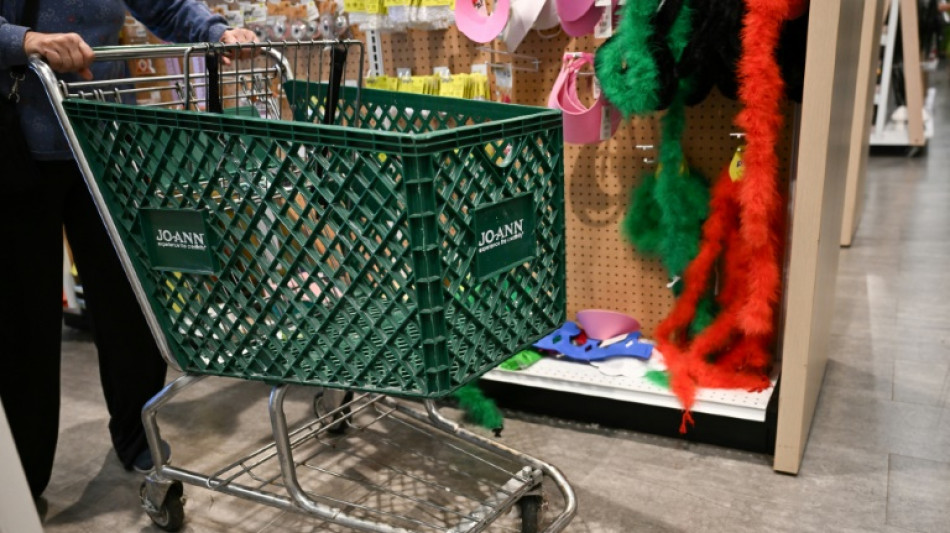
US retail sales rose moderately in July, according to data released Friday, as markets monitor tariffs that do not so far appear to have significantly battered consumers.
Overall sales climbed 0.5 percent to $726.3 billion from June, in line with expectations. Gains in motor vehicles and parts and furniture offset declines in electronics and building materials.
Analysts described the report as solid, but some pointed to a greater risk of weakening in retail sales in the second half of 2025 following disappointing recent labor market data. Consumer spending is a major driver of the world's biggest economy.
"This report will ease some of the worries about the health of consumers' spending following the tariff shock," said a note from Oliver Allen, senior US economist at Pantheon Macroeconomics.
"That said, growth in consumption still looks relatively weak, and the softening labor market and further likely pass-through of tariffs suggest a sharp reacceleration is unlikely."
The report comes as surveys point to a partial recovery in consumer sentiment compared with the spring, following a dive in the stock market after President Donald Trump in early April unveiled plans for sweeping, large tariff increases with trading partners that have since been watered down somewhat.
A survey released Friday from the University of Michigan suggested consumers are girding for a worse hit ahead, with year-ahead inflation expectations rising to 4.9 from 4.5 percent.
Overall, the report showed a dip in consumer sentiment in August to 58.6 points from 61.7 in July. The reading bottomed out at 52.2 in the spring.
"Consumers are no longer bracing for the worst-case scenario for the economy feared in April when reciprocal tariffs were announced and then paused," said survey director Joanne Hsu.
"However, consumers continue to expect both inflation and unemployment to deteriorate in the future."
- Retailers absorb hit -
Since the spring, Trump has suspended many of the most onerous tariffs and announced preliminary trade deals with some major partners such as Japan and the European Union.
But the net effect of his evolving policy is still a lofty tariff rate by historical standards -- even if it is not as high as earlier threats.
Moreover, Trump is continuing to unveil new levies. On Friday, the president told reporters he would set tariffs "next week and the week after" on semiconductors and steel.
Data released earlier this week showed a bigger uptick in wholesale prices compared with consumer prices. Some analysts warned that dynamic could mean that those pricing pressures will soon be passed on to consumers.
Aware of the vulnerability of consumers, many retailers are so far accepting lower profit margins and absorbing some of the tariffs "with the intention of eventually offsetting it through cost reductions elsewhere," said Neil Saunders of GlobalData.
"While some price increases are almost certain, the overall tariff response is shaping up to be far more mixed than initially anticipated," Saunders added.
This approach is seen with auto dealers so far, with auto sales rising 1.6 percent, according to Friday's data.
"Consumers maintain a moderate rate of spending and even picked up the pace in the past two months as the tariff-price pass-through has been limited thus far," said Kathy Bostjancic, chief economist at Nationwide Financial.
Time will tell whether there is a greater hit to consumers down the line.
Carl Weinberg, chief economist at High Frequency Economics, said US data Friday that showed an uptick in import prices in July constituted "new evidence of price pressure building in the pipeline," adding that "consumer spending is slowing."
L.Janezki--BTB