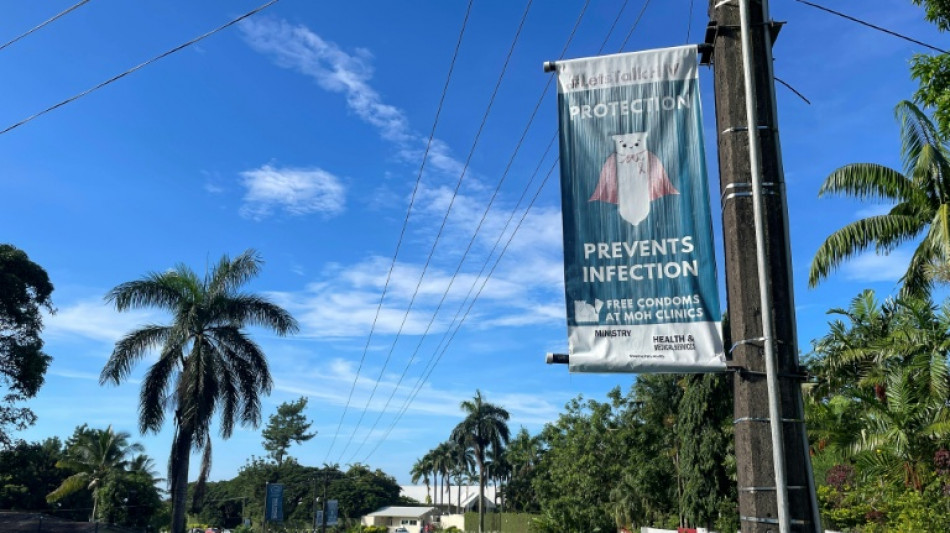
'Spreading like wildfire': Fiji grapples with soaring HIV cases / Photo: © AFP

 Japan Olympic chief says 'lot more' athletes at Games than expected
 Asian carmakers besting US rivals at home, China poised to strike

 Widgets & Web Offers All-Inclusive Investor Relations Websites for Public Companies, IPOs and SPACs

 Adams named new US captain to 2030 World Cup

 China a better influence in Latin America than US: poll
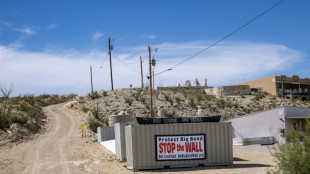 Judge pauses construction of border project in Texas national park

 Belgium's De Bruyne fires double to sink Turkey, France held by Italy
 US jobs data boosts stocks as oil prices dip

 US Supreme Court to hear high-stakes climate case
 Trump expected to name intel chief Clayton as AI czar: reports
 Argentina unveils passports-for-investment scheme

 Brazil election debate chaos sparks censorship row

 England's Carse charged by cricket body over nightclub incident

 Amazon vows $1 bn for data center towns, decries 'myths'
 Oil prices drop on G7 fuel release, US jobs data boosts stocks

 G7 agrees deal to ease global energy supply concerns

 Spain's government dealt blow as lawmakers reject housing bills
 Food, medicine shortages deepen in Russian-occupied Oleshky

 Man City whistleblower Rui Pinto facing 'dire consequences' - lawyers
 Russia 'tearing Kyiv apart', mayor says, as strikes paralyse traffic

 Taiwan boxer Lin wins Games gold as Japan edge North Korea on penalties

 Japan tame North Korea to win Games gold after shootout drama

 US posts weak job growth data in September

 Ethiopia's conflict: the regional dimension

 Life expectancy almost back to pre-Covid levels, says WHO

As evening falls in Fiji's capital, a steady stream of people approaches a makeshift clinic that is a first line of defence against one of the world's fastest-growing HIV epidemics.
In the South Pacific nation -- a popular tourist destination of just under a million people -- there were over 2,000 new HIV cases recorded last year, a 26 percent increase from 2024.
The government has declared an HIV outbreak and described it as a national crisis.
"It's spreading like wildfire," Siteri Dinawai, 46, who came to be tested, told AFP.
The Moonlight Clinic, a converted minibus parked in a suburban cul-de-sac in Suva, is part of a push to bring testing into neighbourhoods.
Volunteers from the Survival Advocacy Network -- a group supporting sex workers -- and Rainbow Pride Fiji, which works with LGBTQ+ communities, are on hand to speak to those who may be reluctant.
Ana Fofole and her team at Medical Services Pacific, which runs the clinic, hand out condoms as part of their awareness drive and test for syphilis and hepatitis B.
"We don't just turn up anywhere -- we have to do it the right way," says Fofole.
Irinieta Foi, 45, is among those Medical Services Pacific hopes to reach by bringing testing into neighbourhoods.
Foi, who is able to get a result in 15 minutes, says she stumbled upon the clinic.
"I decided, OK, why not?"
Many stay away for fear of returning a positive result, said 28-year-old Ecelina Lalabaluva, who also got tested.
- Transit hub for drugs -
Clinics like this raise awareness about the blood-borne disease and can help pin down just how many people are living with HIV in Fiji and refer them to treatment.
The number of known cases is around 5,000, according to Renata Ram, country director for Fiji and the Pacific at UNAIDS, who says the crisis has been building for years.
That number was as low as 500 in 2014, according to estimates by UNAIDS, which classifies Fiji as having among the world's fastest-growing HIV epidemics.
Transmission rates began to increase around 2019, when a group of "very high-risk" injecting drug users emerged, primarily in the sex worker community, Ram explained.
"Fiji, like other Pacific islands, for a long time have been transit hubs for drugs from Latin America and Asia destined for Australia and New Zealand," said Virginia Comolli, Pacific programme head at the Global Initiative against Transnational Organized Crime.
The flow of highly addictive drugs such as methamphetamine and cocaine to those lucrative markets rose sharply after a lull during the Covid pandemic, she explained.
Those drugs are increasingly seeping into the Pacific's domestic markets -- in part due to foreign criminal syndicates opting to pay their local facilitators in kind, she said.
For those living with the virus, the social stigma can weigh heavy in a country where conservative values largely prevail.
- 'Wait to die?' -
One of the few public faces of the crisis is Mark Lal, who was diagnosed with HIV two years ago.
"In Fiji, whenever the topic of sex comes up, everyone just disperses," says Lal, 24, a gay man who said he is not a drug user.
He originally knew little about HIV and the available treatment.
"When I was diagnosed, the first thing I asked the doctors was: 'What now? Do I just wait to die?'"
On his "Living Positive Fiji" page on Facebook, Lal has fielded questions from more than a hundred people.
Most are aged 17 to 20 and are unsure whether to disclose their HIV status out of fear of discrimination.
"If you come out publicly as someone living with HIV, there's a chance where you might actually not get a good reaction," Lal said.
His own hospital visit for his initial diagnosis left its mark.
"I saw some walking out with fear in their eyes, and I was like: 'I want to change this. I want to help people'."
Fiji has a tough task to rein in case numbers, according to Ram of UNAIDS, who said the country is "15 to 20 years behind" in its HIV efforts.
"A needle-syringe programme is what is very much needed right now."
The government has said it will adopt a plan to prevent the spread of disease through drug injections, but implementation of its programme to provide safe injecting equipment has been delayed.
For Foi, one of the women attending the outreach clinic, the task is simple.
"It's really important for everybody to get tested."
J.Bergmann--BTB