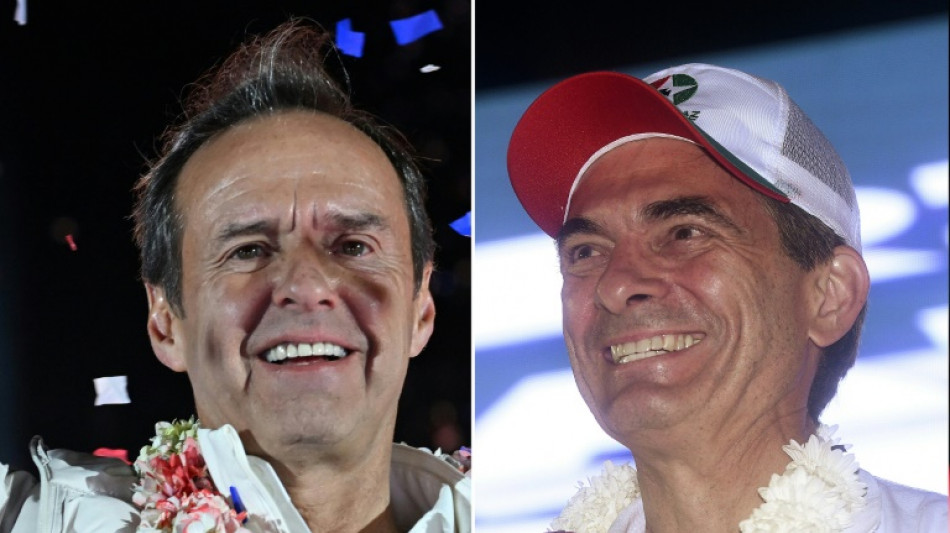
Two right-wing candidates headed to Bolivia presidential run-off / Photo: © AFP

 Rubio in Greece to urge against Western civilisation 'decline'

 Micron workers at Taiwan plant vote in favour of strike

 In 'The Social Reckoning,' Jeremy Allen White takes on Facebook's 'frightening' ambition
 Chip industry activists call for South Korea to recognise cancer cases
 Famine-scarred southern Madagascar braces for El Nino
 How the EU regulates lobbyists
 I.Coast refuge offers lifelong care for youngsters scorned as 'sorcerers'

 Indian central bank hikes rates for first time in more than 3 years
 Hotel Blacklist Launches New Accommodation Industry Risk Assessment Tool

 Bangladesh nuclear plant draws hope -- and worry

 US beat Canada 1-0 to wrap up four-win international break

 Turkey, Australia's joint COP31 leadership raises doubts

 For Turkish NGOs, COP31 offers rare space for action

 Sleep, appetite, gene-editing experts contend for Nobel chemistry prize

 Nobel Peace Prize haunted by the 'spectre' of Trump

 Africa launches own credit agency in bid for cheaper borrowing

 US, China, EU: three paths to regulating AI
 Australia's High Court rules against coal mine in landmark climate case
 Australia touts new funds for Pacific infrastructure at Fiji 'pre-COP'

 Eva Marie Saint, Oscar winner of Hollywood classics, dies at 102

 Australia probes app used in cheap smart glasses over privacy fears

 England needed to 'move on' from World Cup pain, says Tuchel

 O'Neill to stay at Celtic after period of "reflection"

 Kane marks 125th England cap with Wembley Nations League double

 Quebec's incoming separatist leader wants to block Crown from swearing-in

A center-right senator and a right-wing ex-president will advance to a run-off for Bolivia's presidency after the first round of elections on Sunday, marking the end of two decades of leftist rule, preliminary official results showed.
Senator Rodrigo Paz was the surprise frontrunner, with 32.15 percent of the vote cast in an election dominated by a deep economic crisis, results published by the electoral commission showed
He was followed by former right-wing president Jorge "Tuto" Quiroga in second with 26.87 percent, according to results based on 92 percent of votes cast.
Millionaire businessman Samuel Doria Medina, who had been tipped to finish first, trailed in third with 19.86 percent, while the main leftist candidate, Senate president Andronico Rodriguez, limped to a fourth-place finish.
Doria Medina immediately threw his support behind Paz, as the leading opposition candidate.
- A vote for change -
Quiroga, who has vowed to overhaul Bolivia's big-state economic model if elected, hailed the outcome as a victory for democracy and for "liberty."
Paz, the son of former president Jaime Paz Zamora who has campaigned as a unifier, said the election was a vote for "change" and stressed that his program was "of all, for all."
Gustavo Flores-Macias a political scientist at Cornell University in the United States, said Paz's late surge showed people were "tired of the same candidates" repeatedly running for the top job.
Doria Medina and Quiroga had three previous failed bids to their names.
Flores-Macias also linked Paz's success to a widespread disdain in Bolivia for candidates with links to big business.
The vote brings the curtain down on 20 years of socialist rule, which began in 2005 when Evo Morales, an Indigenous coca farmer, was elected president on a radical anti-capitalist platform.
Bolivia enjoyed more than a decade of strong growth and Indigenous upliftment under Morales, who led the country from 2006 to 2019.
But underinvestment in exploration caused gas revenues -- the country's main earner -- to implode, eroding the government's foreign currency reserves and leading to shortages of imported fuel and other basics.
"The left has done us a lot of harm. I want change for the country," Miriam Escobar, a 60-year-old pensioner, told AFP after voting in La Paz.
- Political 'dinosaur' -
Quiroga served as vice-president under ex-dictator Hugo Banzer and then briefly as president when Banzer stepped down to fight cancer in 2001.
On his fourth run for president he vowed to slash public spending, open the country to foreign investment and boost ties with the United States, which were downgraded under Morales.
Some voters however have balked at his promises of a "small state" and plans to dot the Andean high plains, which contain 30 percent of the world's lithium deposits, with tax-free investment zones.
Agustin Quispe, a 51-year-old miner, branded him a "dinosaur" and said he voted for Paz as a "third way" candidate, who was not tainted by association with the traditional right or the socialists.
"What people are looking for now, beyond a shift from left to right, is a return to stability," Daniela Osorio Michel, a Bolivian political scientist at the German Institute for Global and Area Studies, told AFP.
- Spoiled ballots -
Morales, who was barred from standing for an unconstitutional fourth term, cast a long shadow over the campaign.
Nearly one in five voters answered his call to spoil their ballot over his exclusion from the election, shrinking the left-wing vote.
Rodriguez, the main leftist candidate, whom Morales branded a "traitor" for contesting the election was stoned while voting in Morales central Cochabamba stronghold.
Morales, who has threatened mass protests if the right returns to power, had yet to react to Sunday's results.
J.Horn--BTB