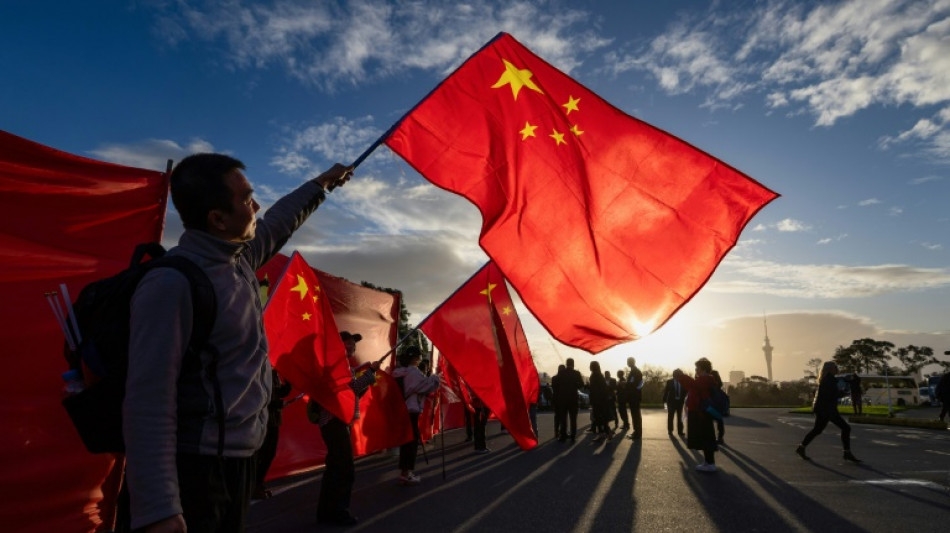
New Zealand spy service warns of China interference / Photo: © AFP

 England's Nations League surge helps heal World Cup wounds

 Mayor of opposition stronghold Izmir defects to Erdogan party

 Mertens beats Gauff to set up Swiatek clash at China Open
 Benin full of pride at role in Messi's last dance

 France suspends stun grenade use at student protests ahead of PM speech

 Indonesian court hears 'negligence' complaint against state over fires, haze

 Rubio in Greece to urge against Western civilisation 'decline'
 Micron workers at Taiwan plant vote in favour of strike

 In 'The Social Reckoning,' Jeremy Allen White takes on Facebook's 'frightening' ambition
 Chip industry activists call for South Korea to recognise cancer cases

 Famine-scarred southern Madagascar braces for El Nino
 How the EU regulates lobbyists
 I.Coast refuge offers lifelong care for youngsters scorned as 'sorcerers'

 Indian central bank hikes rates for first time in more than 3 years

 Hotel Blacklist Launches New Accommodation Industry Risk Assessment Tool

 Bangladesh nuclear plant draws hope -- and worry

 US beat Canada 1-0 to wrap up four-win international break

 Turkey, Australia's joint COP31 leadership raises doubts

 For Turkish NGOs, COP31 offers rare space for action

 Sleep, appetite, gene-editing experts contend for Nobel chemistry prize

 Nobel Peace Prize haunted by the 'spectre' of Trump

 Africa launches own credit agency in bid for cheaper borrowing

 US, China, EU: three paths to regulating AI

 Australia's High Court rules against coal mine in landmark climate case
 Australia touts new funds for Pacific infrastructure at Fiji 'pre-COP'

New Zealand's spy service warned Thursday that China is the most active power engaging in foreign interference in the country, including through front organisations.
New Zealand faces the "most challenging national security environment of recent times", the country's intelligence agency said in an annual risk assessment.
Key drivers of the deteriorating threat environment were less stable relationships between states, deepening polarisation and growing grievances.
Though several states seek to manipulate New Zealand's government and society, China remains the "most active", the New Zealand Security Intelligence Service said.
The spy agency specifically accused China's United Front Work Department of engaging in foreign interference to build influence outside of China.
Not all of its activity amounted to foreign interference, and some could be beneficial, it said.
"However, its activities are regularly deceptive, coercive and corruptive and come with risks for New Zealand organisations."
The agency cautioned New Zealand businesses that under China's national security legislation, individuals and organisations in China must comply with requests from the country's security services.
The Indo-Pacific region is a focal point for strategic competition between powers, the security service said.
- Undetected espionage -
China is a "particularly assertive and powerful actor", seeking to extend and embed its influence across the region, the report said.
"It has demonstrated both a willingness and capability to undertake intelligence activity that targets New Zealand's national interests."
Without naming countries, the intelligence service highlighted the routine use of "transnational repression" by foreign states, often by co-opting people to collect information about someone within their own diaspora living in New Zealand.
Looking at other risks, the agency said the most plausible extremist threat in New Zealand remained that of a lone actor, radicalised in an increasingly polarised, grievance-laden online world, who attacks without forewarning.
Young and vulnerable people were at the highest risk of radicalisation, it said.
"Increasing levels of polarisation and grievance are driving support for violent extremist ideologies and foreign states are more willing to target New Zealand organisations and communities in order to achieve their aims," director-general of security Andrew Hampton said.
"These threats are worthy of greater attention."
It is "almost certain" some foreign espionage activity is going undetected, the service said, reporting the targeting of critical organisations, infrastructure and technology -- mostly through cyber exploitation.
"It is not just intelligence officers conducting this activity," the agency said.
"Some governments take a 'whole of state approach' to intelligence gathering, which includes utilising businesses, universities, think tanks, or cyber actors to act on their behalf."
Global competition and insecurity drive most of the espionage activity against New Zealand, it said.
The service cited "multiple examples" of states seeking covert access to information on government policy positions, security partnerships, technological innovations and research.
D.Schneider--BTB